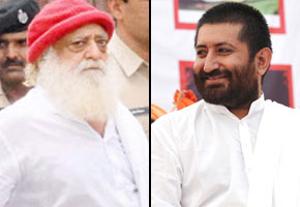
Fresh sexual assault complaints against Asaram, son

October 6, 2013
Surat, Oct 6: Fresh sexual assault complaints have been registered against controversial self-styled godman Asaram Bapu and his son Narayan Sai here after two sisters accused the duo of abusing them.Asaram-son-booked-for-raping-two-sisters-in-Surat

Asaram, 75, was arrested in August on charges of sexually assaulting a minor girl and has been in prison at Jodhpur in Rajasthan since then.

"We have registered two complaints, one against Asaram and another against Narayan Sai of sexual assault, illegal confinement and other charges," Surat Police Commissioner Rakesh Asthana said today.

"The victims are two sisters," he said.

The complaint against Narayan Sai has been registered at Jhangirpura police station in Surat, while the one against his father Asaram has been transferred to Ahmedabad as the alleged incident happened there, Asthana said.

The police will question Narayan Sai in connection with the complaint shortly, he said.

The older sister in her complaint is understood to have accused Asaram of sexual assault, while the younger one filed a complaint against his son. The incidents reportedly happened between 2001 and 2006.

Comments

Add new comment

  • Coastaldigest.com reserves the right to delete or block any comments.
  • Coastaldigset.com is not responsible for its readers’ comments.
  • Comments that are abusive, incendiary or irrelevant are strictly prohibited.
  • Please use a genuine email ID and provide your name to avoid reject.
News Network
March 21,2020

Mar 21: India’s economy, already in the grip of a slowdown, is in for more pain after Prime Minister Narendra Modi appealed to citizens to stay at and work from home to curb the coronavirus outbreak.

The services sector, which accounts for about 55% of India’s gross domestic product, is poised to be the worst hit after Modi, in a late evening address on Thursday, urged citizens to go on a self-imposed curfew for a day and private companies to allow employees to work from home for longer. In the country’s vast informal sector, social-distancing measures could mean a dent to productivity and consumption because of job or pay losses.

“The impact of a partial lock-down or social distancing will be significant,” said Rahul Bajoria, a senior economist at Barclays Plc in Mumbai. “If there’s a widespread community outbreak, GDP could fall as low as 3.5% in the year starting April 1.”

Shrinking output may limit growth in an economy that’s already set to expand at an 11-year low of 5% in the current year to March 31. Before the virus outbreak, India had forecast growth to recover to 6%-6.5% in the next fiscal year. S&P Global Ratings and Fitch Ratings have already slashed their growth forecast by 50 basis points.

“The current social-distancing measures will severely impact airlines, hotels, malls, multiplexes, restaurants and retailers,” according to analysts at Crisil Ltd., the local unit of S&P Global. “Lower footfalls and occupancies, decline in business volume and sub-optimal operating efficiencies will impact cash flows of companies in these sectors,” wrote the analysts led by Chief Economist Dharmakirti Joshi.

The government will try to announce a relief package for virus-affected sectors as early as possible, Finance Minister Nirmala Sitharaman said Friday.

In a televised address, Modi advised all citizens to stay at home for a day on March 22, as he sought to stem the spread of the coronavirus -- cases of which are relatively low in India at about 200, compared with more than 200,000 infected people globally. His government also barred incoming flights for a week from that day, joining a growing list of countries effectively sealing their borders.

What Bloomberg’s Economists Say

We had only earlier this week lowered our GDP outlook to consider the direct impact of the local outbreak as confirmed virus cases exceeded 100 as of March 15 and the federal and state governments announced social distancing measures that have already started to crimp economic activity. We are now revising down our GDP estimate for 4Q fiscal 2020 to 3.3%, from our 3.5%.

-- Abhishek Gupta, India economist

For more, click here

“Consumption being the biggest component of GDP, a lock-down is bound to have a big impact on the economy,” said Devendra Kumar Pant, chief economist at India Ratings and Research, the local unit of Fitch. “Modeling uncertainty in any system will be very difficult, but one can say the slowdown could deepen or prolong further.”

Work From Home

While companies, including billionaire Mukesh Ambani-controlled Reliance Industries Ltd., are asking employees to work from home, the option isn’t feasible in India’s vast informal sector.

“The option to work remotely simply won’t exist for most,” said Shilan Shah, an economist with Capital Economics Pte. in Singapore.

As many households don’t have savings buffers, the government would probably have to back this up with large-scale cash handouts that reach the poorest, he said.

Work from home is posing implementation challenges for the manufacturing sector where workers are required to be physically present at the production sites. The services sector, such as banking and information technology, also needs employees to be present in offices as confidential data is used, according to industry group Federation of Indian Chambers of Commerce and Industry.


Comments

Add new comment

  • Coastaldigest.com reserves the right to delete or block any comments.
  • Coastaldigset.com is not responsible for its readers’ comments.
  • Comments that are abusive, incendiary or irrelevant are strictly prohibited.
  • Please use a genuine email ID and provide your name to avoid reject.
News Network
February 28,2020

Feb 28: The best economic tonic for the coronavirus shock is to contain its spread and worry about stimulus later, said Raghuram Rajan, former head of the Reserve Bank of India.

There’s little central banks can do, and while more government spending would help, the priority should be on convincing companies and households that the virus is under control, he said.

“People want to have a sense that there is a limit to the spread of this virus perhaps because of containment measures or because there is hope that some kind of viral solution can be found,” Rajan told Bloomberg Television’s Haidi Stroud Watts and Shery Ahn.

“At this point I would say the best thing that governments can do is to really fight the epidemic rather than worry about stimulus measures that comes later,” said Rajan, who is currently a professor at the Chicago Booth School of Business.

The spread of coronavirus is pushing the world economy toward its worst performance since the financial crisis more than a decade ago.

Bank of America Corp. economists warned clients Thursday that they now expect 2.8% global growth this year, the weakest since 2009.

“We have moved from extreme confidence in markets to extreme panic, all in the space of one week,” said Rajan, who previously was chief economist at the International Monetary Fund.

The virus outbreak will force companies to rethink supply chains and overseas production facilities, he said.

“I think we will see a lot of rethinking on this, coming on the back of the trade disruption, now we have this,” Rajan said. “Globalization in production is going to be hit quite badly.”

Comments

Add new comment

  • Coastaldigest.com reserves the right to delete or block any comments.
  • Coastaldigset.com is not responsible for its readers’ comments.
  • Comments that are abusive, incendiary or irrelevant are strictly prohibited.
  • Please use a genuine email ID and provide your name to avoid reject.
News Network
January 14,2020

New Delhi, Jan 14: The curative petitions of Vinay Sharma and Mukesh, who were sentenced to death in the Nirbhaya gang rape and murder case, was on Tuesday rejected by a five-judge Supreme Court Bench led by Justice N.V. Ramana.

In a three-page order, the Bench concluded, after an in chamber consideration that began about 1.45 p.m., that there was no merit in their pleas to spare them from the gallows.

“We have gone through the curative petitions and relevant documents. In our opinion, no case is made out within the parameters indicated in the decision of this Court in Rupa Ashok Hurra versus Ashok Hurra. Hence, the curative petitions are dismissed,” the court held.

Curative is a rare remedy devised by a Constitution Bench of the Supreme Court in its judgment in the Rupa Ashok Hurra case in 2002. A party can take only two limited grounds in a curative petition - one, he was not heard by the court before the adverse judgment was passed, and two, the judge was biased. A curative plea, which follows the dismissal of review petition, is the last legal avenue open for convicts in the Supreme Court. Sharma was the first among the four convicts to file a curative.

The Bench also rejected their pleas to stay the execution of their death sentence and for oral hearing in open court.

Besides Justice Ramana, the Bench comprised Arun Mishra, Rohinton Nariman, R. Banumathi and Ashok Bhushan.

Curative petitions were filed in the Supreme Court by both convicts on January 9. The petitions had come just days after a Delhi sessions court schedulled the execution of all the four convicts in Tihar jail on January 22.

Sharma and Mukesh, in separate curative petitions, argued that there was a “sea change” in the death penalty jurisprudence since their convictions. Carrying out the death sentence on such changed circumstances would be a “gross miscarriage of justice”.

In his plea, Sharma said the Court had commuted the death penalty in several rape and murder cases since 2017, when it first confirmed the death penalty to the Nirbhaya convicts.

“fter the pronouncement of judgment in 2017, there have been as many as 17 cases involving rape and murder in which various three-judge Benches of the Supreme Court have commuted the sentence of death,” the petition contended.

The Supreme Court recently dismissed a review petition filed by Akshay Singh, another of the four four condemned men, to review its May 5, 2017 judgment confirming the death penalty. It also refused his plea to grant him three weeks' time to file a mercy petition before the President of India.

A Bench led by Justice R. Banumathi had said it was open for the Nirbhaya case convicts to avail whatever time the law prescribes for the purpose of filing a mercy plea.

Akshay (33), Mukesh (30), Pawan Gupta (23) and Sharma (24) had brutally gang-raped a 23-year-old paramedical student in a moving bus on the intervening night of December 16-17, 2012. She died of her injuries a few days later.

The case shocked the nation and led to the tightening of anti-rape laws. Rape, especially gang rape, is now a capital crime.

One of the accused in the case, Ram Singh, allegedly committed suicide in the Tihar jail. A juvenile, who was among the accused, was convicted by a juvenile justice board. He was released from a reformation home after serving a three-year term.

Comments

Add new comment

  • Coastaldigest.com reserves the right to delete or block any comments.
  • Coastaldigset.com is not responsible for its readers’ comments.
  • Comments that are abusive, incendiary or irrelevant are strictly prohibited.
  • Please use a genuine email ID and provide your name to avoid reject.