No change in stand on Palestine: Govt.

July 22, 2014

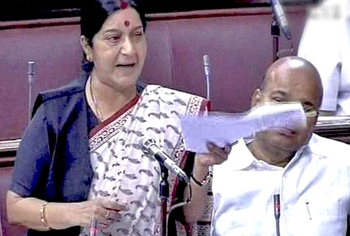
Palestine GovtNew Delhi, Jul 22: The Government on Monday asserted in the Rajya Sabha that India’s policy on the Palestine issue remains unchanged but stonewalled demands for a unanimous resolution on the Gaza conflict, triggering a walkout by the Opposition.

Replying to a short duration discussion in Rajya Sabha on Monday, External Affairs Minister Sushma Swaraj rebutted the Opposition’s call for suspension of all military purchases from Israel and raising the issue at the United Nations. “We fully support the Palestinian cause while maintaining good relations with Israel,” she said.

The Opposition’s demand for a resolution was turned down by Deputy Chairman P.J. Kurien who pointed out that Rule 176, under which the discussion took place, does not provide for a resolution or motion of any kind. Another reason was the Government’s disinclination for a resolution which meant there was no consensus.

With none of their demands met, almost the entire Opposition staged a walkout.

Stating the Government’s position on the conflict in Gaza, Ms. Swaraj said peace would have been restored by now had Hamas accepted the ceasefire proposal from Egypt.

An effort to form a Unity Government by Palestine also failed as Israel refused to recognise a government supported by Hamas, even from outside, leading to a breakdown of the peace talks, she said.

Mr Sitaram Yechury’s (CPI-M) call for suspending arms purchases from Israel was met by a riposte from the External Affairs Minister who wanted to know why his party, which was supporting the UPA-1, had not made such a demand in 2008 when 1,400 Palestinians were killed and then later in 2012 when there was another spurt of violence.

Comments

Add new comment

  • Coastaldigest.com reserves the right to delete or block any comments.
  • Coastaldigset.com is not responsible for its readers’ comments.
  • Comments that are abusive, incendiary or irrelevant are strictly prohibited.
  • Please use a genuine email ID and provide your name to avoid reject.
Agencies
August 6,2020

Mumbai, Aug 6: Former Reserve Bank of India governor Raghuram Rajan said on Thursday that overly focusing on what sovereign rating agencies think can take one's eyes off what needs to be done for the economy.

"It is also important to convince both domestic and international investors that after the crisis associated with the pandemic is over, we will return to fiscal responsibility over the medium term, and the government should do more to convince them of that," Rajan told the Global Markets Forum.

India was placed under one of the strictest lockdowns in the world in late March for more than two months to stem the spread of the coronavirus, but cases have continued to rise steadily since the government eased restrictions in June, stymieing hopes of an economic recovery.

The government has announced several initiatives to help the poor and small- and medium-size businesses, but actual cash outgo from the government's measures has been estimated at just about 1% of GDP.

Several attribute the fiscal prudence to fear of a downgrade after Moody's cut India's rating and outlook in early June followed closely by a change in outlook from Fitch.

The central bank on its part too has reduced the key lending rate by 115 basis points on top of the 135 bps last year and is widely expected to cut rates by another 25 bps later on Thursday.

"The RBI and government have certainly been cooperating, but it seems like it is elsewhere, the ball is in the government's court to do more," Rajan said.

He said the RBI needs to focus on whether credit is reaching the stressed areas of the economy and also if the viable firms were able to access credit and not the unviable ones.

"And I think that's where it has to focus its attentions, because resources, as you well know, are limited in India today."

Recently analysts, however, have cited the growing possibility the RBI may prefer to pause and cut rates only at its October meeting.

Government officials too have suggested the possibility of any more fiscal stimulus being announced, would only come in the second half of the fiscal year, once a recovery has taken root and coronavirus cases have peaked.

"What India should focus on at this point is protecting its economic capabilities, so that when it has dealt with the virus it can go resume activity in a reasonable way. That should be the focus," Rajan said.

"And if it does that, there is no reason why the rating agencies will not see that as an appropriate policy".

Comments

Add new comment

  • Coastaldigest.com reserves the right to delete or block any comments.
  • Coastaldigset.com is not responsible for its readers’ comments.
  • Comments that are abusive, incendiary or irrelevant are strictly prohibited.
  • Please use a genuine email ID and provide your name to avoid reject.
News Network
January 20,2020

Davos, Jan 20: India's richest 1 per cent hold more than four-times the wealth held by 953 million people who make up for the bottom 70 per cent of the country's population, while the total wealth of all Indian billionaires is more than the full-year budget, a new study said on Monday.

Releasing the study 'Time to Care' here ahead of the 50th annual meeting of the World Economic Forum (WEF), rights group Oxfam also said the world's 2,153 billionaires have more wealth than the 4.6 billion people who make up 60 per cent of the planet's population.

The report flagged that global inequality is shockingly entrenched and vast and the number of billionaires has doubled in the last decade, despite their combined wealth having declined in the last year.

"The gap between rich and poor can't be resolved without deliberate inequality-busting policies, and too few governments are committed to these," said Oxfam India CEO Amitabh Behar, who is here to represent the Oxfam confederation this year.

The issues of income and gender inequality are expected to figure prominently in discussions at the five-day summit of the WEF, starting Monday. The WEF's annual global risks Report has also warned that the downward pressure on the global economy from macroeconomic fragilities and financial inequality continued to intensify in 2019.

Concern about inequality underlies recent social unrest in almost every continent, although it may be sparked by different tipping points such as corruption, constitutional breaches, or the rise in prices for basic goods and services, as per the WEF report.

Although global inequality has declined over the past three decades, domestic income inequality has risen in many countries, particularly in advanced economies and reached historic highs in some, the Global Risks Report flagged last week.

The Oxfam report further said "sexist" economies are fuelling the inequality crisis by enabling a wealthy elite to accumulate vast fortunes at the expense of ordinary people and particularly poor women and girls.

Regarding India, Oxfam said the combined total wealth of 63 Indian billionaires is higher than the total Union Budget of India for the fiscal year 2018-19 which was at Rs 24,42,200 crore.

"Our broken economies are lining the pockets of billionaires and big business at the expense of ordinary men and women. No wonder people are starting to question whether billionaires should even exist," Behar said.

As per the report, it would take a female domestic worker 22,277 years to earn what a top CEO of a technology company makes in one year.

With earnings pegged at Rs 106 per second, a tech CEO would make more in 10 minutes than what a domestic worker would make in one year.

It further said women and girls put in 3.26 billion hours of unpaid care work each and every day -- a contribution to the Indian economy of at least Rs 19 lakh crore a year, which is 20 times the entire education budget of India in 2019 (Rs 93,000 crore).

Besides, direct public investments in the care economy of 2 per cent of GDP would potentially create 11 million new jobs and make up for the 11 million jobs lost in 2018, the report said.

Behar said the gap between rich and poor cannot be resolved without deliberate inequality-busting policies, and too few governments are committed to these.

He said women and girls are among those who benefit the least from today's economic system.

"They spend billions of hours cooking, cleaning and caring for children and the elderly. Unpaid care work is the 'hidden engine' that keeps the wheels of our economies, businesses and societies moving.

"It is driven by women who often have little time to get an education, earn a decent living or have a say in how our societies are run, and who are therefore trapped at the bottom of the economy,” Behar added.

Oxfam said governments are massively under-taxing the wealthiest individuals and corporations and failing to collect revenues that could help lift the responsibility of care from women and tackle poverty and inequality.

Besides, the governments are also underfunding vital public services and infrastructure that could help reduce women and girls' workload, the report said.

As per the global survey, the 22 richest men in the world have more wealth than all the women in Africa.

Besides, women and girls put in 12.5 billion hours of unpaid care work each and every day -- a contribution to the global economy of at least USD 10.8 trillion a year, more than three times the size of the global tech industry.

Getting the richest one per cent to pay just 0.5 per cent extra tax on their wealth over the next 10 years would equal the investment needed to create 117 million jobs in sectors such as elderly and childcare, education and health.

Governments must prioritise care as being as important as all other sectors in order to build more human economies that work for everyone, not just a fortunate few, Behar said.

Oxfam said its calculations are based on the latest data sources available, including from the Credit Suisse Research Institute's Global Wealth Databook 2019 and Forbes' 2019 billionaires list.


Comments

Add new comment

  • Coastaldigest.com reserves the right to delete or block any comments.
  • Coastaldigset.com is not responsible for its readers’ comments.
  • Comments that are abusive, incendiary or irrelevant are strictly prohibited.
  • Please use a genuine email ID and provide your name to avoid reject.
Agencies
January 4,2020

New Delhi, Jan 4: In more troubles for the former Finance Minister and senior Congress leader P Chidambaram, the Enforcement Directorate (ED) on Friday questioned him for over six hours in its probe into the Air India aircraft deal case, first time since his release from Tihar jail almost a month ago.

A senior ED official told IANS, "We questioned Chidambaram for over six hours today in the ongoing probe into the Air India deal with Airbus."

According to financial probe agency officials, Air India had planned to buy over 111 aircraft from Airbus and Boeing during the erstwhile United Progressive Alliance (UPA) government in 2009. This is the first time the ED has questioned the senior Congress leader in the Air India deal case.

The questioning of Chidambaram came for the first time since his release from the Tihar jail where he spent 106 days in connection with the INX Media money laundering case. He was released from Tihar on December 4 last year after he was granted bail by the Supreme Court. The former finance minister is also being investigated by the ED in a separate money-laundering cases of Aircel-Maxis deal.

An ED official said the contract to buy 43 aircraft from Airbus was finalised by a panel of ministers headed by Chidambaram in 2009. According to the ED, when the proposal to buy 43 aircraft from Airbus was sent to the Cabinet Committee on Security (CCS), there was a condition that the aircraft manufacturer would have to build training facilities and MRO (Maintenance, Repair and Overhaul) centres at a cost of Rs 70,000 crore. But later, when the purchase order was placed, the clause was removed.

The name of another UPA minister, Praful Patel, had also come up in the alleged scam in a charge sheet filed by the ED against corporate lobbyist Deepak Talwar on March 30 last year. Talwar was arrested last year by the ED after he was deported from the UAE.

The ED is probing the Air India-Indian Airlines merger; purchase of 111 aircraft from Boeing and Airbus at Rs 70,000 crore; ceding profitable routes and schedules to private airlines, and opening of training institutes with foreign investment.

Comments

Add new comment

  • Coastaldigest.com reserves the right to delete or block any comments.
  • Coastaldigset.com is not responsible for its readers’ comments.
  • Comments that are abusive, incendiary or irrelevant are strictly prohibited.
  • Please use a genuine email ID and provide your name to avoid reject.