


Pakistan in mourning as Peshawar buries its children

December 17, 2014

Peshawar, December 17: Pakistan woke up to a day of mourning on Wednesday after Taliban militants killed 132 students at a school in the city of Peshawar in a grisly attack which shocked the nation and put pressure on the government to do more to tackle the insurgency.Pakistan
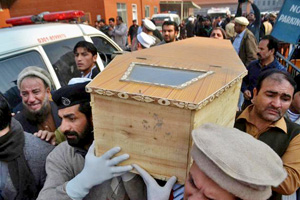
People around the country lit candles and staged overnight vigils as parents prepared to bury their children during mass funerals in and around Peshawar — a big, volatile city on the edge of Pakistan's lawless tribal belt.

Pakistanis may be used to almost daily militant attacks against the security forces but an outright assault on children stunned the country, prompting commentators to call for a tough military response.

In Peshawar, the vast grounds of the military-run Army Public School were all but deserted, with a handful of snipers manning the roofs of its pink brick-and-stone buildings.

Army vehicles and soldiers wearing face masks and carrying automatic rifles were deployed by the entrance.

A day after the attack, Peshawar appeared subdued and many were still in shock, recalling the gruesome events and trying to soothe each other. More details of the well-organised attack emerged as witnesses came forward with their stories.

“The attackers came around 10.30 a.m. on a pickup van,” said Issam Uddin, a 25-year-old school bus driver.

“They drove it around the back of the school and set it on fire to block the way. Then they went to Gate 1 and killed a soldier, a gatekeeper and a gardener. Firing began and the first suicide attack took place.”

The government of Prime Minister Nawaz Sharif has announced a three-day mourning period but people's anxiety focused on what the authorities can do to protect the country.

Mr. Sharif came to power last year promising to negotiate peace with the Pakistani Taliban — but those efforts failed this year, weakening his position and prompting the Army to launch an air-and-ground operation against insurgents along the Afghan border.

The military staged more air strikes against Taliban positions there late on Tuesday, a security source said, but it was unclear whether it was done in response to the school attack.

GOOD AND BAD TALIBAN

Yet, despite the well-publicised crackdown, the military has long been accused of being too lenient towards Islamist militants who critics say are used to carry out the Army's bidding in places like Jammu and Kashmir and Afghanistan.

The military denies the accusations.

“People will have to stop equivocating and come together in the face of national tragedy,” said Sherry Rehman, a former ambassador to the United States and an opposition politician.

“There have been national leaders who had been apologetic about the Taliban, who have not named the Taliban in their speeches.”

The Pakistani Taliban, who are fighting to impose strict Islamic rule in Pakistan, are holed up in the inaccessible mountains straddling the Pakistan-Afghanistan border.

They are allied with the Afghan Taliban as well as al-Qaeda and other foreign fighters, and Pakistan has long accused Afghanistan of not doing enough to crack down on their bases.

Afghanistan, for its part, blames Pakistan for allowing militant groups such as the Afghan Taliban and the Haqqani network to operate freely on its territory and stage attacks in Afghanistan.

Pakistan's Army chief was expected to visit Afghanistan on Wednesday for what is likely to be a day of uneasy talks with his Afghan counterparts on how to tackle the insurgency.

Pakistan's Dawn newspaper quoted a source as saying that the militants were acting on direct orders from their handlers in Afghanistan and that prominent Taliban commander Umar Naray was the ultimate mastermind of the attack.

Speaking late on Tuesday, Army spokesman Major General Asim Saleem Bajwa hinted at that without naming Afghanistan.

“When these militants reached the school ... we found out which group was involved, who they were talking to, from where the operation was being controlled,” he said. “God willing, in coming two-four days you will get to know.”

Comments

Add new comment

  • Coastaldigest.com reserves the right to delete or block any comments.
  • Coastaldigset.com is not responsible for its readers’ comments.
  • Comments that are abusive, incendiary or irrelevant are strictly prohibited.
  • Please use a genuine email ID and provide your name to avoid reject.
Agencies
August 7,2020

Russia boasts that it's about to become the first country to approve a Covid-19 vaccine, with mass vaccinations planned as early as October using shots that are yet to complete clinical trials -- and scientists worldwide are sounding the alarm that the headlong rush could backfire.

Moscow sees a Sputnik-like propaganda victory, recalling the Soviet Union's launch of the world's first satellite in 1957.

But the experimental Covid-19 shots began first-in-human testing on a few dozen people less than two months ago, and there's no published scientific evidence yet backing Russia's late entry to the global vaccine race, much less explaining why it should be considered a front-runner.

“I'm worried that Russia is cutting corners so that the vaccine that will come out may be not just ineffective, but also unsafe,” said Lawrence Gostin, a global public health law expert at Georgetown University. “It doesn't work that way... Trials come first. That's really important.”

According to Kirill Dmitriev, head of Russia's Direct Investment Fund that bankrolled the effort, a vaccine developed by the Gamaleya research institute in Moscow may be approved in days, before scientists complete what's called a Phase 3 study.

That final-stage study, usually involving tens of thousands of people, is the only way to prove if an experimental vaccine is safe and really works.

Health Minister Mikhail Murashko said members of “risk groups,” such as medical workers, may be offered the vaccine this month.

He didn't clarify whether they would be part of the Phase 3 study that is said to be completed after the vaccine receives “conditional approval.”

Deputy Prime Minister Tatyana Golikova promised to start “industrial production” in September, and Murashko said mass vaccination may begin as early as October.

Dr Anthony Fauci, the top US infectious disease specialist, questioned the fast-track approach last week.

“I do hope that the Chinese and the Russians are actually testing a vaccine before they are administering the vaccine to anyone, because claims of having a vaccine ready to distribute before you do testing I think is problematic at best," he said.

Questions about this vaccine candidate come after the US, Britain and Canada last month accused Russia of using hackers to steal vaccine research from Western labs.

Delivering a vaccine first is a matter of national prestige for the Kremlin as it tries to assert the image of Russia as a global power capable of competing with the US and China.

The notion of being “the first in the world” dominated state news coverage of the effort, with government officials praising reports of the first-step testing.

In April, President Vladimir Putin ordered state officials to shorten the time of clinical trials for a variety of drugs, including potential coronavirus vaccines.

According to Russia's Association of Clinical Trials Organizations, the order set “an unattainable bar” for scientists who, as a result, "joined in on the mad race, hoping to please those at power.”

The association first raised concern in late May, when professor Alexander Gintsburg, head of the Gamaleya institute, said he and other researchers tried the vaccine on themselves.

The move was a “crude violation of the very foundations of clinical research, Russian law and universally accepted international regulations" the group said in an open letter to the government, urging scientists and health officials to adhere to clinical research standards.

But a month later, the Health Ministry authorized clinical trials of the Gamaleya product, with what appeared to be another ethical issue.

Human studies started June 17 among 76 volunteers. Half were injected with a vaccine in liquid form and the other half with a vaccine that came as soluble powder.

Some in the first half were recruited from the military, which raised concerns that servicemen may have been pressured to participate.

Some experts said their desire to perform well would affect the findings. “It's no coincidence media reports we see about the trials among the military said no one had any side effects, while the (other group) reported some," said Vasily Vlassov, a public health expert with Moscow's Higher School of Economics.

As the trials were declared completed and looming regulatory approval was announced last week, questions arose about the vaccine's safety and effectiveness.

Government assurances the drug produced the desired immune response and caused no significant side effects were hardly convincing without published scientific data describing the findings.

The World Health Organization said all vaccine candidates should go through full stages of testing before being rolled out.

“There are established practices and there are guidelines out,” WHO spokesman Christian Lindmeier said Tuesday.

“Between finding or having a clue of maybe having a vaccine that works, and having gone through all the stages, is a big difference.”

Offering an unsafe compound to medical workers on the front lines of the outbreak could make things worse, Georgetown's Gostin said, adding: “What if the vaccine started killing them or making them very ill?”

Vaccines that are not properly tested can cause harm in many ways — from a negative impact on health to creating a false sense of security or undermining trust in vaccinations, said Thomas Bollyky, director of the global health program at the Council on Foreign Relations. 

Comments

Add new comment

  • Coastaldigest.com reserves the right to delete or block any comments.
  • Coastaldigset.com is not responsible for its readers’ comments.
  • Comments that are abusive, incendiary or irrelevant are strictly prohibited.
  • Please use a genuine email ID and provide your name to avoid reject.
Agencies
April 17,2020

Beijing/Wuhan, Apr 17: China's coronavirus death toll mounted to 4,632 on Friday as the country revised figures in its epicentre Wuhan with 1,290 additional fatalities amid international criticism of under-reporting of COVID-19 data.

The Wuhan municipal headquarters on Friday revised the number of confirmed COVID-19 cases and deaths due to the disease, state-run Xinhua news agency reported.

As of April 16, the total number of confirmed coronavirus cases in Wuhan was increased by 325 to 50,333 and the number of fatalities up by 1,290 to 3,869.

The revised figure raised China's overall COVID-19 death toll to 4,632. The total number of cases also increased to 82,692.

The Wuhan municipal headquarters in a notification said the revisions were made in accordance with related laws and regulations as well as the principle of being responsible for history, the people and the deceased.

The revision of figures came amid sharp criticism of China by the US and other nations for its alleged under-reporting of the coronavirus cases and cover-up of the origin of the viral strain, which emerged in Wuhan in December last, reportedly from the local Hunan sea food market.

Explaining the reason for the figure revision, the Wuhan municipality said it was done to ensure that the information on the city's COVID-19 epidemic is open and transparent, and that the data are accurate.

Listing the reasons for the data discrepancies, it said the surging number of patients at the early stage of the epidemic overwhelmed medical resources and the admission capacity of medical institutions. Some patients died at home without having been treated in hospitals.

Besides, during the height of their treating efforts, hospitals were operating beyond their capacities and medical staff were preoccupied with saving and treating patients, resulting in belated, missed and mistaken reporting.

Also, due to a rapid increase of designated hospitals for treating COVID-19 patients -- including those administered by ministries, Hubei Province, Wuhan city and its districts, those affiliated to companies, as well as private hospitals and makeshift hospitals -- a few medical institutions were not linked to the epidemic information network and failed to report their data in time.

The registered information of some of the deceased patients was incomplete, and there were repetitions and mistakes in the reporting, the Wuhan authorities noted.

Citing an official of the Wuhan municipal headquarters, Xinhua reported that a group for epidemic-related big data and epidemiological investigations was established in late March.

The group used information from online systems and collected full information from all epidemic-related locations to ensure that facts about every case are accurate and every figure is objective and correct.

"What lie behind the epidemic data are the lives and health of the general public, as well as the credibility of the government," the official was quoted by the report.

The timely revision of the figures, among other things, shows respect for every single life, the official said.

Meanwhile, the revised cases were not included in the overall national figures released by China's National Commission (NHC) in its daily report on Friday as it reports previous day's cases.

As per NHC data, as of Thursday the overall confirmed cases of coronavirus was 82,367, including 3,342 deaths.

As many as 1,081 patients are being treated and 77,944 people discharged after recovery, it said.

NHC said it received reports of 26 new confirmed COVID-19 cases from the mainland on Thursday, of which 15 were imported.

The other 11 new cases were domestically transmitted, it said, noting that five cases were reported in Guangdong Province, three in Heilongjiang Province, two in Shandong Province and one in Liaoning Province.

No death was reported on Thursday on the mainland.

As of Thursday, China has a total of 1,549 imported cases, NHC said, adding that 879 were undergoing treatment with 45 in severe condition. Besides, there were 66 new asymptomatic cases, taking the tally to 1,038.

Comments

Add new comment

  • Coastaldigest.com reserves the right to delete or block any comments.
  • Coastaldigset.com is not responsible for its readers’ comments.
  • Comments that are abusive, incendiary or irrelevant are strictly prohibited.
  • Please use a genuine email ID and provide your name to avoid reject.
News Network
January 3,2020

Washington, Jan 3: US President Donald Trump ordered the killing of Iran Revolutionary Guards commander Qasem Soleimani, who died in Baghdad "in a decisive defensive action to protect US personnel abroad," the Pentagon said Thursday.

"General Soleimani was actively developing plans to attack American diplomats and service members in Iraq and throughout the region. General Soleimani and his Quds Force were responsible for the deaths of hundreds of American and coalition service members and the wounding of thousands more," the Department of Defense said.

Following Soleimani's death, Trump tweeted an image of the US flag without any further explanation.

"US' act of international terrorism, assassinating General Soleimani—the most effective force fighting Daesh (ISIS), Al Nusrah,Al Qaeda, is extremely dangerous & foolish escalation. US bears responsibility for all consequences of rogue adventurism." said Iran Foreign Minister Javad Zarif.

Comments

Add new comment

  • Coastaldigest.com reserves the right to delete or block any comments.
  • Coastaldigset.com is not responsible for its readers’ comments.
  • Comments that are abusive, incendiary or irrelevant are strictly prohibited.
  • Please use a genuine email ID and provide your name to avoid reject.