


Pakistan in mourning as Peshawar buries its children

December 17, 2014

Peshawar, December 17: Pakistan woke up to a day of mourning on Wednesday after Taliban militants killed 132 students at a school in the city of Peshawar in a grisly attack which shocked the nation and put pressure on the government to do more to tackle the insurgency.Pakistan
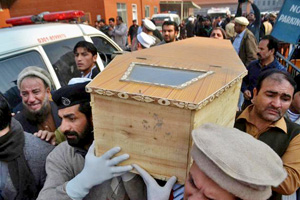
People around the country lit candles and staged overnight vigils as parents prepared to bury their children during mass funerals in and around Peshawar — a big, volatile city on the edge of Pakistan's lawless tribal belt.

Pakistanis may be used to almost daily militant attacks against the security forces but an outright assault on children stunned the country, prompting commentators to call for a tough military response.

In Peshawar, the vast grounds of the military-run Army Public School were all but deserted, with a handful of snipers manning the roofs of its pink brick-and-stone buildings.

Army vehicles and soldiers wearing face masks and carrying automatic rifles were deployed by the entrance.

A day after the attack, Peshawar appeared subdued and many were still in shock, recalling the gruesome events and trying to soothe each other. More details of the well-organised attack emerged as witnesses came forward with their stories.

“The attackers came around 10.30 a.m. on a pickup van,” said Issam Uddin, a 25-year-old school bus driver.

“They drove it around the back of the school and set it on fire to block the way. Then they went to Gate 1 and killed a soldier, a gatekeeper and a gardener. Firing began and the first suicide attack took place.”

The government of Prime Minister Nawaz Sharif has announced a three-day mourning period but people's anxiety focused on what the authorities can do to protect the country.

Mr. Sharif came to power last year promising to negotiate peace with the Pakistani Taliban — but those efforts failed this year, weakening his position and prompting the Army to launch an air-and-ground operation against insurgents along the Afghan border.

The military staged more air strikes against Taliban positions there late on Tuesday, a security source said, but it was unclear whether it was done in response to the school attack.

GOOD AND BAD TALIBAN

Yet, despite the well-publicised crackdown, the military has long been accused of being too lenient towards Islamist militants who critics say are used to carry out the Army's bidding in places like Jammu and Kashmir and Afghanistan.

The military denies the accusations.

“People will have to stop equivocating and come together in the face of national tragedy,” said Sherry Rehman, a former ambassador to the United States and an opposition politician.

“There have been national leaders who had been apologetic about the Taliban, who have not named the Taliban in their speeches.”

The Pakistani Taliban, who are fighting to impose strict Islamic rule in Pakistan, are holed up in the inaccessible mountains straddling the Pakistan-Afghanistan border.

They are allied with the Afghan Taliban as well as al-Qaeda and other foreign fighters, and Pakistan has long accused Afghanistan of not doing enough to crack down on their bases.

Afghanistan, for its part, blames Pakistan for allowing militant groups such as the Afghan Taliban and the Haqqani network to operate freely on its territory and stage attacks in Afghanistan.

Pakistan's Army chief was expected to visit Afghanistan on Wednesday for what is likely to be a day of uneasy talks with his Afghan counterparts on how to tackle the insurgency.

Pakistan's Dawn newspaper quoted a source as saying that the militants were acting on direct orders from their handlers in Afghanistan and that prominent Taliban commander Umar Naray was the ultimate mastermind of the attack.

Speaking late on Tuesday, Army spokesman Major General Asim Saleem Bajwa hinted at that without naming Afghanistan.

“When these militants reached the school ... we found out which group was involved, who they were talking to, from where the operation was being controlled,” he said. “God willing, in coming two-four days you will get to know.”

Comments

Add new comment

  • Coastaldigest.com reserves the right to delete or block any comments.
  • Coastaldigset.com is not responsible for its readers’ comments.
  • Comments that are abusive, incendiary or irrelevant are strictly prohibited.
  • Please use a genuine email ID and provide your name to avoid reject.
Agencies
August 3,2020

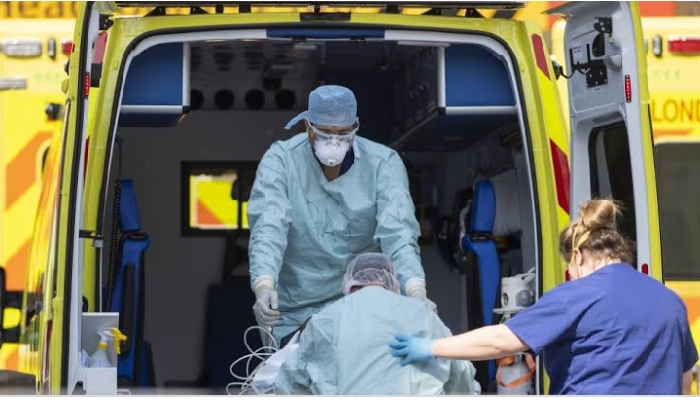
Manila, Aug 2: The number of COVID-19 cases in the Philippines has exceeded the 100,000 marks with a record 5,032 new infections registered on Sunday, the Health Ministry's data showed.

With the total cases now reaching 103,185, the spread of COVID-19 in the Southeast Asian nation is steeply rising. The daily growth rate just this Thursday set a record at over 3,800 cases, the next day there were nearly 4,000 new infections detected and on Saturday, over 4,800 cases were detected.

More than 65,000 people have recovered from the ailment, while 2,059 people have died.

The Philippines' epidemiological dynamic mirrors that of many Southeast Asian nations, where COVID-19 infections have only recently begun to climb. 

Most other nations in Europe and the Americas experienced an initial spread of the virus which later tailed off only to begin climbing again after easing of restrictions.

Comments

Add new comment

  • Coastaldigest.com reserves the right to delete or block any comments.
  • Coastaldigset.com is not responsible for its readers’ comments.
  • Comments that are abusive, incendiary or irrelevant are strictly prohibited.
  • Please use a genuine email ID and provide your name to avoid reject.
News Network
May 30,2020

Washington, May 30: The United States will end its relationship with the World Health Organization over the body’s handling of the coronavirus pandemic, U.S. President Donald Trump said on Friday, accusing the U.N. agency of becoming a puppet of China.

The move to quit the Geneva-based body, which the United States formally joined in 1948, comes amid growing tensions between Washington and Beijing over the coronavirus outbreak. The virus first emerged in China’s Wuhan city late last year.

Speaking in the White House Rose Garden, Trump said Chinese officials “ignored their reporting obligations” to the WHO about the virus - that has killed hundreds of thousands of people globally - and pressured the agency to “mislead the world.”

“China has total control over the World Health Organization despite only paying $40 million per year compared to what the United States has been paying which is approximately $450 million a year,” he said.

Trump’s decision follows a pledge last week by Chinese President Xi Jinping to give $2 billion to the WHO over the next two years to help combat the coronavirus. The amount almost matches the WHO’s entire annual program budget for last year.

Trump last month halted funding for the 194-member organization, then in a May 18 letter gave the WHO 30 days to commit to reforms.

“Because they have failed to make the requested and greatly needed reforms, we will be today terminating our relationship with the World Health Organization and redirecting those funds to other worldwide and deserving urgent global public health needs,” Trump said on Friday.

It was not immediately clear when his decision would come into effect. A 1948 joint resolution of Congress on U.S. membership of the WHO said the country “reserves its right to withdraw from the organization on a one-year notice.”

The World Health Organization did not immediately respond to a request for comment on Trump’s announcement. It has previously denied Trump’s assertions that it promoted Chinese “disinformation” about the virus.

“It’s important to remember that the WHO is a platform for cooperation among countries,” said Donna McKay, executive director of Physicians for Human Rights. “Walking away from this critical institution in the midst of an historic pandemic will hurt people both in the United States and around the world.”

‘ABSOLUTELY CRITICAL’

The United States currently owes the WHO more than $200 million in assessed contributions, according to the WHO website. Washington also gives several hundred million dollars annually in voluntary funding tied to specific WHO programs such as polio eradication, HIV, hepatitis and tuberculosis.

Amesh A. Adalja, a senior scholar at Johns Hopkins Center for Health Security, said that in practice Trump’s decision was unlikely to change the operations of the WHO.

“From a symbolic or moral standpoint it’s the wrong type of action to be taking in the middle of a pandemic and seems to deflect responsibility for what we in the U.S. failed to do and blame the WHO,” said Adalja.

When Trump halted funding to the WHO last month, two Western diplomats said the U.S. suspension was more harmful politically to the WHO than to the agency’s current programs, which are funded for now.

The WHO is an independent international body that works with the United Nations. U.N. Secretary-General Antonio Guterres said last month that the WHO is “absolutely critical to the world’s efforts to win the war against COVID-19.”

When asked about Trump’s decision, a U.N. spokesman said: “We have consistently called for all states to support WHO.”

Trump has long scorned multilateralism as he focuses on an “America First” agenda. Since taking office, he has quit the U.N. Human Rights Council, the U.N. cultural agency, a global accord to tackle climate change and the Iran nuclear deal. He has also cut funding for the U.N. population fund and the U.N. agency that aids Palestinian refugees.

“The WHO is the world’s early warning system for infectious diseases,” said U.S. Representative Nita Lowey, a Democrat who chairs the House Committee on Appropriations. “Now, during a global pandemic that has cost over 100,000 American lives, is not the time to put the country further at risk.”

Comments

Add new comment

  • Coastaldigest.com reserves the right to delete or block any comments.
  • Coastaldigset.com is not responsible for its readers’ comments.
  • Comments that are abusive, incendiary or irrelevant are strictly prohibited.
  • Please use a genuine email ID and provide your name to avoid reject.
News Network
May 27,2020

Washington, May 27: Most viruses and other germs do not spread easily on flights, the US Center for Disease Control and Prevention has said in its COVID-19 guidelines which do not recommend following social distancing between two passengers inside a plane or keeping the middle seat unoccupied.

As a result of coronavirus pandemic, air traffic inside the US has come to a near halt. Air traffic is said to be down to about 90 per cent. For all travellers coming from overseas, the Center for Disease Control and Prevention (CDC) has recommended 14 days quarantine.

"Most viruses and other germs do not spread easily on flights because of how air circulates and is filtered on aeroplanes," the CDC has said in its set of COVID-19 guidelines for air travellers.

However, it noted that the air travellers were not risk-free especially in the time of the coronavirus pandemic and recommended Americans to avoid travel as far as possible.

"Air travel requires spending time in security lines and airport terminals, which can bring you in close contact with other people and frequently touched surfaces," it said.

"Social distancing is difficult on crowded flights, and you may have to sit near others (within six feet), sometimes for hours. This may increase your risk for exposure to the virus that causes COVID-19," the CDC said.

But instead of recommended social distancing inside commercial planes, the CDC has advised a series of preventive and hygienic measures to be taken by the airlines pilot and crew to prevent the spread of coronavirus.

The US Department of Transportation and Federal Aviation Administration in its latest safety alerts for operators on May 11 said that air carriers and crews conducting flight operations having a nexus to the US, including both domestic and foreign air carriers, should follow CDC's occupational health and safety guidance.

The CDC issued its guidelines in first guidelines for the airlines and airline crew on March and again in May.

The CDC, which has issued an exhaustive social guideline measures in various sections, is silent on keeping the middle seat of a plane unoccupied so as to maintain the six feet distance between two passengers.

It calls for the plane crew to report to the CDC a traveller with specific COVID-19 symptoms like fever, persistent cough, difficulty in breathing and appearing unwell.

Asking the airlines and cabin crew to review infection control guidelines for cabin crew, the CDC recommends several measures for cabin crew to protect themselves and others, manage a sick traveller, clean contaminated areas, and take actions after a flight.

Prominent among them include washing hands often with soap and water for at least 20 seconds, particularly after assisting sick travellers or touching potentially contaminated body fluids or surfaces and use of alcohol-based hand sanitizer (containing at least 60 per cent alcohol) if soap and water are not available.

Airlines should consider providing alcohol-based hand sanitizer to cabin and flight crews for their personal use, it said.

The CDC guidelines do not recommend following social distancing inside a plane between two passengers or keeping the middle seat unoccupied. But it asks to minimise contact between passengers and cabin crew and the sick person.

"If possible, separate the sick person from others (by a distance of 2 meters or 6 feet, ideally) and designate one crew member to serve the sick person. Offer a facemask, if available and if the sick person can tolerate it. If a facemask is not available or cannot be tolerated, ask the sick person to cover their mouth and nose with tissues when coughing or sneezing," said the CDC guidelines.

If no symptomatic passengers were identified during or immediately after the flight, the CDC recommends airlines to follow routine operating procedures for cleaning aircraft, managing solid waste, and wearing PPE.

"If symptomatic passengers are identified during or immediately after the flight, routine cleaning procedures should be followed, and enhanced cleaning procedures should also be used," it said.

Clean porous (soft) surfaces (e.g, cloth seats, cloth seat belts) at the seat of the symptomatic passengers and within 6 feet of the symptomatic passengers in all directions, it added.

Comments

Add new comment

  • Coastaldigest.com reserves the right to delete or block any comments.
  • Coastaldigset.com is not responsible for its readers’ comments.
  • Comments that are abusive, incendiary or irrelevant are strictly prohibited.
  • Please use a genuine email ID and provide your name to avoid reject.