



Resurgence of Godse Worship

[email protected] (Ram Puniyani)
January 2, 2015

Times are a changing; and changing fast. During last many decades most Hindu nationalists have kept the appreciation of their hero, Nathuram Godse under wraps. The programs appreciating his politics did use to make small news here and there some time; but as such it was a muted act not much publicized and generally kept as a low key affair. During last few years Pradeep Dalvi’s play in Marathi, Mee Nathuram Boltoy (I, Nathuram speaking), attacking Gandhi and upholding Godse, drew packed houses in various places in Maharashtra. Many people had also protested against staging of this play off and on.
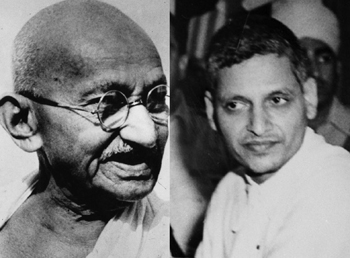
Resurgence of Godse

With the new dispensation coming to power (Modi Sarkar, May, 2014) many a communal assertions, acts and intimidations are up in the air. It seems these acts are being silently appreciated by those in power. This inference is logical as none in the positions of power have either reprimanded or opposed these Godse acolytes. The main reason is that due to the compulsions of power they do not openly support the Godse appreciation clubs. They also do not condemn these voices as they too belong to the Godse ideology of Hindu nationalism. This Hindu nationalism in popular parlance is projected as ‘Nationalism’, keeping the Hindu prefix in the silent mode.

The latest in the series of acts-statements by this Godse appreciation clubs is the bhumi pujan (earth prayer-a ritual before beginning of new construction) by Hindu Mahasabha for Godse temple in Meerut (Dec 25 2014). The activists of Akhil Bharatiya Hindu Mahasabha are all set to build the country's first temple for murderer of Mahatma Gandhi in Meerut. There are several demands from the Hindu Mahasabha offices to install his statues. The Hindu Mahasabha has requested land from the Centre to erect a statue of Godse in the national capital. The paperback issue of Godse’s book is already running into second reprint.

The BJP MP Sakhshi Maharaj recently called Godse as Nationalist; of course he retracted it soon; apparently to ensure that the ruling party, BJP, is not embarrassed on the issue. At the same time, BJP’s parent organization RSS has come out with two books meant for internal circulation. These books claim to ensure that RSS viewpoint is reached to its Pracharaks, swayamsevaks. These books are RSS-Ek Parichay (RSS-an introduction) and RSS-Ek Saral Parichay (RSS-a simple introduction), the second of which is written by veteran RSS member MG Vaidya. Mr. Vaidya claims that "a narrative of accusation was built around RSS" so the book to dispel that. Essentially these books aim to dissociate RSS from Godse. While the Prime Minister Mr. Modi is maintaining maun (silence) on the subject the opposition leaders are strongly criticizing Hindu Mahasabha's and others’ views on the murder of Mahatma Gandhi by Nathuram Godse.

What is the relationship between Godse and RSS? Was he part of RSS and later left it or was he part of it and also joined Hindu Mahasabha in mid 1930s? As for as official line is concerned RSS has tried to keep its slate clean by stating that it had nothing to do with Godse and he was not a member of RSS when he killed Mahatma Gandhi. Just to recall, in early 1998 Professor Rajendra Singh, the then RSS chief, had stated "Godse was motivated by akhand Bharat. His intention was good but he used the wrong method." (April 27 1998, Outlook)

How do we understand the whole issue? The major backdrop to understand the issue is to see the politics of Hindu nationalism as expressed through Hindu Mahasbah and RSS. These organizations remained aloof from freedom struggle. Hindu Mahasabha (HM), was more interested in the immediate participation in politics, as the flag bearers of Hindu communal politics, and the RSS wanted to concentrate on making a network of ‘cadres’ before forming organizations and infiltrating into different arena of education, culture, electoral politics and state apparatus. There was a lot of overlap in the agenda of these organizations as they were both working for the common goal of Hindu Nation. Nathuram Godse, ‘uniquely’ symbolized the fusion of both these two trends.

RSS could get away with dissociating with Godse or rather underplaying Godse’s association with RSS as there was no official record of members of RSS, and so they could disown Godse at legal level. In 1930 Godse joined RSS and very soon rose to be the bauddhik pracharak (intellectual propagator). Like both HM & RSS he was ardent Hindu Nationalist.

As a strong Hindutvawadi he was extremely critical of Gandhi’s ahimsa (non-violence) and the anti British movements led by him. Godse had very poor opinion of Gandhi’s role in freedom movement. RSS-Hindu Mahasbha kept criticizing Gandhi for his involving all religious communities in the freedom movement. Gandhi kept religion as personal matter and projected overarching Indian identity for all. This was what annoyed the HM-RSS combine, as they wanted only Hindus to be recognized as Indians. Godse’s assessment of nationalism of Gandhi is expressed in a way which identifies nationalism with Hindu kings. He used very peculiar parameters to assess Gandhi, “His (Gandhi’s, added) followers cannot see what is clear even to the blind viz. that Gandhi was a mere pigmy before Shivaji, Rana Pratap and Guru Govind (ibid Pg. 40, Why I assassinated Gandhi?) and finally about the winning of swaraj and freedom I maintain the Mahatma’s contribution was negligible.” (Ibid. pg. 87)

He held Mahatma responsible for appeasing Muslims, and thereby the formation of Pakistan. About his association with RSS and Hindu Mahasabha, he writes, “Having worked for the uplift of the Hindus I felt it necessary to take part in political activities of the country for the protection of just rights of Hindus. I therefore left the Sangh and joined Hindu Mahasabha (Godse, ‘Why I Assassinated Mahatma Gandhi’ 1993, Pg. 102).

Hindu Mahasabha at that time the only political party of Hindutva, and he became general secretary of its Pune Branch. In due course he started a newspaper, as founder editor, called Agrani or Hindu Rashtra. As such Gandhi murder was not on the charges propagated by them (Partition and insistence on paying Pakistan’s dues (55 crore) from the treasury), but due to the basic deep differences with the politics of Gandhi and that of the followers of the Hindu Rashtra. These two reasons are proffered merely as a pretext for the same.

What does Godse mean when he says that he left RSS? Is it true? This truth behind Nathuram’s leaving RSS, is clarified by his brother Gopal Godse. In an interview given to ‘The Times of India’ (25 Jan 98); Gopal Godse, who was also an accomplice in the murder when tells us the reality behind Nathuram’s statement that ‘he left RSS’. Gopal Godse says “The appeasement policy followed by him (Gandhi, added) and imposed on all Congress governments’ encouraged the Muslim separatist tendencies that eventually created Pakistan…Technically and theoretically he (Nathuram) was a member (of RSS), but he stopped workings for it later. His statement in the court that he had left the RSS was to protect the RSS workers who would be imprisoned following the murder. On the understanding that they (RSS workers) would benefit from his dissociating himself from the RSS, he gladly did it."

So this is the logic of Godse saying that he ‘left’ RSS. The dual membership (RSS+Hindu Mahasabha) was not a problem. Thus the murder of Gandhi was steeped in both the streams of Hindutva politics, RSS and HM. His editing the paper called, ‘Hindu Rashtra was quite symbolic. This murder had a broad sanction of the followers of HM and RSS, as they celebrated Mahatma’s murder by distributing sweets, “All their (RSS) leaders’ speeches were full of communal poison. As a final result, the poisonous atmosphere was created in which such a ghastly tragedy (Gandhi’s murder) became possible. RSS men expressed their joy and distributed sweets after Gandhi’s death." (excerpt from Sardar Patel’s letters to M S Golwalkar and S P Mookerjee.). Godse was no freak. The way Hindu communalists were spewing poison against Gandhi, it was the logical outcome of their politics. And Godse had the ‘benefit’ of the teachings of both RSS as well as HM. They used the word wadh for this murder. This word wadh stands for killing a demon who is harming the society. In a way Gandhi murder was the first major offensive of the Hindutva politics on Indian Nationalism; in a way it was to herald the onset of bigger strides which Hindutva politics has assumed during last few decades, and this is what we are witnessing today.

So though officially RSS family kept dissociating from Gandhi’s murder by Godse, in private many a members not only uphold the dastardly act, but also have even succeeded in undermining the importance of Mahatma and they do ‘sympathize’ with Godse. This complex trick kept going on so far. Now with Modi Sarkar there is no need to hide the true ideology and thinking of this combine and so the open efforts to glorify Godse!

Comments

Add new comment

  • Coastaldigest.com reserves the right to delete or block any comments.
  • Coastaldigset.com is not responsible for its readers’ comments.
  • Comments that are abusive, incendiary or irrelevant are strictly prohibited.
  • Please use a genuine email ID and provide your name to avoid reject.
Ram Puniyani
January 14,2020

In the beginning of January 2020 two very disturbing events were reported from Pakistan. One was the attack on Nankana Sahib, the holy shrine where Sant Guru Nanak was born. While one report said that the place has been desecrated, the other stated that it was a fight between two Muslim groups. Prime Minister of Pakistan Imran Khan condemned the incident and the main accused Imran Chisti was arrested. The matter related to abduction and conversion of a Sikh girl Jagjit Kaur, daughter of Pathi (One who reads Holy Guru Granth Sahib in Gurudwara) of the Gurudwara. In another incident one Sikh youth Ravinder Singh, who was out on shopping for his marriage, was shot dead in Peshawar.

While these condemnable attacks took place on the Sikh minority in Pakistan, BJP was quick enough to jump to state that it is events like this which justify the Citizenship Amendment Act (CAA). Incidentally CAA is the Act which is discriminatory and relates to citizenship with Religion, which is not as per the norms of Indian constitution. There are constant debates and propaganda that population of Hindus has come down drastically in Pakistan and Bangla Desh. Amit Shah, the Home minister stated that in Pakistan the population of Hindus has come down from 23% at the time of partition to 3.7% at present. And in Bangla Desh it has come down from 22% to present 8%.

While not denying the fact that the religious minorities are getting a rough deal in both these countries, the figures which are presented are totally off the mark. These figures don’t take into consideration the painful migrations, which took place at the time of partition and formation of Bangla Desh later. Pakistan census figures tell a different tale. Their first census was held in 1951. As per this census the overall percentage of Non Muslim in Pakistan (East and West together) was 14.2%, of this in West Pakistan (Now Pakistan) it was 3.44 and in Eat Pakistan it was 23.2. In the census held in Pakistan 1998 it became 3.72%. As far as Bangla Desh is concerned the share of Non Muslims has gone down from 23.2 (1951) to 9.6% in 2011.

The largest minority of Pakistan is Ahmadis, (https://minorityrights.org/country/pakistan/) who are close to 4 Million and are not recognised as Muslims in Pakistan. In Bangla Desh the major migrations of Hindus from Bangla Desh took place in the backdrop of Pakistan army’s atrocities in the then East Pakistan.

As far as UN data on refugees in India it went up by 17% between 2016-2019 and largest numbers were from Tibet and Sri Lanka.  (https://www.un.org/en/development/desa/population/migration/publication…)

The state of minorities is in a way the index of strength of democracy. Most South Asian Countries have not been able to sustain democratic values properly. In Pakistan, the Republic began with Jinnah’s classic speech where secularism was to be central credo of Pakistan. This 11th August speech was in a way what the state policy should be, as per which people of all faiths are free to practice their religion. Soon enough the logic of ‘Two Nation theory” and formation of Pakistan, a separate state for Muslim took over. Army stepped in and dictatorship was to reign there intermittently. Democratic elements were suppressed and the worst came when Zia Ul Haq Islamized the state in collusion with Maulanas. The army was already a strong presence in Pakistan. The popular formulation for Pakistan was that it is ruled by three A’s, Army, America and Allah (Mullah).

Bangla Desh had a different trajectory. Its very formation was a nail in the coffin of ‘two nation theory’; that religion can be the basis of a state. Bangla Desh did begin as a secular republic but communal forces and secular forces kept struggling for their dominance and in 1988 it also became Islamic republic. At another level Myanmar, in the grip of military dictatorship, with democratic elements trying to retain their presence is also seeing a hard battle. Democracy or not, the army and Sanghas (Buddhist Sang has) are strong, in Myanmar as well. The most visible result is persecution of Rohingya Muslims.

Similar phenomenon is dominating in Sri Lanka also where Budhhist Sanghas and army have strong say in the political affairs, irrespective of which Government is ruling. Muslim and Christian minorities are a big victim there, while Tamils (Hindus, Christians etc.) suffered the biggest damage as ethnic and religious minorities. India had the best prospect of democracy, pluralism and secularism flourishing here. The secular constitution, the outcome of India’s freedom struggle, the leadership of Gandhi and Nehru did ensure the rooting of democracy and secularism in a strong way.

India so far had best democratic credentials amongst all the south Asian countries. Despite that though the population of minorities rose mainly due to poverty and illiteracy, their overall marginalisation was order of the day, it went on worsening with the rise of communal forces, with communal forces resorting to identity issues, and indulging in propaganda against minorities.

While other South Asian countries should had followed India to focus more on infrastructure and political culture of liberalism, today India is following the footsteps of Pakistan. The retrograde march of India is most visible in the issues which have dominated the political space during last few years. Issues like Ram Temple, Ghar Wapasi, Love Jihad, Beef-Cow are now finding their peak in CAA.

India’s reversal towards a polity with religion’s identity dominating the political scene was nicely presented by the late Pakistani poetess Fahmida Riaz in her poem, Tum bhi Hum Jaise Nikle (You also turned out to be like us). While trying to resist communal forces has been an arduous task, it is becoming more difficult by the day. This phenomenon has been variously called, Fundamentalism, Communalism or religious nationalism among others. Surely it has nothing to do with the religion as practiced by the great Saint and Sufi traditions of India; it resorts mainly to political mobilization by using religion as a tool.

Comments

Ashi
 - 
Tuesday, 14 Jan 2020

If Malaysia implement similar NRC/CAA, India and China are the loser.

Add new comment

  • Coastaldigest.com reserves the right to delete or block any comments.
  • Coastaldigset.com is not responsible for its readers’ comments.
  • Comments that are abusive, incendiary or irrelevant are strictly prohibited.
  • Please use a genuine email ID and provide your name to avoid reject.
Ram Puniyani
January 26,2020

During last couple of decades we have been witnessing the coming up of various statues in different parts of the country. There is diverse political logic and different set of political tendencies for erecting these statues. When Mayawati was UP CM, she got multiple of her own statues made, in addition to many statues of major dalit icons, irrespective of the criticism against that act. As per her strategy it was a symbol of identity of dalit assertion. The biggest statue to come up was that of Sardar Vallabh Bhai Patel, a lifelong Congressman, whom RSS combine is trying to appropriate. This statue of Unity was ‘Made in China’. The clever trick was that the same forces were behind this statue, which was banned by Patel in the aftermath of Gandhi murder. Interestingly while currently BJP is blaming Congress for Partition of India, ironically it was Sardar Patel who was in the committee which gave final stamp of approval for the partition of India.

There is also a talk in UP, where the Ram temple campaign yielded rich electoral dividends for BJP, to have tallest statue of Lord Ram in Ayodhya. In a state where children are dying in hospitals due to lack of Oxygen cylinders, a huge budgetary allocation will be required for such project. While on statues one should also remember that in Maharashtra a tall statue of Chatrapati Shivaji Maharaj is underway in Arabian Sea, near Mumbai. Only few voices of protest against it came up, e.g. that of renowned journalist, now, MP, Kumar Ketkar, whose house was vandalised for his opposing the move on the grounds that same massive amount can be utilized for welfare-development activities in the state.

On the back of this comes a comparatively low budget 114 feet tall statue of Jesus Christ in Karnataka, in Kappala hills Harobele village, where Christian pilgrims have been thronging from last several centuries. The land for this has been donated by Congress leader Shivaprasad and his brother, a Congress MP. It is planned to be carved out from a single rock. The plan of this statue is being opposed by those who have been behind most of the statue projects so far. Hindu Jagran Vedike, VHP, RSS are up in arms saying that they will not let this come up. There are various arguments cited for this opposition. It is being said that this was a place of worship of Lord Munnieshwara (a form of Lord Shiva).

More than this it is being argued that Shivakumar is trying to please his Italian boss in the party. Also that this will bring back the period of slavery of foreign rule, the colonial rule of British. As such this opposition is more in tune with the ideology of RSS combine, which has been for a statue here and a statue there. Their politics regards Christianity as a ‘foreign religion’! It is true that in Citizenship Amendment Act, they have not excluded Christianity while other religion, which they regard as ‘Foreign’ i.e. Islam. Here they are using a different logic, that the countries from where persecuted minorities are coming, are Muslim countries, Pakistan, Afghanistan and Bangla Desh.

In India the major targeting by RSS combine has been against Muslims, but Christians are also not spared. Starting in the decade of 1980, an intense propaganda has been going on that Christian Missionaries are converting. As RSS affiliate Vanvasi Kalyan Ashram became active in Adivasi areas, the likes of Swami Aseemanand, Swami Laxmanand and followers of Aasaram bapu spread out in Tribal areas. They started their programs to popularise Shabri and Hanuman, with congregations like Shabri Kumbh being regularly organized in these areas. The aim was to Hinduize the people in those areas.

The first major anti Christian violence came up in the ghastly form of burning alive of Pastor Graham Steward Stains along with his two minor sons Timothy and Philip. RSS affiliate Bajrang Dal's Dara Siingh aka Rajendra Pal was behind this and he is serving the life term for that. At the same time Wadhva Commission was appointed to investigate this crime which shook the country and President K.R. Narayan termed it as the one belonging to the inventory of the black deeds of human history.

The Wadhva commission report pointed out that there was no statistical significant change in the region where the pastor was working. Similarly the national figures tell us that the Christian population, if at all, has marginally declined in last five decades as per the census figures. They stand like this, percentage of Christians in population, 1971-2.60, 1981- 2.44, 1991-2.34, 2001-2.30 and 2011-2.30. There are arguments that some people are converting to Christianity but are not revealing their religion. This may be true in case of miniscule percentage of dalits, who may not reveal there conversion, as they stand to loose reservation provisions if they convert.

The anti Christian violence is scattered and is below the radar most of the places. There was massive valence in Kandhamal, Orissa, when on the pretext that Christians have murdered Swami Laxmananand, a massive violence was unleashed in 2008. On regular basis prayer meetings of Christians are attacked on the pretext that these are attempts at conversion. While there is a huge demand for the schools and colleges run by Christian groups, in Adivasis areas and remote areas the work of Swamis is on.

Now the trend is to dump Christian traditions. Since Ramnath Kovind became President, the usual practice of Carol Singers visiting Rashtrapati Bhavan has been stopped. In the army retreat so far ‘Abide with me’ by Scottish poet, Henri Francis Lyte, a Christian song, a favourite of Gandhi, has been dropped. The Christian minorities have perceived the threat in various forms. Currently they are as much part of the protests against CAA, NPR and NRIC as any other community.

While statues and identity issues cannot have primacy over the social development issues, it cannot be selective. To oppose Jesus Christ statue while spending fortunes for other statues is a part of the agenda of RSS combine, which is unfolding itself in various forms. opposition to Jesus Christ statue being yet another step in the direction.

Comments

Add new comment

  • Coastaldigest.com reserves the right to delete or block any comments.
  • Coastaldigset.com is not responsible for its readers’ comments.
  • Comments that are abusive, incendiary or irrelevant are strictly prohibited.
  • Please use a genuine email ID and provide your name to avoid reject.
Ram Puniyani
March 14,2020

In the wake of Citizenship Amendment Act (CAA) UN High Commissioner, Michele Bachelet, has filed an intervention in the Supreme Court petition challenging the constitutionality of the Citizenship Amendment Act, as she is critical of CAA. Responding to her, India’s Foreign Minister S. Jai Shanker strongly rebutted her criticism, saying that the body (UNHCR) has been wrong and is blind to the problem of cross border terrorism. The issue on hand is the possibility of scores of people, mainly Muslims, being declared as stateless. The problem at hand is the massive exercise of going through the responses/documents from over 120 crore of Indian population and screening documents, which as seen in Assam, yield result which are far from truthful or necessary.

The issue of CAA has been extensively debated and despite heavy critique of the same by large number of groups and despite the biggest mass opposition ever to any move in Independent India, the Government is determined on going ahead with an exercise which is reminiscent of the dreaded regimes which are sectarian and heartless to its citizens, which have indulged in extinction of large mass of people on grounds of citizenship, race etc. The Foreign minister’s assertion is that it is a matter internal to India, where India’s sovereignty is all that matters! As far as sovereignty is concerned we should be clear that in current times any sovereign power has to consider the need to uphold the citizenship as per the principle of non-discrimination which is stipulated in Art.26 of the International Covenant on Civil and Political (ICCPR) rights.

Can such policies, which affect large number of people and are likely to affect their citizenship be purely regarded as ‘internal’? With the World turning into a global village, some global norms have been formulated during last few decades. The norms relate to Human rights and migrations have been codified. India is also signatory to many such covenants in including ICCPR, which deals with the norms for dealing with refugees from other countries. One is not talking of Chicago speech of Swami Vivekanand, which said that India’s greatness has been in giving shelter to people from different parts of the World; one is also not talking of the Tattariaya Upanishad’s ‘Atithi Devovhav’ or ‘Vasudhaiva Kutumbkam’ from Mahaupanishad today.

What are being talked about are the values and opinions of organizations which want to ensure to preserve of Human rights of all people Worldwide. In this matter India is calling United Nations body as ‘foreign party’; having no locus standi in the case as it pertains to India’s sovereignty. The truth is that since various countries are signatories to UN covenants, UN bodies have been monitoring the moves of different states and intervening at legal level as Amicus (Friend of the Court) to the courts in different countries and different global bodies. Just to mention some of these, UN and High Commissioner for Human Rights has often submitted amicus briefs in different judicial platforms. Some examples are their intervention in US Supreme Court, European Court of Human Rights, International Criminal Court, and the Inter-American Court of Human Rights. These are meant to help the Courts in areas where UN bodies have expertise.

 Expertise on this has been jointly formulated by various nations. These interventions also remind the nations as to what global norms have been evolved and what are the obligations of individual states to the values which have evolved over a period of time. Arvind Narrain draws our attention to the fact that, “commission has intervened in the European Court of Human Rights in cases involving Spain and Italy to underscore the principle of non-refoulement, which bars compulsory expulsion of illegal migrants… Similarly, the UN has intervened in the International Criminal Court in a case against the Central African Republic to explicate on the international jurisprudence on rape as a war crime.”

From time to time organizations like Amnesty International and Human Rights Watch have been monitoring the status of Human rights of different countries. This puts those countries in uncomfortable situation and is not welcome by those establishments. How should this contradiction between ‘internal matter’, ‘sovereignty’ and the norms for Human rights be resolved? This is a tough question at the time when the freedom indices and democratic ethos are sliding downwards all over the world. In India too has slid down on the scale of these norms.

In India we can look at the intervention of UN body from the angle of equality and non discrimination. Democratic spirit should encourage us to have a rethink on the matters which have been decided by the state. In the face of the greatest mass movement of Shaheen bagh, the state does need to look inwards and give a thought to international morality, the spirit of global family to state the least.

The popular perception is that when Christians were being persecuted in Kandhmal the global Christian community’s voice was not strong enough. Currently in the face of Delhi carnage many a Muslim majority countries have spoken. While Mr. Modi claims that his good relations with Muslim countries are a matter of heartburn to the parties like Congress, he needs to relook at his self gloating. Currently Iran, Malaysia, Indonesia and many Muslim majority countries have spoken against what Modi regime is unleashing in India. Bangladesh, our neighbor, has also seen various protests against the plight of Muslims in India. More than the ‘internal matter’ etc. what needs to be thought out is the moral aspect of the whole issue. We pride ourselves in treading the path of morality. What does that say in present context when while large section of local media is servile to the state, section of global media has strongly brought forward what is happening to minorities in India.   

The hope is that Indian Government wakes up to its International obligations, to the worsening of India’s image in the World due to CAA and the horrific violence witnessed in Delhi.

Comments

Add new comment

  • Coastaldigest.com reserves the right to delete or block any comments.
  • Coastaldigset.com is not responsible for its readers’ comments.
  • Comments that are abusive, incendiary or irrelevant are strictly prohibited.
  • Please use a genuine email ID and provide your name to avoid reject.