



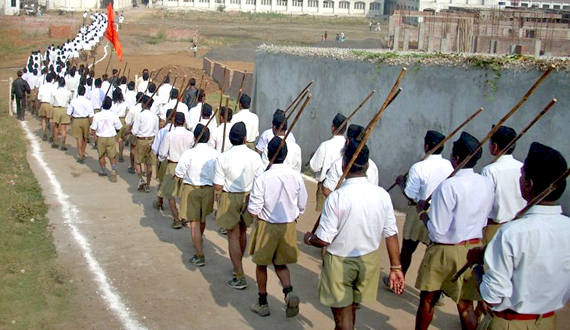
Sangh Parivar's Population Bomb

November 19, 2013

twocirclesnet

Once again the Rashtriya Swayamsewak Sangh [RSS] has urged Hindus that more children should be produced, in order to check the demographic imbalance. Did anyone call it fatwa or a diktat? How many TV channels found RSS joint secretary Dattatreya Hosbale's comments as controversial? Has there been strong criticism on editorial pages in mainstream newspapers? This is not the first time that RSS leaders have said that Hindus need to produce more kids. For them, Hindus are the 'victim'.

The bogey of 'Muslim population rise' or 'Ham Panch-Hamare Pachchis' are used by RSS to portray Muslims in bad light. Not only that the statement aims at driving wedge among religious communities, the fact is that it is truly regressive in nature.

Shouldn't RSS turn itself into a forward looking organisation?

The reason is that if RSS been a forward looking organisation, it would stop looking at things from the Hindu vs. Muslim. In that case it should have urged middle-class Indians [mostly Hindus] to stop female foeticide [and infanticide] to control the fascination for 'baby boy'.

It is this gender imbalance that is really threatening Hinduism [and India]. There are vast regions where there are less than 800 girls for 1,000 boys. Even the upper class and middle-class want the 'baby boy'. If the first child is a girl, many go for second, in the hope to have a boy.

This 'sickness' needs to be fought. Strangely, RSS leaders never tell their followers how Hinduism has been growing much faster over the last century in the world. While Islam has grown fast after 1900, overall population of Hindus in the world, has also gone up significantly, even as Christianity and other religions have now lost the pace.

As far as rise in Muslim population in India is concerned, it is not a very unusual phenomenon. The minority [Muslim] rate of growth is quite close to Dalits. Clearly, economic reasons and social backwardness are the cause behind the high birthrate.

Muslim growth rate in Kerala, Tamil Nadu much less than in UP, Bihar

In states like Tamil Nadu and Kerala, Muslims have a growth rate of much less than 20% per decade, which is less than the growth rate of Hindu population in India in many other states of North India. UP and Bihar have overall bigger families. No wonder, fertility rates are higher among Muslims in these states.

Secondly, there is no open opposition to family planning among Muslims, and they have adopted it widely. As Muslims go up on socio-economic indicators, they also tend to have smaller families, just like rest of the Indians.

As per 2001 census, the overall population grew by 21.5% in India in the previous decade. Muslim decadal population grew by a mere 13.7% in Tamil Nadu and 15.8% in Kerala [from 1991 to 2001]. These states have a higher Muslim literacy rate and here Muslims are financially better-off. In contrast, Hindu population increased by 28.7% in Punjab, 24.7% in Karnataka and 23.4% in Bihar.

How do you explain that? Now there will be critics who would say that if Muslims grew by 13.7% in Tamil Nadu in the decade, the decennial Hindu growth was just 11%.

The problem is that when the Hindu growth rate is seen, they don't take into account the growth rate of backwards and Dalits, whose population growth is comparable to Muslims.

For example, you can't expect to compare Iyers or Iyengars' decadal rise in population with Dalits or even Vanniyars. If you have to at all compare then do it with the socially upward Muslims. Else, consider Muslims also as a social group and then look at them with their growth rate.

The right comparison would be Muslim population rise vis-a-vis increase in population of social groups that have similar earning, living conditions and socio-economic backwardness. Statistics clearly reveal that Muslim population rate is falling in India and would stabilise in a few decades.

The difference of population growth rates is narrowing down fast. Far from becoming majority or even 25%, it will take centuries before they even reach the figure of 20% in India.

Perpetuating old myths: Fact is that Muslims are least polygamous in India

For decades, right-wing groups have made similar claims. Take for example, the charge of polygamy. Census clearly reveals that the practice of polygamy was highest among Adivasis, Jains, Buddhists and Hindus. Muslims came last as far as prevalence of the practice was concerned.

See this link. This is despite the fact that polygamy is legal for Muslims and unlawful for Hindus. But this is not highlighted or even mentioned. Tell a lie a thousand times and people tend to believe it. Senior RSS and BJP leaders often make attacks on Muslims about being more polygamous.

In December 2005, the then RSS chief [sarsanghchalak] KS Sudharshan had also urged the majority community in a similar manner. He said that 3-4 children per couple would keep the 'changing religious demography' in control. Just imagine had any other religious community [like a Muslim cleric from Nadwatul Ulema or Deoband] made such a statement, what would have happened?

There would have been wide condemnation, politicians and activists gunning for him and effigies burnt. TV channels would have continued debates for days. But in the case of RSS, it was simply ignored even though the 'cultural organisation' has huge impact and has a cadre strength of tens of lakhs.

If the RSS leaders take up real issues that affect the nation, they would be taken more seriously. It may also strike chord with the young generation. However, they remain stuck in regressive rhetoric.

Comments

Add new comment

  • Coastaldigest.com reserves the right to delete or block any comments.
  • Coastaldigset.com is not responsible for its readers’ comments.
  • Comments that are abusive, incendiary or irrelevant are strictly prohibited.
  • Please use a genuine email ID and provide your name to avoid reject.
Agencies
July 11,2020

Citing the current dismal aviation scenario, Air India is terminating the services of trainee cabin crew and cabin crew by withdrawing the offer of employment of those who were under training.

As per sources, the new crew and trainee pilots might reduce contracts from five years to one year. Sources said Air India is terminating 1,200 crew and employees who are more than 55-yr-old including 190 trainee pilots.

In a letter reviewed by IANS, Air India has informed an applicant who had been selected as cabin crew in August 2019 subject to successful completion of training.

"On behalf of Air India we would like to thank you for the interest shown by you in joining our organization. However, in view of the current aviation scenario, it would not be possible for Air India to impart any further training to you for engaging your services," the company said.

"In view of the above reasons, which are beyond the control of the company, it has been decided to discontinue your training arrangements and dispense with the offer of engagement with immediate effect. The bank guarantee furnished by you at the time of joining is returned herewith," Air India told the cabin crew.

"Once again on behalf of Air India we thank you for your cooperation and trust that you will appreciate the circumstances under which we are constrained to discontinue the training arrangements," the carrier said.

Comments

Add new comment

  • Coastaldigest.com reserves the right to delete or block any comments.
  • Coastaldigset.com is not responsible for its readers’ comments.
  • Comments that are abusive, incendiary or irrelevant are strictly prohibited.
  • Please use a genuine email ID and provide your name to avoid reject.
Agencies
May 27,2020

Due to impacts of COVID-19, shipments of total mobile phones are forecast to decline 14.6% in 2020, while smartphone shipments will achieve a slightly slower decline of 13.7 % year over year to total 1.3 billion units this year, according to a Gartner forecast on Tuesday.

"While users have increased the use of their mobile phones to communicate with colleagues, work partners, friends and families during lockdowns, reduced disposable income will result in fewer consumers upgrading their phones," Ranjit Atwal, Senior Research Director at Gartner, said in a statement.

"As a result, phone lifetimes will extend from 2.5 years in 2018 to 2.7 years in 2020," said Atwal.

In 2020, affordable 5G phones were expected to be the catalyst to increase phone replacements, but now it is unlikely to be the case.

5G phones are now forecast to represent only 11% of total mobile phone shipments in 2020.

"The delayed delivery of some 5G flagship phones is an ongoing issue," said Annette Zimmermann, Research Vice President at Gartner.

"Moreover, the lack of 5G geographical coverage along with the increasing cost of the 5G phone contract will impact the choice of a 5G phone."

Overall, spending on 5G phones will be impacted in most regions apart from China, where continued investment in 5G infrastructure is expected, allowing providers in China to effectively market 5G phones.

The combined global shipments PCs, tablets and mobile phones are on pace to decline 13.6% in 2020, according to the forecast.

PC shipments are expected to decline 10.5% this year. Shipments of notebooks, tablets and Chromebooks are forecast to decline slower than the PC market overall in 2020.

"The forecasted decline in the PC market in particular could have been much worse," said Atwal.

"However, government lockdowns due to COVID-19 forced businesses and schools to enable millions of people to work from home and increase spending on new notebooks, Chromebooks and tablets for those workers. Education and government establishments also increased spending on those devices to facilitate e-learning."

Gartner said that 48 per cent of employees will likely work remotely at least part of the time after the COVID-19 pandemic, compared to 30 % pre-pandemic.

Overall, the work from home trend will make IT departments shift to more notebooks, tablets and Chrome devices for work.

"This trend combined with businesses required to create flexible business continuity plans will make business notebooks displace desk based PCs through 2021 and 2022," said Atwal.

Comments

Add new comment

  • Coastaldigest.com reserves the right to delete or block any comments.
  • Coastaldigset.com is not responsible for its readers’ comments.
  • Comments that are abusive, incendiary or irrelevant are strictly prohibited.
  • Please use a genuine email ID and provide your name to avoid reject.
Agencies
January 10,2020

Indian enterprises were flooded with a whopping 14.6 crore malware threats in 2019 - a growth of 48 per cent (year-on-year) compared to 2018, a new report said on Friday.

Manufacturing, BFSI (banking, financial services and insurance), education, healthcare, IT/ITES, and the government were the most at-risk industries in the country, said the report from Seqrite, the enterprise arm of Pune-based IT security firm Quick Heal Technologies.

Interestingly, almost a quarter (23 per cent) of the threats were identified through 'Signatureless behaviour-based' detection by Seqrite, indicating how a growing number of cybercriminals were deploying new or previously unknown threat vectors to compromise enterprise security.

"With the latest Seqrite annual threat report, we want to empower CIOs, CISOs, business leaders and all key public stakeholders with the insights they need to combat the growing complexity of the threat landscape," said Sanjay Katkar, Joint Managing Director and CTO, Quick Heal Technologies.

The most prominent trend was the drastic increase in the volume, intensity, and sophistication of cyber-attack campaigns targeting Indian enterprises in 2019.

The rapid integration of IoT devices, BYOD (bring your own device), and third-party APIs into enterprise networks has created newer security vulnerabilities that might go unnoticed until a major breach occurs.

Threat researchers at Seqrite observed several large-scale advanced persistent threats (APT) attacks deployed against organisations in the government sector.

"The entry of nation-states and organised cybercrime cells into the fray is expected to add more complication to this situation and will require Indian government bodies and corporate enterprises to shore up their cyber defence strategies in 2020 and beyond," the report noted.

More alarming, however, was the continued lack of security awareness amongst enterprises and government organisations.

"Unsecured Remote Desktop Protocol (RDP) and Server Message Block (SMB) protocols continued to be targeted through brute-force attacks," said the report.

Spear phishing attack campaigns leveraging Office exploits and infected macros were also used extensively by cybercriminals to gain access to enterprise networks and steal critical data.

"India's digital journey depends on ensuring robust cybersecurity for all stakeholders within the enterprise ecosystem," said Katkar.

The sharp spike should be a cause of concern for CIOs and CISOs in the country, especially given the growing digital penetration within their enterprise networks.

"With network vulnerabilities and potential entry points increasing at a rapid pace, threat actors are expected to leverage artificial intelligence (AI) capabilities to power their malware campaigns in the future to capitalise on newer attack vectors," the report added.

Comments

Add new comment

  • Coastaldigest.com reserves the right to delete or block any comments.
  • Coastaldigset.com is not responsible for its readers’ comments.
  • Comments that are abusive, incendiary or irrelevant are strictly prohibited.
  • Please use a genuine email ID and provide your name to avoid reject.