


Saudi Cabinet deplores brutal attacks on civilians, hospitals

November 22, 2016

Riyadh, Nov 22: The Council of Ministers, chaired by Custodian of the Two Holy Mosques King Salman, met in Riyadh on Monday and denounced the brutal shelling and heinous attacks on the Syrian people in Aleppo and its surroundings.
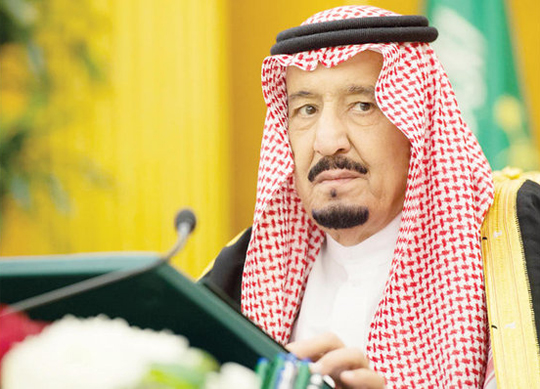
king salman

The Cabinet deplored the severe damage caused to people and property, particularly hospitals and schools.

The attacks resulted in the demolition of buildings and civilians being deprived of relief assistance.

The ministers noted that such attacks are contrary to the principles, values and essence of international law and humane principles in general.

The ministers reaffirmed the decisions of the emergency meeting of the foreign ministers of the Organization of the Islamic Cooperation (OIC) that the Kingdom would defend the Two Holy Mosques and enforce a strict call for putting an end to the practices of the Houthi militias and their supporters and their persistence in launching ballistic missiles at Makkah. These were unpredictable threats to Islamic sanctity and hurt the feelings of Muslims.

At the beginning of the meeting, the Custodian of the Two Holy Mosques briefed the ministers on the contents of messages he had received from Algerian President Abdulaziz Bouteflika and the outcome of his meetings and talks with Algerian Premier Abdulmalik Al-Sallal, Ethiopian Prime Minister Hailemariam Desalegn, Arab League Secretary-General Ahmed Abulghait, GCC Secretary-General Abdullatif Al-Zayani and Italian Interior Minister Engelo Alfano.

On reading the 52nd annual report of Saudi Arabian Monetary Agency (SAMA) for the fiscal year 2015, King Salman lauded the Kingdom’s vibrant financial situation which is attributed to strong security and stability in the country.

He also expressed his appreciation for SAMA’s efforts in the service of the country’s economy.

The Cabinet also hoped for a bright future in the forward march in accordance with the objectives of the Kingdom’s Vision 2030 and the national transformation program, (NTP) which will make a tangible economic impact through its diversification of national economic resources.

The Cabinet highlighted the statement made by Crown Prince Mohammed bin Naif, deputy premier and minister of interior, on the importance of protecting children from the threats of human society that harm their innocence and breach their dignity and honor.

The Kingdom’s hosting of the National Forum for Preventing Children’s Sexual Abuse on the Internet reflects its interest and care for human rights in general and children’s rights in particular based on the teachings of Islam.

The Cabinet was also briefed on the points raised by Deputy Crown Prince Mohammed bin Salman, second deputy premier and minister of defense, about his chairing of the 15th meeting of the GCC defense ministers, citing that everybody is looking forward to seeing the GCC move onward, particularly in the defense field amid the current challenges engulfing the countries in the region which necessitate more coordination and work and the taking of prompt action.

It was also briefed on the Kingdom’s stand at the UN Framework Convention’s 22nd Conference on Climate Change held in Marrakech.

It said that it would remain committed to its firm role in facing the problem of climate change and meeting the world’s oil energy needs and also providing support for a gradual transformation toward a more sustainable environmental future.

The Cabinet lauded the outcome of the conference.

Also highlighted was the Kingdom’s assertion at the Africa Labor summit that the GCC seeks fruitful cooperation at the Arab-African level for consolidating partnerships in order to achieve the objectives of UN sustainable development which was approved in New York in 2015.

The Cabinet also lauded the outcome of the 33rd GCC ministers of labor and social affairs held in Riyadh.

It cited the initiatives and programs envisaged to contribute effectively to a number of issues pertaining to the labor and social development fields, including the GCC joint common market.

The Cabinet praised the results of the first Arab Gulf Security exercise held in Bahrain where the Kingdom took part upon instructions of the Custodian of the Two Holy Mosques.

Later, the Cabinet approved the following decisions:

Firstly, the Cabinet authorized the crown prince or his delegated authority to discuss with the Zambians a draft cooperation agreement between the governments of Saudi Arabia and Zambia on the fight against terrorism, organized crimes and illegal trafficking in drugs and psychotropic items and their smuggling.

Secondly on the privatization of sports clubs in the Kingdom, based on recommendations of the Council of Economic Affairs and Development.

The Cabinet approved the following: privatization of sports clubs joining the Saudi championship for Premier Football League clubs.

The General Authority for Sports will, in coordination with the ministers of commerce and investment and economy and planning, stipulate regulations and conditions whereby the sports companies will carry out their activities.

Formation of a committee to supervise the completion of the club privatization stages to be headed by the president of the General Authority for Sports and members composed of the deputy minister of economy and planning, commerce undersecretary for systems and regulations in addition to representatives of the Finance Ministry, Saudi Football Association, and the Professional League Association.

Thirdly, the Cabinet approved a memorandum of understanding between the Saudi Ministry of Islamic Affairs, Call and Guidance and the Ministry of Islamic Affairs in Maldives in the field of Islamic affairs and endowments.

Fourthly, the Cabinet authorized the Minister of Islamic Affairs, Call and Guidance, or whomever he authorizes, to discuss with Djibouti a draft memo of understanding between the Saudi Ministry of Islamic Affairs, Call and Guidance and the Ministry of Islamic Affairs, Culture and Endowments in Djibouti in the area of Islamic affairs.

Fifth, the Cabinet authorized the Minister of Foreign Affairs, or whomever he authorizes, to discuss with the Independent Permanent Commission on Human Rights at the Organization of Islamic Cooperation (OIC) a draft head office agreement between the Saudi government and the Independent Permanent Commission on Human Rights at the OIC.

Sixth, the Cabinet approved the establishment of diplomatic relations between Saudi Arabia and the Republic of Central Africa at the level of “non-resident ambassador”.

The Cabinet also approved an agreement on the employment of domestic workers between the Saudi Ministry of Labor and Social Development and the Ministry of Public Office in Chad.

Finally, the Cabinet approved the establishment of a national program to maximize the benefits of government incentives in the energy and water sectors aimed at reducing consumption of energy and water in order to ensure economic efficiency in the productive sectors.

Comments

Add new comment

  • Coastaldigest.com reserves the right to delete or block any comments.
  • Coastaldigset.com is not responsible for its readers’ comments.
  • Comments that are abusive, incendiary or irrelevant are strictly prohibited.
  • Please use a genuine email ID and provide your name to avoid reject.
Agencies
February 5,2020

Paris, Feb 5: Saudi Arabia has reported an outbreak of the highly pathogenic H5N8 bird flu virus on a poultry farm, the World Organisation for Animal Health (OIE) said on Tuesday, February 4.

The outbreak, which occurred in the central Sudair region, killed 22,700 birds, the OIE said, citing a report from the Saudi agriculture ministry.

The other 385,300 birds in the flock were slaughtered, it said.

The case was the first outbreak of the H5N8 virus in Saudi Arabia since July 2018.

Comments

Add new comment

  • Coastaldigest.com reserves the right to delete or block any comments.
  • Coastaldigset.com is not responsible for its readers’ comments.
  • Comments that are abusive, incendiary or irrelevant are strictly prohibited.
  • Please use a genuine email ID and provide your name to avoid reject.
Agencies
July 22,2020

Dubai, Jul 22: Saudi Arabia's Minister of Haj and Umrah, Dr Muhammad Saleh Benten, has inspected the facilities and arrangement made for the Haj pilgrims in Makkah and the holy sites.

Speaking to the Saudi Press Agency after the tour, the minister said that the Saudi government has worked out unprecedented plans for the running of this year's Haj, enabling pilgrims to perform their rituals in ease and comfort.
 
This year's Haj, which has been scaled back dramatically to include only around 1,000 Muslim pilgrims as Saudi Arabia battles a coronavirus surge, will begin on July 29, authorities said Monday.

"The comprehensive, foolproof plans will be implemented by the security, health and service agencies. The plans include the provision of the best health services, and the most appropriate crowd control, strictly in line with the precautionary measures and preventive protocols, formulated by the Ministry of Health to ensure full safety of pilgrims from the coronavirus pandemic," Dr Benten said.

According to the Saudi Gazette, Benten emphasised the eagerness of the government of the Custodian of the Two Holy Mosques, King Salman bin Abdulaziz of Saudi Arabia and Saudi Crown Prince Mohammed bin Salman bin Abdulaziz Al Saud to implement the Haj operation by following the highest health standards and precautionary measures in order to ensure the safety of the pilgrims.

Earlier, the minister inspected the arrangements and facilities for the reception and accommodation of pilgrims at Four Point Hotel in Makkah.

He was briefed by ministry officials with regard to receiving and accommodating pilgrims during the period from 4 to 8 of Dhul Hijjah before leaving for Mina.

Benten also visited the tents in Arafat and the facilities in Muzdalifah.

After that, his inspection tour visited the tent city of Mina, where he viewed one of the towers designated for the housing of pilgrims. 

According to the Saudi Gazette, he was impressed with the services and facilities being arranged for the accommodation and serving of food for the pilgrims.

To complete his visit, the minister watched a visual presentation of the mechanism for providing logistical services for the pilgrims during their travel from accommodation to Jamarat to undertake the stoning ritual.

Meanwhile, Maj. Gen. Mohammed Bin Wasl Al Ahmadi, assistant commander of the Haj security forces for the Grand Mosque and its premises, said on Tuesday that the security plan for this year's pilgrimage prioritises on organisational, security, humanitarian and health aspects.

He said the Haj security forces have installed entry and exit mechanisms from the Grand Mosque during Haj, with passages for pilgrims extending from the southern and western premises of venue as well as special passages around the circumambulation and Saey areas.

Comments

Add new comment

  • Coastaldigest.com reserves the right to delete or block any comments.
  • Coastaldigset.com is not responsible for its readers’ comments.
  • Comments that are abusive, incendiary or irrelevant are strictly prohibited.
  • Please use a genuine email ID and provide your name to avoid reject.
Agencies
July 31,2020

Mount Arafat, July 30: Muslim pilgrims converged Thursday on Saudi Arabia's Mount Arafat for the climax of this year's hajj, the smallest in modern times and a sharp contrast to the massive crowds of previous years.

A tight security cordon has been erected all around the foot of the rocky hill outside Mecca, also known as Jabal al-Rahma or Mount of Mercy.

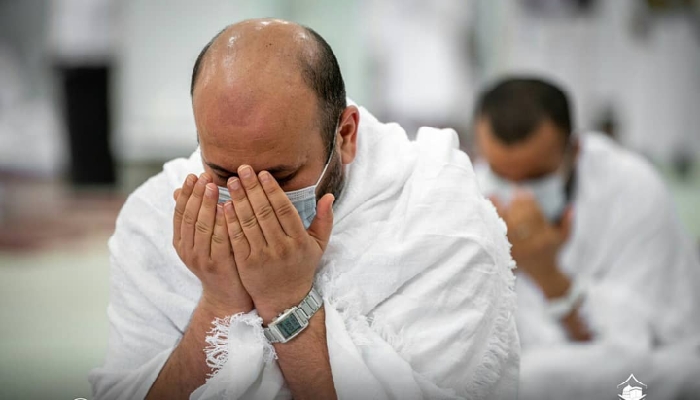
Pilgrims, donning masks and observing social distancing, were brought in buses from neighbouring Mina, state television showed, as Saudi authorities impose measures to prevent a coronavirus outbreak.

They were subject to temperature checks and attended a sermon -- which state media said was translated into 10 languages -- before they set off on the climb to the summit for hours of Koran recitals and prayers to atone for their sins.

The scene was strikingly different to last year's ritual when a sea of pilgrims ascended Mount Arafat, marshalled by tens of thousands of stewards in a bid to prevent any crushes.

After sunset prayers, pilgrims will make their way down Mount Arafat to Muzdalifah, another holy site where they will sleep under the stars to prepare for the final stage of hajj, the symbolic "stoning of the devil".

It takes place on Friday and also marks the beginning of Eid al-Adha, the festival of sacrifice.

The hajj, one of the five pillars of Islam and a must for able-bodied Muslims at least once in their lifetime, is usually one of the world's largest religious gatherings.

But only up to 10,000 people already residing in the kingdom will participate in this year's ritual, compared with 2019's gathering of some 2.5 million from around the world.

"You are not our guests but those of God, the custodian of the two holy mosques (Saudi Arabia's King Salman) and the nation," Hajj Minister Mohammad Benten said in a video released by the media ministry on Wednesday.

Security cordon

A security cordon has been thrown around the holy sites to prevent any security breaches, an interior ministry spokesman said.

Riyadh faced strong criticism in 2015 when some 2,300 worshippers were killed in the deadliest stampede in the gathering's history.

But this year, those risks are greatly reduced by the much smaller crowd.

The pilgrims have all been tested for the virus, and foreign journalists were barred from this year's hajj, usually a huge global media event.

As part of the rites completed over five days in the holy city of Mecca and its surroundings, the pilgrims converged on Mount Arafat after spending the night in Mina.

A district of Mecca, Mina sits in a narrow valley surrounded by rocky mountains, and is transformed each year into a vast encampment for pilgrims.

They began the hajj on Wednesday with their first "tawaf", the circumambulation of the Kaaba, a large structure in Mecca’s Grand Mosque towards which Muslims around the world pray.

The Kaaba is draped in a black cloth embroidered in gold with Koranic verses and known as the kiswa, which is changed each year during the pilgrimage.

Pilgrims were brought inside the mosque in small batches, walking along paths marked on the floor, in sharp contrast to the normal sea of humanity that swirls around the Kaaba during hajj.

Comments

Add new comment

  • Coastaldigest.com reserves the right to delete or block any comments.
  • Coastaldigset.com is not responsible for its readers’ comments.
  • Comments that are abusive, incendiary or irrelevant are strictly prohibited.
  • Please use a genuine email ID and provide your name to avoid reject.