


Saudi King's Month-Long Journey In Asia With Traveling Court Of 1,000

March 11, 2017

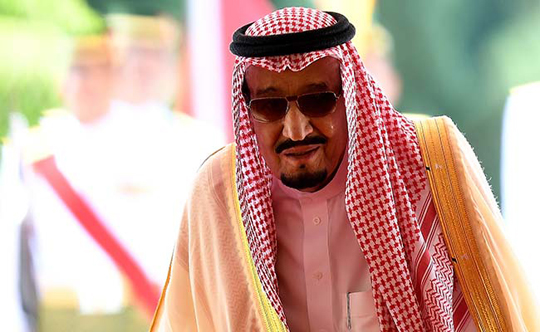
Mar 11: Saudi King Salman bin Abdul Aziz's month-long journey through Asia has been eye-catching because of its scale. The world's most powerful royal is touring seven countries with a traveling court of more than 1,000 people, including 25 princes and 10 ministers.
salman

The entourage's total baggage weighs a reported 506 tons.

This week, Salman decided to extend his stay at a luxury resort on the scenic Indonesian island of Bali - perhaps an easy decision - ahead of stops in Japan and China. Salman began his trip in Malaysia, where he oversaw the inking of lucrative oil pacts and was apparently the subject of a foiled assassination attempt before he called on the sultan of Brunei.

The trip has huge implications, both for regional politics and for Washington. The Saudis are deeply aware of the need to diversify their economy, which is heavily dependent on oil exports, and are keen to attract investment from major Asian economies in addition to spreading their own largesse. They also see Southeast Asia, with its huge population of Sunni Muslims, as a realm where they can exert power.

At a time when uncertainty and political paralysis seems to be gripping the West, a pivot to Asia makes a great deal of sense. "There can also be no doubt that the not-too-subtle subtext of the king's tour is a signal that Saudi Arabia will preserve its flexibility when it comes to its dealings with the United States," wrote Gerald Feierstein in Foreign Affairs.

But one arena for Saudi expansion is perhaps surprising: the Maldives, which Salman will visit on the way back to Riyadh. The nation made of Indian Ocean islands may have a tiny population - about 400,000 people - but it is a vast ocean state, spanning some 1,000 kilometers across some of the world's most significant shipping routes. Controversy is swirling there about a reported Saudi plan to invest billions of dollars in Faafu atoll, which comprises 26 islands.

The Maldivian government, led by President Abdulla Yameen, has argued that the deal would lead to infrastructure investment and new housing in a country imperiled by rising sea levels. Critics insist the government is essentially handing a chunk of the country to foreign buyers in order to line its own pockets.

A government statement this week rejected such claims. "The administration categorically rebuts allegations that the atoll has been 'sold off' to a foreign entity," it read. But little has been revealed about the plans for the atoll or the nature of the investment deal.

"I find it very difficult to believe this is a straightforward commercial enterprise," said opposition leader Mohamed Nasheed during a trip to Washington. "Usually you have to have a proper, transparent bidding process, but President Yameen has chosen to do it in the dark."

Nasheed, who lives in exile in London, endured years of imprisonment as a political dissident before helping bring down a three-decade-long dictatorship. He won the Maldives' first free and fair democratic elections in 2008, but his rule was cut short by what most international observers characterized as a coup in 2012.

A tumultuous period followed, in which Nasheed won fresh elections, was thwarted by political opponents and eventually ended up in jail once more on trumped-up charges. The work of an international team of lawyers, including Amal Clooney, won him medical leave last year and led him to claim asylum in Britain.

But Nasheed has not given up the fight, and he said he worries about the corrosive influence the Saudis may have on his country. "It's one thing not to have democracy and freedom of expression, to have a dictator," Nasheed said. "But it's another thing to lose an atoll, to lose sovereignty. I am sure that the Maldivian people are very worried, and they may see how they want to push back these designs."

The disquiet extends beyond simply the Saudi role in the atoll deal. The Maldives is an almost-exclusively Sunni Muslim country. In recent years, a troubling religious radicalization has taken root in what was historically one of the most laissez-faire corners of the Muslim world. An estimated 200 to 300 Maldivians have gone to Syria to join jihadist groups, an astonishing statistic when you consider the size of the nation's population. (If Americans went to Syria in the same proportion, there would be just under 165,000 of them - at minimum.)

Nasheed lays this in part at the feet of the Saudis, who have spent decades spreading their stridently orthodox brand of Islam to other Muslim-majority nations. In Indonesia, the world's most populous Muslim country, a network of Saudi-built schools, mosques and medical facilities has bred both goodwill toward the kingdom and a new generation of adherents to its uncompromising faith. "This very narrow version of Islam favors their authoritarian rule," Nasheed said of the Saudis. "It has been propagated in the Maldives for many years and has created a breeding ground for radical Islam."

The Saudis aren't the only outside power interested in the Maldives. China sees the Maldives as a key linchpin in its vision of a "new maritime Silk Route," threading Chinese energy and trade interests to the Middle East. Beijing has been steadily expanding its footprint in the Indian Ocean and deepening ties with Yameen's government.

Nasheed suggests Beijing may also have a role in the Saudi atoll project and may use its increasing leverage over the Maldives to shoulder aside its regional rival, India. The Maldivian government last year gave a Chinese state-run company a 50-year lease on an uninhabited island near the capital isle, Male.

"We do not want to sit in the middle of a Cold War in between countries," Nasheed said.

But when the mammoth entourage of the Saudi monarch eventually circles over the Maldives' turquoise lagoons, it will be hard not to see the start of a new Great Game in Asia.

Comments

Add new comment

  • Coastaldigest.com reserves the right to delete or block any comments.
  • Coastaldigset.com is not responsible for its readers’ comments.
  • Comments that are abusive, incendiary or irrelevant are strictly prohibited.
  • Please use a genuine email ID and provide your name to avoid reject.
Agencies
May 19,2020

Ramallah, May 19: India has given USD 2 million in aid to the United Nations Relief and Works Agency working for the welfare of Palestinian refugees in support of its core programmes and services, including education and health, amidst the coronavirus crisis.

India had increased its annual contribution to the UNRWA from USD 1.25 million in 2016 to USD 5 million in 2019. It pledged another USD 5 million for 2020 which opens its way to become a member of the agency's advisory commission, according to official sources.

The United Nations Relief and Works Agency (UNRWA) applauded India's financial support to keep its basic services operating, especially under the challenges posed by the COVID-19 pandemic.

The contribution was presented to the UN agency by the Representative of India (ROI) to the State of Palestine, Sunil Kumar.

"On behalf of the agency, I would like to express my deep appreciation to the Government of India for advancing part of its contribution, which will help UNRWA address cash flow challenges," Marc Lassouaoui, chief of the Donor Relations at the agency said.

"The continued determination and commitment of India in support of the Palestine refugees is commendable, in particular under the current circumstances brought on us by COVID-19," he said.

"On behalf of the Government of India, I would like to express my appreciation for the commendable work and endeavours carried out by the UNRWA. We believe that our contribution will support the agency's activities in providing the needed assistance to Palestinian refugees, and assist in achieving their full human development potential," Kumar said.

India's contribution will support the agency's "dire" financial situation due to the funding gaps that risk its core services to the Palestinian refugees in the fields of education and health.

About 3.1 million Palestine refugees depend on health services provided by the UNRWA. At the same time, the agency's schools educate 526,000 students every year, of which half are female.

The agency was created in December 1949 by the UN to support the relief and human development of Palestinian refugees.

The UNRWA definition of “refugee” covers Palestinians who fled or were expelled from their homes during the 1948 War.

Meanwhile, India is preparing medical supplies for the Palestinians to help them in their fight against the coronavirus which is likely to reach the Palestine soon, the Indian mission in the West Bank said in a statement.

Prime Minister Narendra Modi last month spoke to Palestinian President Mahmoud Abbas over phone and discussed the challenges posed by the COVID-19 pandemic. He appreciated efforts being made by the Palestinian Authority (PA) to protect its population and assured all possible support from India.

External Affairs Minister S Jaishankar later talked to his Palestinian counterpart Riad Malki and reiterated India's commitment to support Palestine in its battle against the global pandemic.

So far, 554 COVID-19 cases have been detected in the West Bank under PA and east Jerusalem, with two casualties.

Twenty people were found infected with the virus in Gaza, of which 14 are said to have recovered.

Separately, 17 agreements have been signed under an India-Palestine development partnership between the two sides in the fields of agriculture, health care, information technology, youth affairs, consular affairs, women empowerment and media in the past five years.

New Delhi is to provide an assistance of around USD 72 million through these agreements in projects like the post-2014 war reconstruction efforts in Gaza, construction of five schools, setting up a centre of excellence for information and communication technologies at Al-Quds University and developing a satellite centre in Ramallah.

Comments

Add new comment

  • Coastaldigest.com reserves the right to delete or block any comments.
  • Coastaldigset.com is not responsible for its readers’ comments.
  • Comments that are abusive, incendiary or irrelevant are strictly prohibited.
  • Please use a genuine email ID and provide your name to avoid reject.
Agencies
March 15,2020

Riyadh, Mar 15: Saudi Aramco on Sunday reported a 20.6 percent drop in its net profit for 2019 due to low oil prices and production levels, the company said in a statement.

These are the first annual results to be announced by the energy giant after its historical $29.4 billion initial public offering and listing on the Saudi Tadawul market last December.

Aramco posted net profits of $88.2 billion last year compared to $111.1 billion in 2018, Monday's statement said.

"The decrease was primarily due to lower crude oil prices and production volumes, coupled with declining refining and chemical margins," it said.

The company also made $1.6 billion of impairment provisions for losses associated with Sadara Chemical Company, an Aramco subsidiary.

"2019 was an exceptional year for Saudi Aramco. Through a variety of circumstances -- some planned and some not -- the world was offered unprecedented insight into Saudi Aramco's agility and resilience," CEO Amin Nasser said.

"Our unique scale, low costs, and resilience came together to deliver both growth and world-leading returns, while also maintaining our position as one of the world's most reliable energy companies," Nasser said.

The earnings for last year are not affected by the coronavirus outbreak or the ongoing price war between Saudi Arabia and Russia that has sent oil prices crashing.

Aramco said it will distribute dividends worth $73.2 billion for 2019 but based on its commitments under the IPO, its dividends for the next five years starting this year will be at least $75 billion.

It said its capital spending last year dropped to $32.8 billion from $35.1 billion in 2018.

The company expects capital spending, which is expenditure on projects, to be between $25 billion and $30 billion this year "in light of current market conditions and recent commodity price volatility."

But it said that capital expenditure for 2021 and beyond is currently under review.

The results were announced amid a price war between Saudi Arabia and Russia after they failed to agree on additional output cuts to support prices dented by the outbreak of the coronavirus pandemic.

"The recent COVID-19 outbreak and its rapid spread illustrate the importance of agility and adaptability in an ever-changing global landscape," Nasser said.

The kingdom said last week Aramco will pump 12.3 million barrels of oil per day, boosting output by at least 2.5 million bpd.

It also announced plans to raise production capacity from 12 million bpd to 13 million bpd.

Forecasts for future crude prices and demand are also bleak.

In its latest monthly report, the Organization of Petroleum Exporting Countries lowered its forecast for global average daily demand by 0.92 million barrels to 99.73 million barrels.

Saudi Arabia is also in the midst of a royal purge that saw King Salman's brother and nephew detained after sources said they were accused of plotting a palace coup to unseat the crown prince, heir to the Saudi throne.

Aramco shares rallied immediately after the listing on December 11, rising by 19 percent to 38 riyals ($10.1) and temporarily lifting the company's valuation above the $2 trillion mark, which was sought by Crown Prince Mohammed bin Salman, Saudi Arabia's de facto ruler.

But as oil prices tumble, Aramco shares have lost 29 percent from its highest point, slipping below the listing price.

On Thursday, Aramco's market value dropped to around $1.55 trillion, but it still remains the world's largest publicly listed company.

Comments

Add new comment

  • Coastaldigest.com reserves the right to delete or block any comments.
  • Coastaldigset.com is not responsible for its readers’ comments.
  • Comments that are abusive, incendiary or irrelevant are strictly prohibited.
  • Please use a genuine email ID and provide your name to avoid reject.
Agencies
May 31,2020

Riyadh, May 31: Over 90,000 mosques in Saudi Arabia reopened their doors to worshippers on Sunday morning after over a two-month closure as part of an ease in the curfew restrictions to prevent the spread of the novel coronavirus.

The worshipers were allowed to enter the mosques, except the mosques in Makkah, from Fajr prayers today morning (Shawwal 8) with a limit of 40 per cent capacity.

The reopening of mosques was be undertaken in accordance with the guidance of Minister of Islamic Affairs, Dr Abdullatif Al Asheikh, and in line with advice issued by the Senior Council of Ulemas.

The ministry has embarked on a vigorous media campaign to urge all worshippers to abide by preventive measures for their own safety to curb the spread of Covid-19.Among the instructions are doing ablution at home, hand-washing and using sanitisers before going out to the mosque and after coming back home.

On Saturday, the Custodian of the Two Holy Mosques King Salman has approved opening the Prophet's Mosque in Madinah in stages to the public.

The elderly and those with chronic diseases are advised to perform their prayers at home. Reading and reciting the Holy Quran online is advised, too, from one's own mobile phone or at least reading from a privately owned copy of the Holy Quran.

Bringing one's prayer mat to perform prayers in mosques is highly recommended as well as keeping a two-metre distance between one another prayer.

Accompanying children under the age of 15 to the mosques is prohibited. Putting on a face mask and avoiding shaking hands and other contact is also recommended.

Meanwhile, the ministry managed, during the closure of mosques, to undertaking a massive cleaning, sanitising and maintenance drive in all mosques Kingdom-wide, according to world-class standards and best known practices. This included sanitising over 10 million mosques, 43 million copies of several sizes and volumes of the Quran, more than 600,000 Holy Quran cupboards, in addition to repairing and maintaining about 176,000

water closets, annexed to mosques.


Comments

Add new comment

  • Coastaldigest.com reserves the right to delete or block any comments.
  • Coastaldigset.com is not responsible for its readers’ comments.
  • Comments that are abusive, incendiary or irrelevant are strictly prohibited.
  • Please use a genuine email ID and provide your name to avoid reject.