


Saudi King's Month-Long Journey In Asia With Traveling Court Of 1,000

March 11, 2017

Mar 11: Saudi King Salman bin Abdul Aziz's month-long journey through Asia has been eye-catching because of its scale. The world's most powerful royal is touring seven countries with a traveling court of more than 1,000 people, including 25 princes and 10 ministers.
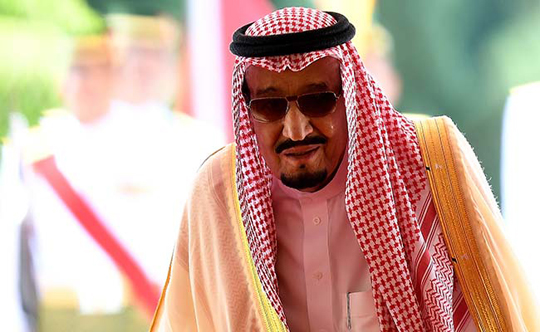
salman

The entourage's total baggage weighs a reported 506 tons.

This week, Salman decided to extend his stay at a luxury resort on the scenic Indonesian island of Bali - perhaps an easy decision - ahead of stops in Japan and China. Salman began his trip in Malaysia, where he oversaw the inking of lucrative oil pacts and was apparently the subject of a foiled assassination attempt before he called on the sultan of Brunei.

The trip has huge implications, both for regional politics and for Washington. The Saudis are deeply aware of the need to diversify their economy, which is heavily dependent on oil exports, and are keen to attract investment from major Asian economies in addition to spreading their own largesse. They also see Southeast Asia, with its huge population of Sunni Muslims, as a realm where they can exert power.

At a time when uncertainty and political paralysis seems to be gripping the West, a pivot to Asia makes a great deal of sense. "There can also be no doubt that the not-too-subtle subtext of the king's tour is a signal that Saudi Arabia will preserve its flexibility when it comes to its dealings with the United States," wrote Gerald Feierstein in Foreign Affairs.

But one arena for Saudi expansion is perhaps surprising: the Maldives, which Salman will visit on the way back to Riyadh. The nation made of Indian Ocean islands may have a tiny population - about 400,000 people - but it is a vast ocean state, spanning some 1,000 kilometers across some of the world's most significant shipping routes. Controversy is swirling there about a reported Saudi plan to invest billions of dollars in Faafu atoll, which comprises 26 islands.

The Maldivian government, led by President Abdulla Yameen, has argued that the deal would lead to infrastructure investment and new housing in a country imperiled by rising sea levels. Critics insist the government is essentially handing a chunk of the country to foreign buyers in order to line its own pockets.

A government statement this week rejected such claims. "The administration categorically rebuts allegations that the atoll has been 'sold off' to a foreign entity," it read. But little has been revealed about the plans for the atoll or the nature of the investment deal.

"I find it very difficult to believe this is a straightforward commercial enterprise," said opposition leader Mohamed Nasheed during a trip to Washington. "Usually you have to have a proper, transparent bidding process, but President Yameen has chosen to do it in the dark."

Nasheed, who lives in exile in London, endured years of imprisonment as a political dissident before helping bring down a three-decade-long dictatorship. He won the Maldives' first free and fair democratic elections in 2008, but his rule was cut short by what most international observers characterized as a coup in 2012.

A tumultuous period followed, in which Nasheed won fresh elections, was thwarted by political opponents and eventually ended up in jail once more on trumped-up charges. The work of an international team of lawyers, including Amal Clooney, won him medical leave last year and led him to claim asylum in Britain.

But Nasheed has not given up the fight, and he said he worries about the corrosive influence the Saudis may have on his country. "It's one thing not to have democracy and freedom of expression, to have a dictator," Nasheed said. "But it's another thing to lose an atoll, to lose sovereignty. I am sure that the Maldivian people are very worried, and they may see how they want to push back these designs."

The disquiet extends beyond simply the Saudi role in the atoll deal. The Maldives is an almost-exclusively Sunni Muslim country. In recent years, a troubling religious radicalization has taken root in what was historically one of the most laissez-faire corners of the Muslim world. An estimated 200 to 300 Maldivians have gone to Syria to join jihadist groups, an astonishing statistic when you consider the size of the nation's population. (If Americans went to Syria in the same proportion, there would be just under 165,000 of them - at minimum.)

Nasheed lays this in part at the feet of the Saudis, who have spent decades spreading their stridently orthodox brand of Islam to other Muslim-majority nations. In Indonesia, the world's most populous Muslim country, a network of Saudi-built schools, mosques and medical facilities has bred both goodwill toward the kingdom and a new generation of adherents to its uncompromising faith. "This very narrow version of Islam favors their authoritarian rule," Nasheed said of the Saudis. "It has been propagated in the Maldives for many years and has created a breeding ground for radical Islam."

The Saudis aren't the only outside power interested in the Maldives. China sees the Maldives as a key linchpin in its vision of a "new maritime Silk Route," threading Chinese energy and trade interests to the Middle East. Beijing has been steadily expanding its footprint in the Indian Ocean and deepening ties with Yameen's government.

Nasheed suggests Beijing may also have a role in the Saudi atoll project and may use its increasing leverage over the Maldives to shoulder aside its regional rival, India. The Maldivian government last year gave a Chinese state-run company a 50-year lease on an uninhabited island near the capital isle, Male.

"We do not want to sit in the middle of a Cold War in between countries," Nasheed said.

But when the mammoth entourage of the Saudi monarch eventually circles over the Maldives' turquoise lagoons, it will be hard not to see the start of a new Great Game in Asia.

Comments

Add new comment

  • Coastaldigest.com reserves the right to delete or block any comments.
  • Coastaldigset.com is not responsible for its readers’ comments.
  • Comments that are abusive, incendiary or irrelevant are strictly prohibited.
  • Please use a genuine email ID and provide your name to avoid reject.
Agencies
July 30,2020

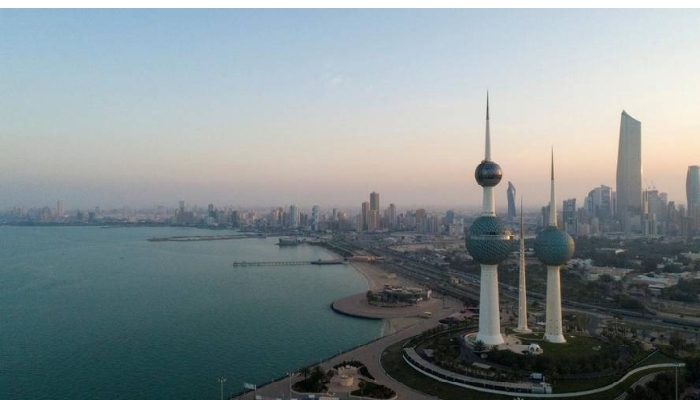
Kuwait will allow citizens and residents to travel to and from the country, starting August 1, the government communication center tweeted on early Thursday, citing a cabinet decision.

The decision excludes residents coming from Bangladesh, Philippines, India, Sri Lanka, Pakistan, Iran, Nepal.

Last month, Kuwait announced it would partially resume commercial flights from August, but does not expect to reach full capacity until a year later, as its aviation sector gradually recovers from a suspension sparked by the Covid-19 crisis.

Comments

Add new comment

  • Coastaldigest.com reserves the right to delete or block any comments.
  • Coastaldigset.com is not responsible for its readers’ comments.
  • Comments that are abusive, incendiary or irrelevant are strictly prohibited.
  • Please use a genuine email ID and provide your name to avoid reject.
News Network
April 28,2020

Riyadh, Apr 28: The number of confirmed coronavirus cases in Saudi Arabia crossed the critical 20,000-mark on Tuesday with the discovery of 1,266 new cases. Eight new deaths were also recorded during the last 24 hours, bringing the virus-related death toll to 152.

Twenty-three percent of the new cases are of Saudi nationals, while 77 percent are of non-Saudi residents, Saudi Press Agency (SPA) quoted the ministry spokesman Dr. Muhammad Al-Abdel Ali as saying.

Out of the total 20,077 cases till Tuesday, 17,141 cases are active, he added. A total of 118 cases are currently critical, the spokesman said.

Out of the 1,266 new cases, 327 were reported in Makkah, 273 in Madinah, 262 in Jeddah, and 171 in Riyadh. There were 58 cases in Jubail, 35 in Dammam, 32 in Taif, 29 in Tabuk and 18 in Al-Zulfi. Additionally, nine cases were recorded in Khulais; eight in Buraidah; seven in Al-Khobar; five in Hufof; four each in Qatif and Ras Tanura; three in Adhum; two each in Al-Jafr, Al-Majaridah, Yanbu, Bisha and Diriyah; and one each in Abha, Khamis Mushayt, Baqeeq, Dhahran, Dhalum, Sabiya, Hafr Al Batin, Hail, Sakaka, Wadi Al-Dawasir and Sajr, the spokesman said.

The Kingdom saw a spike in cases when the health ministry began its field-testing efforts nearly two weeks ago, targeting suspected infection cluster areas. Since then, there has been a steady increase in daily cases.

Till Monday, around 1 million people were screened in various neighborhoods throughout the Kingdom.

Comments

Add new comment

  • Coastaldigest.com reserves the right to delete or block any comments.
  • Coastaldigset.com is not responsible for its readers’ comments.
  • Comments that are abusive, incendiary or irrelevant are strictly prohibited.
  • Please use a genuine email ID and provide your name to avoid reject.
News Network
January 6,2020

Dubai, Jan 6: Iran announced a further rollback of its commitments to the troubled international nuclear accord Sunday amid anger over the US killing of a top commander which also prompted Iraq's parliament to demand the departure of American troops.

While vast crowds gathered in Iran's second city of Mashhad as Qasem Soleimani's remains were returned home, the Tehran government said it would forego the "limit on the number of centrifuges" it had pledged to honour in the 2015 agreement which was already in deep trouble.

The announcement was yet another sign of the fallout from Friday's killing of Soleimani in Baghdad in a drone strike ordered by President Donald Trump, which has inflamed US-Iraqi relations and among the rival camps in Washington.

Iran's 2015 nuclear accord with the United Nations Security Council's five permanent members -- Britain, China, France, Russia and the United States -- plus Germany has been hanging by a thread since the US withdrew unilaterally from it two years ago.

European countries have been pushing for talks with Iran to salvage the deal, inviting Iranian Foreign Minister Mohammed Javad Zarif to Brussels for talks, but the prospect of progress seemed remote after the government's statement on Sunday night.

"Iran's nuclear programme no longer faces any limitation in the operational field", said the statement.

This extends to Iran's capacity for enriching uranium, the level of enrichment carried out, the amount enriched, and other research and development, it said.

"As of now Iran's nuclear programme will continue solely based on its technical needs," it added.

Europe urges Iran to rethink

Until now, Iran has said it needs to enrich uranium up to a level of five percent to produce fuel for electricity generation in nuclear power plants.

Tehran said it would continue cooperating "as before" with the International Atomic Energy Agency but the leaders of Germany, France and Britain reacted by urging Iran to rethink its announcement.

"We call on Iran to withdraw all measures that are not in line with the nuclear agreement," Chancellor Angela Merkel, President Emmanuel Macron and Prime Minister Boris Johnson said in a joint statement.

The European leaders also urged Iran to refrain from taking "further violent actions or support for them."

"It is crucial now to de-escalate. We call on all the players involved to show utmost restraint and responsibility."

The Europeans have been among the chorus of voices urging restraint in the aftermath of the drone strike which killed Soleimani, the veteran commander of the Revolutionary Guards' foreign operations.

But as his remains were paraded through the streets of Mashhad, cries of "Revenge, Revenge" echoed through the streets while mourners threw scarves onto the roof of the truck carrying his coffin.

Soleimani's remains had been returned before dawn to the southwestern city of Ahvaz, where the air resonated with Shiite chants and shouts of "Death to America".

Some 5,200 US soldiers are currently stationed across Iraqi bases to support local troops preventing a resurgence of the Islamic State jihadist group.

But the government could be poised to demand they leave after a vote in the Baghdad parliament where caretaker prime minister Adel Abdel Mahdi joined 168 lawmakers -- just enough for quorum -- to discuss a motion to force US troops.

"The parliament has voted to commit the Iraqi government to cancel its request to the international coalition for help to fight IS," speaker Mohammed Halbusi announced.

The cabinet would have to approve any decision but the premier indicated support for an ouster in his speech.

'Iraqi people want the US'

US Secretary of State Mike Pompeo reacted by saying he would "take a look at what we do when the Iraqi leadership and government makes a decision" but indicated that he felt American troops were still welcome.

"We are confident that the Iraqi people want the United States to continue to be there to fight the counterterror campaign," Pompeo said on Fox News.

Two rockets hit near the US embassy in Baghdad late Sunday, the second night in a row that the Green Zone was hit and the 14th time over the last two months that US installations have been targeted.

Pompeo defended the decision to kill Soleimani while insisting that any further US military action against Iran would conform to international law.

Trump triggered accusations that he had threatening a war crime by declaring cultural sites as potential targets in a Tweet on Saturday night.

Zarif drew parallels with the Islamic State group's destruction of the Middle East's cultural heritage following Trump's tweets that sites which were "important to... Iranian culture" were on a list of 52 potential US targets.

"We'll behave lawfully," Pompeo told the ABC network.

House Speaker Nancy Pelosi has been leading the backlash against the Soleimani strike, an operation that Trump only officially informed Congress about after the event.

But Trump made light of the calls for him to get Congressional approval in the future, saying such notice was "not required" -- and then saying his tweet would serve as prior notification if he did decide to strike against Iran again.

"These Media Posts will serve as notification to the United States Congress that should Iran strike any US person or target, the United States will quickly & fully strike back, & perhaps in a disproportionate manner," Trump wrote.

Comments

Add new comment

  • Coastaldigest.com reserves the right to delete or block any comments.
  • Coastaldigset.com is not responsible for its readers’ comments.
  • Comments that are abusive, incendiary or irrelevant are strictly prohibited.
  • Please use a genuine email ID and provide your name to avoid reject.