


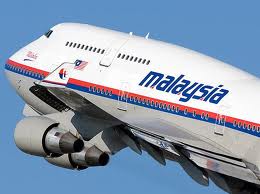
Search resumes for missing Malaysian jetliner

March 9, 2014
Kuala Lumpur, Mar 9: Planes and ships from across Asia resumed the hunt on Sunday for the Malaysian jetliner missing with 239 people on board for more than 24 hours, while Malaysian aviation authorities investigated how two passengers were apparently able to get on the aircraft using stolen passports.

airlines

There was still no confirmed sighting of wreckage from the Boeing 777 in the seas between Malaysia and Vietnam where it vanished from screens early Saturday morning en route to Beijing from Kuala Lumpur. The weather was fine, the plane was already cruising and the pilots had no time to send a distress signal in unusual circumstances for a modern jetliner to crash.

Li Jiaxiang, administrator of the Civil Aviation Administration of China, said some debris had been spotted, but it was unclear whether it came from the plane. Vietnamese authorities said they had seen nothing close to two large oil slicks they saw Saturday and said might be from the missing plane.

Malaysia's civil aviation chief Azaharuddin Abdul Rahman said his country had expanded its area of operation to the west coast of peninsular Malaysia, on the other side of the country from where the plane disappeared. “This is standard procedure. If we can't find it here, we go to other places,” he said.

Finding traces of an aircraft that crashes over sea can take days or longer, even with a sustained search effort. Depending on the circumstances of the crash, wreckage can be scattered over many square kilometers (miles). If the plane enters the water before breaking up, there can be relatively little debris.

Investigators will need access to the flight data recorders to determine what happened. Terrorism is always considered a possibility, but the sudden disappearance of Flight MH370 has given extra emphasis to speculation a bomb might have been on board.

On Saturday, foreign ministries in Italy and Austria said the names of two citizens listed on the flight's manifest matched the names on two passports reported stolen in Thailand. It's unclear how common it is for people to get on flights with fake passports, but the news added to fears of terrorism.

Azaharuddin said Sunday that authorities were “aware of the situation and we are doing an investigation at the moment.”

Just 9 percent of fatal accidents happen when a plane is at cruising altitude, according to a statistical summary of commercial jet accidents done by Boeing. Malaysia Airlines CEO Ahmad Jauhari Yahya said Saturday there was no indication the pilots had sent a distress signal.

The lack of a radio call “suggests something very sudden and very violent happened,” said William Waldock, who teaches accident investigation at Embry-Riddle Aeronautical University in Prescott, Ariz.

The plane was last inspected 10 days ago and found to be “in proper condition,” Ignatius Ong, CEO of Malaysia Airlines subsidiary Firefly airlines, said at a news conference.

Two-thirds of the jet's passengers were from China. The rest were from elsewhere in Asia, North America and Europe.

Asked whether terrorism was suspected, Malaysian Prime Minister Najib Razak said authorities were “looking at all possibilities, but it is too early to make any conclusive remarks.”

The South China Sea is a tense region with competing territorial claims that have led to several low-level conflicts, particularly between China and the Philippines. That antipathy briefly faded Saturday as China, the Philippines, Vietnam, Singapore and Malaysia all sent ships and planes to the region.

Malaysia had dispatched 15 planes and nine ships to the area. The U.S. Navy was sending a warship and a surveillance plane, while Singapore said it would send a submarine and a plane. China and Vietnam also sent aircraft to help in the search.

Malaysia Airlines has a good safety record, as does the 777, which had not had a fatal crash in

its 19—year history until an Asiana Airlines plane crashed last July in San Francisco, killing three passengers, all teenagers from China.

Comments

Add new comment

  • Coastaldigest.com reserves the right to delete or block any comments.
  • Coastaldigset.com is not responsible for its readers’ comments.
  • Comments that are abusive, incendiary or irrelevant are strictly prohibited.
  • Please use a genuine email ID and provide your name to avoid reject.
News Network
June 9,2020

Washington, Jun 9: When epidemiologists talked about "flattening the curve," they probably didn't mean it this way: the US hit its peak coronavirus caseload in April, but since that time the graph has been on a seemingly unending plateau.

That's unlike several other hard-hit countries which have successfully pushed down their numbers of new cases, including Spain and Italy, which now have bell-shaped curves.

Experts say the prolonged nature of the US epidemic is the result of the cumulative impact of regional outbreaks, as the virus that started out primarily on the coasts and in major cities moves inward.

Layered on top of that are the effects of lifting lockdowns in parts of the country that are experiencing rising cases, as well as a lapse in compliance with social distancing guidelines because of economic hardship, and in some cases a belief that the threat is overstated.

"The US is a large country both in geography and population, and the virus is at very different stages in different parts of the country," Tom Frieden, a former director of the Centers for Disease Control and Prevention told AFP.

The US saw more than 35,000 new cases for several days in April. While that figure has declined, it has still been exceeding 20,000 regularly in recent days.

By contrast, Italy was regularly hitting more than 5,000 cases per day in March but is currently experiencing figures in the low hundreds.

"We did not act quickly and robustly enough to stop the virus spreading initially, and data indicate that it travelled from initial hotspots along major transport routes into other urban and rural areas," added Frieden, now CEO of the non-profit Resolve to Save Lives.

To wit: the East Coast states of New York, New Jersey and Massachusetts accounted for about 50 percent of all cases until about a month or so ago -- but now the geographic footprint of the US epidemic has shifted to the Midwest and southeast, including Florida.

Another key problem, said Jennifer Nuzzo, an epidemiologist at Johns Hopkins, is that the United States is still not doing enough testing, contact tracing and isolation.

After coming late to the testing party -- for reasons ranging from technical issues to regulatory hurdles -- the US has now conducted more COVID-19 tests than any other country.

It even has one of the highest per capita rates per country of 62 per 1,000 people, according to the website ourworldindata.org -- better than Germany (52 per 1,000) and South Korea (20 per 1,000).

But according to Nuzzo, these numbers are misleading, because "the amount of testing that a country should do should be scaled to the size of its epidemic.

"The United States has the largest epidemic in the world so obviously we need to do a lot more testing than any other country."

For Johns Hopkins, the more important metric is the positivity rate -- that is, out of all tests conducted, how many came back positive for COVID-19.

As of June 7, the United States had an average daily positivity rate of 14 percent, well above the World Health Organization guideline of 5 percent over two weeks before social distancing guidelines should be relaxed.

By contrast, Germany, which has tested far fewer people in relation to its population, has a positivity rate of 5 percent.

Even if testing were scaled up, carrying out tests in of itself does very little good without the next steps -- finding out who was exposed and then asking them to isolate.

Here also, too many US states are lagging woefully behind.

Texas, which is experiencing a surge in cases after relaxing its lockdown, is a case in point. The state targeted hiring a modest 4,000 tracers by June, but according to local reports is still more than a thousand shy of even that goal.

Opt-in app based efforts have also been slow to get off the ground.

Then there is the fact that some people are growing tired of lockdowns, while others don't have the economic luxury of being able to stay home for prolonged periods.

The government sent some 160 million Americans a single stimulus check of up to $1,200 back in April but it's not clear whether more will be forthcoming.

Still others, particularly in so-called red states under Republican leadership, have chafed under restrictions and mask-wearing guidelines that they see as an affront to their personal freedom.

"The US is kind of on the extreme of the individual liberty side," Sten Vermund, dean of the Yale School of Public Health, told AFP.

Part of this has to do with mixed messaging from Republican leaders, including President Donald Trump, said Nuzzo.

"We have had at the highest political level an assertion that this is a situation that's been overblown, and that maybe certain protective behaviors are not necessary," she said.

More recently, tens of thousands of people across the country have taken to the streets to protest the killing on an unarmed black man by police, risking coronavirus infection to demonstrate against the public health threat of racialized state violence.

Comments

Add new comment

  • Coastaldigest.com reserves the right to delete or block any comments.
  • Coastaldigset.com is not responsible for its readers’ comments.
  • Comments that are abusive, incendiary or irrelevant are strictly prohibited.
  • Please use a genuine email ID and provide your name to avoid reject.
News Network
March 29,2020

Beijing, Mar 29: In a rare display of public anger in China, dozens of people in central Hubei province, the epicentre of the coronavirus outbreak till recently, attacked official vehicles after they were stopped from crossing a bridge and travel to neighbouring Jiangxi after the lifting of the lockdown.
Hubei province with over 56 million people was kept under lockdown from January 23 as part of aggressive measures to bring down COVID-19 cases which rapidly spread in the area.

Videos on Chinese social media on Friday showed unprecedented scenes of police from Hubei and Jiangxi clashing on the bridge connecting the two provinces over barricades erected from stopping Hubei people from moving out over fears of coronavirus spreading.

Policemen from both sides argued over how to verify if people were allowed to enter Jiangxi, according to local media reports.

It was a major relief for millions of people in Hubei province, when the Chinese government which kept it under lockdown lifted the restrictions on travel.

The government will permit people from the province to travel if they hold a green health code, meaning no contact with any infected or suspected COVID-19 cases.

But people of Hubei to their shock on Friday found roadblocks on the 1st Yangtze River Bridge that separates Huangmei county in Hubei erected by Huangmei county of Jiangxi province.

In local media reports, witnesses were quoted as saying that Huangmei police in Jiujiang erected roadblocks on the bridge to stop people from Hubei from crossing it, a move they alleged stigmatised them.

Video footage shared online showed rows of police armed with riot shields holding back the crowds, while members of the public could be seen damaging and even overturning police vehicles.

In a clip published by the Huanggang city government, which administers Huangmei, the county's Communist Party chief Ma Yanzhou could be heard speaking to the people through a loud hailer, warning them that by gathering in a large group they were increasing their chances of contracting the virus, Hong Kong-based South China Morning Post reported.

While it is unclear exactly how the clash started, police from the two sides published separate official statements online, which were quickly deleted, it said.

The incident underlines the problems China faces as it seeks a return to normalcy after months of lockdown, the Post said.

After the incident, the governments of Huangmei and Jiujiang on Friday issued a joint statement saying they had agreed to remove the barriers set up to restrict travel during the lockdown, and also to recognise each other's health screening codes to make it easier for people in good health to get to where they needed to be, the Post report said.

An article by the ruling Communist Party of China (CPC) mouthpiece, People''s Daily acknowledged the problems in getting the country back on its feet.

"In the past few days, all walks of life have called for governments to accept workers from Hubei," it said.

"However, it is undeniable that some places, intentionally or not, have set up obstacles for Hubei migrant workers to return to their posts and hold prejudices against them."

Comments

Add new comment

  • Coastaldigest.com reserves the right to delete or block any comments.
  • Coastaldigset.com is not responsible for its readers’ comments.
  • Comments that are abusive, incendiary or irrelevant are strictly prohibited.
  • Please use a genuine email ID and provide your name to avoid reject.
Agencies
February 26,2020

Islamabad, Feb 26: Islamabad on Tuesday declared former Prime Minister Nawaz Sharif an absconder while simultaneously denying extending bail to him.

The federal cabinet presided over by Prime Minister Imran Khan, cited that Sharif failed to provide required medical reports and has violated the bail terms.

The government has also decided to freeze gas and electricity tariffs for the next four months, The Dawn reported.

"After Nawaz Sharif failed to submit his medical report of any hospital in London, the medical board rejected a medical certificate sent by him and [the government] declared him an absconder. From today, Nawaz Sharif is an absconder according to the law of land and if he does not return to the country he will be declared a proclaimed offender," said Dr Firdous Ashiq Awan, Special Assistant to the Prime Minister on Information, in a press conference.

She further asserted that the Punjab government, which was authorized by the Islamabad High Court (IHC) to decide Sharif's case on medical grounds, had written several letters asking him to submit his medical report from any hospital in London. However, he failed to do so and only sent a certificate that was not accepted by the medical board.

"If he (Nawaz Sharif) is seriously ill then why a comprehensive medical report is not being submitted to the medical board," Firdous added.

Further, she said that the office of the opposition leader was also waiting for his younger brother and Leader of the Opposition in the National Assembly Shahbaz Sharif, who was also staying in London for 'no reason'.

"He is getting a monthly salary and enjoying luxurious offices and other perks and privileges but not performing his duties required by his office and the people. Shahbaz Sahib, return to the country and justify your salary and other benefits being given from taxpayers' money," Firdous added.

On October 29 last year, the IHC granted bail for eight weeks to Sharif, who was convicted and disqualified in corruption cases, on medical grounds.

Sharif left Pakistan for London along with Shahbaz on November 19, 2019, for his medical treatments there.

Comments

Add new comment

  • Coastaldigest.com reserves the right to delete or block any comments.
  • Coastaldigset.com is not responsible for its readers’ comments.
  • Comments that are abusive, incendiary or irrelevant are strictly prohibited.
  • Please use a genuine email ID and provide your name to avoid reject.