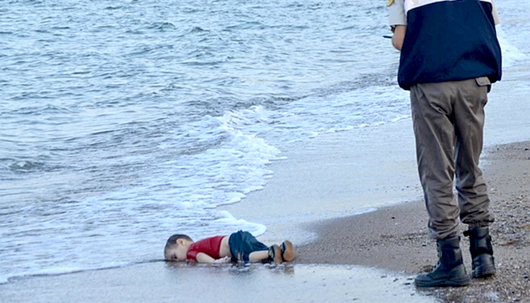
Shocking image of dead child washed up on Turkish beach lays bare Europe's migrant crisis

September 3, 2015

Ankara, Sep 3: An image of a drowned toddler washed up on the beach in one of Turkey's prime tourist resorts swept across social media on Wednesday, after at least 12 presumed Syrian refugees died trying to reach the Greek island of Kos.

child

The picture showed a little boy wearing a bright red t-shirt and shorts lying face-down in the surf on a beach near the resort town of Bodrum. In a second image, a grim-faced policeman carries the tiny body away.

The hashtag "KiyiyaVuranInsanlik" - "humanity washed ashore" - became the top trending topic on Twitter after the picture was retweeted heavily.

The two boats, carrying a total of 23 people, had set off separately from the Akyarlar area of the Bodrum peninsula, a senior Turkish naval official said.

The confirmed dead included five children and one woman. Seven people were rescued and two reached the shore in lifejackets. The official said hopes were fading of saving the two people still missing.

Television images showed the lifeless body of a small boy dressed in a red t-shirt and blue shorts lying face-down on the sand in Bodrum, one of Turkey's most popular beach resorts.

Tens of thousands of Syrians fleeing the war in their homeland have descended on Turkey's Aegean coast this summer to board boats to Greece, their gateway to the European Union.

The official said almost 100 people in all had been rescued by Turkish vessels overnight as they tried to reach Kos.

Aid agencies estimate that, over the past month, about 2,000 people a day have been making the short crossing to Greece's eastern islands on rubber dinghies.

A ship bringing about 1,800 migrants and refugees from one of the islands arrived at the port of Piraeus near Athens on Tuesday night, the Greek coastguard said.

Thousands of people, mainly Africans, have also been trying to reach Europe via boat from Libya to Italy. The United Nations refugee agency UNHCR said four bodies had been pulled from the central Mediterranean on Tuesday and 781 migrants rescued, mostly from Nigeria, Ivory Coast and Senegal.

So far this year, more than 2,500 people have died trying to cross the Mediterranean, the UNHCR said.

Comments

Add new comment

  • Coastaldigest.com reserves the right to delete or block any comments.
  • Coastaldigset.com is not responsible for its readers’ comments.
  • Comments that are abusive, incendiary or irrelevant are strictly prohibited.
  • Please use a genuine email ID and provide your name to avoid reject.
Agencies
June 7,2020

Moscow, Jun 7: OPEC, Russia and allies agreed on Saturday to extend record oil production cuts until the end of July, prolonging a deal that has helped crude prices double in the past two months by withdrawing almost 10% of global supplies from the market.

The group, known as OPEC+, also demanded countries such as Nigeria and Iraq, which exceeded production quotas in May and June, compensate with extra cuts in July to September.

OPEC+ had initially agreed in April that it would cut supply by 9.7 million barrels per day (bpd) during May-June to prop up prices that collapsed due to the coronavirus crisis. Those cuts were due to taper to 7.7 million bpd from July to December.

“Demand is returning as big oil-consuming economies emerge from pandemic lockdown. But we are not out of the woods yet and challenges ahead remain,” Saudi Energy Minister Prince Abdulaziz bin Salman told the video conference of OPEC+ ministers.

Benchmark Brent crude climbed to a three-month high on Friday above $42 a barrel, after diving below $20 in April. Prices still remain a third lower than at the end of 2019.

“Prices can be expected to be strong from Monday, keeping their $40 plus levels,” said Bjornar Tonhaugen from Rystad Energy.

Saudi Arabia, OPEC’s de facto leader, and Russia have to perform a balancing act of pushing up oil prices to meet their budget needs while not driving them much above $50 a barrel to avoid encouraging a resurgence of rival U.S. shale production.

It was not immediately clear whether Saudi Arabia, the United Arab Emirates and Kuwait would extend beyond June their additional, voluntary cuts of 1.18 million bpd, which are not part of the deal.

BULGING INVENTORIES

The April deal was agreed under pressure from U.S. President Donald Trump, who wants to avoid U.S. oil industry bankruptcies.

Trump, who previously threatened to pull U.S. troops out of Saudi Arabia if Riyadh did not act, spoke to the Russian and Saudi leaders before Saturday’s talks, saying he was happy with the price recovery.

While oil prices have partially recovered, they are still well below the costs of most U.S. shale producers. Shutdowns, layoffs and cost cutting continue across the United States.

“I applaud OPEC-plus for reaching an important agreement today which comes at a pivotal time as oil demand continues to recover and economies reopen around the world,” U.S. Energy Secretary Dan Brouillette wrote on Twitter after the extension.

As global lockdowns ease, oil demand is expected to exceed supply sometime in July but OPEC has yet to clear 1 billion barrels of excess oil inventories accumulated since March.

Rystad’s Tonhaugen said Saturday’s decisions would help OPEC reduce inventories at a rate of 3 million to 4 million bpd in July-August. “The quicker stocks fall, the higher prices will get,” he said.

Nigeria’s petroleum ministry said Abuja backed the idea of compensating for its excessive output in May and June.

Iraq, with one of the worst compliance rates in May, agreed to extra cuts although it was not clear how Baghdad would reach agreement with oil majors on curbing Iraqi output.

Iraq produced 520,000 bpd above its quota in May, while overproduction by Nigeria was 120,000 bpd, Angola’s was 130,000 bpd, Kazakhstan’s was 180,000 bpd and Russia’s was 100,000 bpd, OPEC+ data showed.

OPEC+’s joint ministerial monitoring committee, known as the JMMC, will meet monthly until December to review the market, compliance and recommend levels of cuts. JMMC’s next meeting is scheduled for June 18.

OPEC and OPEC+ will hold their next scheduled meetings on Nov. 30-Dec. 1.

Comments

Add new comment

  • Coastaldigest.com reserves the right to delete or block any comments.
  • Coastaldigset.com is not responsible for its readers’ comments.
  • Comments that are abusive, incendiary or irrelevant are strictly prohibited.
  • Please use a genuine email ID and provide your name to avoid reject.
News Network
June 16,2020

Beijing, Jun 16: The coronavirus situation in China's capital is "extremely severe", a city official warned Tuesday, as 27 new infections were reported from Beijing where a new cluster has sparked a huge trace-and-test programme.

The COVID-19 resurgence -- believed to have started at the sprawling Xinfadi wholesale food market in the capital -- has sparked alarm as China had largely brought its outbreak under control through mass testing and lockdowns imposed earlier in the year.

The new cases took the number of confirmed infections in Beijing over the past five days to 106, as authorities locked down almost 30 communities in the city and tested tens of thousands of people.

"The epidemic situation in the capital is extremely severe," Beijing city spokesman Xu Hejian warned at a press conference.

The World Health Organization had already expressed concern about the cluster, pointing to Beijing's size and connectivity.

Officials in the capital have said they will test stall owners and managers at all of the city's food markets, restaurants and government canteens.

Beijing's coronavirus testing capacity has been expanded to 90,000 a day, according to China's official news agency Xinhua.

On Tuesday, the capital's transport commission banned taxi- and ride-hailing services from driving out of the city, Xinhua reported, in another move to try and contain the new outbreak.

All indoor sports and entertainment venues in Beijing were ordered to shut on Monday, and some other cities across China warned they would quarantine those arriving from the capital.

The National Health Commission also reported four new domestic infections in Hebei province, which surrounds Beijing, and a case reported in southwestern Sichuan province was linked to the Beijing cluster.

Authorities were also racing to track people from Beijing who had travelled to other parts of China, and those who visited the capital have been encouraged to get tested.

Beijing spokesman Xu said: "High-risk people who have left Beijing must inform local authorities immediately."

Market inspections

Authorities shut down another market on Tuesday -- Tiantaohonglian in the central Xicheng district -- after one employee there was diagnosed with COVID-19, state broadcaster CCTV reported.

Seven residential estates surrounding that market were also locked down.

In total, Beijing officials said Tuesday they have disinfected 276 agricultural markets, closed 11 markets, and disinfected more than 33,000 food and beverage businesses in a bid to stamp out the new cluster.

Officials had warned Sunday that since May 30, 200,000 people had visited the Xinfadi market -- the original site of the new outbreak.

More than 8,000 workers from Xinfadi have been tested and sent to centralised quarantine facilities.

Until this recent outbreak, most of China's cases in recent months were nationals returning home as the pandemic spread to other countries.

China's Center for Disease Control and Prevention said Monday that the virus strain found in the Beijing outbreak was a "major epidemic strain in the European countries".

While the virus was detected on chopping boards used to handle imported salmon at Xinfadi, "it does not clearly or definitely indicate it's from imported seafood", Wu Zunyou, the body's chief epidemiologist, said in an interview with state broadcaster CCTV.

"Ever since new cases suddenly emerged in Beijing, we have tried to figure out the reasons for the outbreak since there were no COVID-19 cases found over the past two months," Wu Zunyou said.

"We came up with several possibilities, and the most likely one is that the carrier of the novel coronavirus comes from outside China or other parts of China and brought it here."

On Tuesday, another eight imported cases were reported.

Comments

Add new comment

  • Coastaldigest.com reserves the right to delete or block any comments.
  • Coastaldigset.com is not responsible for its readers’ comments.
  • Comments that are abusive, incendiary or irrelevant are strictly prohibited.
  • Please use a genuine email ID and provide your name to avoid reject.
News Network
January 6,2020

Sydney, Jan 6: Reserve troops fanned out across fire-ravaged regions in three Australian states on Monday after a horror weekend, as the government pledged $1.4 billion over two years to help recover from the devastating months-long crisis.

Catastrophic bushfires have turned swathes of land into smouldering, blackened hellscapes and destroyed an area about the size of the island of Ireland, according to official figures, with authorities warning the disaster still has weeks or months to run.

Prime Minister Scott Morrison, whose government has been criticised for its slow response to the emergency, pledged Australian $2 billion ($1.4 billion) of taxpayer money for a national recovery fund.

"It's a long road ahead and we will be with these communities every step of the way as they rebuild," Morrison said.

Firefighters joined by fresh teams from the US and Canada were taking advantage of rainy and cooler conditions to tackle out-of-control blazes ahead of rising temperatures forecast later this week.

In the biggest-ever call up of reserves, military teams were deployed across eastern Australia to help emergency services assess the damage, restore power and deliver supplies of food, water and fuel to cut-off communities.

For the first time in Australian history the government also deployed its medical assistance team, normally sent to other nations to lend support in the aftermath of their disasters to help evacuees.

"There is no room for complacency, especially as we have over 130 fires burning across (New South Wales) state still," Premier of New South Wales state Gladys Berejiklian said on Monday.

New normal

Almost five million hectares (50,000 square kilometres) have been razed across New South Wales and more than 1.2 million hectares in Victoria since late September, officials said.

That took the total amount of land burnt close to eight million hectares, around the size of the island of Ireland or South Carolina.

Twenty-four people have lost their lives so far, with over 1,800 homes damaged.

Two people are missing in New South Wales, the nation's most populous state.

In Victoria, Premier Daniel Andrews established a bushfire recovery agency to help devastated towns. It will be a permanent body, he said, as intense fires will become commonplace.

"We should just be honest about the fact that we're going to see more and more fires, more and more damage as each fire season comes... this is the new normal," Andrews told reporters.

The chair of the newly established Victoria state's bushfire appeal fund, Pat McNamara, added that this year's summer bushfire season was a "creeping disaster".

"We're still not even into what we would regard as the peak of the fire season," McNamara told national broadcaster ABC.

In the usually picturesque southeastern town of Eden, Holly Spence said she spent more than 12 hours defending her family's farm on Saturday, less than a week after saving it on New Year's Eve.

"We don't want to go through this for a third time," the 28-year-old told AFP.

Fiona Kennelly, 50, who evacuated with 24 members of her extended family to a motel outside Eden, said she was relieved the easing conditions allowed them to get some respite from the crisis.

"It's good to see daylight at the right time again," she told AFP, adding that the skies had been turning pitch-black in the afternoons.

Public anger

The impact of the bushfires has spread beyond affected communities, with heavy smoke engulfing the country's second-largest city Melbourne and the national capital Canberra.

Some government departments were shut in Canberra as the city's air quality was once-again ranked the world's poorest, according to independent online air-quality index monitor Air Visual.

The disaster has sparked growing public anger with Morrison. Rallies are planned on Friday to call on his government to step up efforts to tackle climate change, which experts say have helped fuel the fires.

In Los Angeles, Hollywood superstar Russell Crowe said he was back home fighting the fires and that the disaster was "climate change-based".

"We need to act on science, move our global workforce to renewable energy and respect our planet for the unique and amazing place it is. That way, we all have a future," he said in a message read out by Jennifer Aniston.

Australian actress Cate Blanchett praised the volunteer firefighters battling the blazes, adding: "When one country faces a climate disaster, we all face a climate disaster. We're in it together."


Comments

Add new comment

  • Coastaldigest.com reserves the right to delete or block any comments.
  • Coastaldigset.com is not responsible for its readers’ comments.
  • Comments that are abusive, incendiary or irrelevant are strictly prohibited.
  • Please use a genuine email ID and provide your name to avoid reject.