


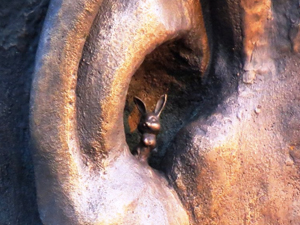
South Africa orders removal of rabbit from Mandela statue's ear

January 23, 2014

South_AfricaJohannesburg, Jan 22: The South African government has ordered the removal of a rabbit that was secretly sculpted into a recently unveiled statue of Nelson Mandela, an official said today.

The artists who built the nine metre (30-foot), bronze colossus in Pretoria, added a rabbit into the ear of the statue, without clearance from government.

"We want to restore the integrity of the sculpture as soon as possible," Mogomotsi Mogodiri, spokesman for the ministry of arts and culture said.

The government said it was unaware of the rabbit's existence until a local newspaper brought it to their attention.

The two bronze sculptors -- Andre Prinsloo and Ruhan Janse van Vuuren -- who added the mammal as their 'signature' of the work, have apologised for doing so without permission.

"We accepted their apology," Mogodiri said, adding it was unclear how long it would take to extract the rabbit from the statue's ear.

The boss of the company that was contracted by government to erect the statue, which in turn hired the two artists, said the artists' action was "regrettable" and akin to a "senseless prank".

Dali Tambo, chairman of Koketso Growth said it had from the beginning been decided against engraving the statue.

But the names of the artists were going to be installed at a plaque near the statue.

"It is regrettable that the artists chose this way of expressing their opinion about not signing the sculpture," said Tambo, who is also the son of one of the leading anti-apartheid politicians, Oliver Tambo.

Built at a cost of eight million rand (about $740,000), the 4.5-tonne sculpture is the largest of Mandela statues erected around the world.

It was unveiled just a day after Mandela was buried.

Mandela, who became South Africa's first black president after 27 years in apartheid prisons, died on December 5, 2013 at the age of 95.


Mandela_statues_ear

Comments

Add new comment

  • Coastaldigest.com reserves the right to delete or block any comments.
  • Coastaldigset.com is not responsible for its readers’ comments.
  • Comments that are abusive, incendiary or irrelevant are strictly prohibited.
  • Please use a genuine email ID and provide your name to avoid reject.
Agencies
April 4,2020

Kozhikode, Apr 4: In a bid to maintain the lockdown amid COVID-19 outbreak, Police in Kozhikode is monitoring the situation using drone cameras and making sure that people are not breaking the law.

The police have so far arrested 41 persons who were out on a morning walk on Saturday during the lockdown in the backdrop of coronavirus outbreak.

The SHO of Town South Police Station informed that the accused were later released on bail.
At least 295 cases have been reported in the state so far.

Talking about COVID-19 testing, State Health Minister KK Shailaja told media: "Nine labs are conducting polymerase chain reaction (PCR) tests in Kerala. We've received 2000 rapid test kits and will start rapid tests from tomorrow. If a person tests positive in rapid test, we need to confirm it with PCR test."

The total number of COVID-19 positive cases in India climbed to 3072 on Saturday, according to Ministry of Health and Family Welfare.

Comments

Add new comment

  • Coastaldigest.com reserves the right to delete or block any comments.
  • Coastaldigset.com is not responsible for its readers’ comments.
  • Comments that are abusive, incendiary or irrelevant are strictly prohibited.
  • Please use a genuine email ID and provide your name to avoid reject.
Agencies
January 19,2020

New Delhi, Jan 19: Messaging service WhatsApp which on Sunday faced issues in transmitting multimedia content including pictures and images, prompting social media users to share hilarious memes and messages, resumed regular services after over two hours.

#WhatsAppDown was the trending hashtag on Twitter for most part of Sunday afternoon in India along with several other countries such as Brazil, Europe and also parts of Middle-East including UAE, reported downdetector.in, a realtime problem and outage monitoring website.

Users of the popular messaging app were unable to send media files, stickers and GIFs.

Most users immediately went to Twitter to find out about the problem and check if others were facing the same issue.

Numerous tweets and memes took over the internet as soon as the news broke about the WhatsApp tech issue. After around two hours of technical glitch, the app resumed full service.

Even after full recovery of media transfer, people globally still continued checking the status of the messaging app.

WhatsApp has been one of the prime messaging apps since May 2009 and has recently collaborated with Facebook.

Comments

Add new comment

  • Coastaldigest.com reserves the right to delete or block any comments.
  • Coastaldigset.com is not responsible for its readers’ comments.
  • Comments that are abusive, incendiary or irrelevant are strictly prohibited.
  • Please use a genuine email ID and provide your name to avoid reject.
Agencies
January 3,2020

Giving each and every app access to personal information stored on Android smartphones such as your contacts, call history, SMS and photos may put you in trouble as bad actors can easily use these access to spy on you, send spam messages and make calls anywhere at your expense or even sign you up for a premium "service", researchers from cybersecurity firm Kaspersky have warned.

But one can restrict access to such information as Android lets you configure app permissions. 

Giving an app any of these permissions generally means that from now on it can obtain information of this type and upload it to the Cloud without asking your explicit consent for whatever it intends to do with your data.

Therefore, security researchers recommend one should think twice before granting permissions to apps, especially if they are not needed for the app to work. 

For example, most games have no need to access your contacts or camera, messengers do not really need to know your location, and some trendy filter for the camera can probably survive without your call history, Kaspersky said. 

While decision to give permission is yours, the fewer access you hand out, the more intact your data will be.

Here's what you should know to protect your data.

SMS: An app with permission to send and receive SMS, MMS, and WAP (Wireless Application Protocol) push messages, as well as view messages in the smartphone memory will be able to read all of your SMS correspondence, including messages with one-time codes for online banking and confirming transactions.

Using this permission, the app can also send spam messages in your name (and at your expense) to all your friends. Or sign you up for a premium "service." You can see and conrol which apps have these rights by going to the settings of your phone.

Calendar: With permission to view, delete, modify, and add events in the calendar, prying eyes can find out what you have done and what you are doing today and in the future. Spyware loves this permission.

Camera: Permission to access the camera is necessary for the app to take photos and record video. But apps with this permission can take a photo or record a video at any moment and without warning. Attackers armed with embarrassing images and other dirt on you can make life a misery, according to Kaspersky.

Contacts: With permission to read, change, and add contacts in your address book, and access the list of accounts registered in the smartphone, an app can send your entire address book to its server. Even legitimate services have been found to abuse this permission, never mind scammers and spammers, for whom it is a windfall.

This permission also grants access to the list of app accounts on the device, including Google, Facebook, and many other services.

Phone: Giving access to your phone means permission to view and modify call history, obtain your phone number, cellular network data, and the status of outgoing calls, add voicemail, access IP telephony services, view numbers being called with the ability to end the call or redirect it to another number and call any number.

This permission basically lets the app do anything it likes with voice communication. It can find out who you called and when or prevent you from making calls (to a particular number or in general) by constantly terminating calls. 

It can eavesdrop on your conversations or, of course, make calls anywhere at your expense, including to pay-through-the-nose numbers, Kaspersky warned.

Comments

Add new comment

  • Coastaldigest.com reserves the right to delete or block any comments.
  • Coastaldigset.com is not responsible for its readers’ comments.
  • Comments that are abusive, incendiary or irrelevant are strictly prohibited.
  • Please use a genuine email ID and provide your name to avoid reject.