



Symbolic 'Doomsday Clock' moves closer to midnight

January 27, 2017

Washington, Jan 27: Comments by US President Donald Trump on nuclear weapons and climate change have helped make the world less safe, the Bulletin of the Atomic Scientists warned on Thursday, moving its symbolic "Doomsday Clock" 30 seconds closer to midnight.
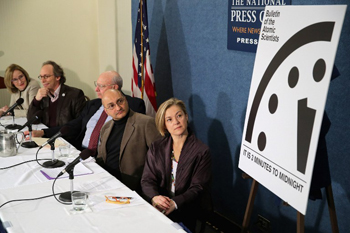
doomsdayThe clock which serves as a metaphor for how close humanity is to destroying the planet was last changed in 2015, from five to three minutes before midnight.

It is now set at two and a half minutes to midnight, amid concerns about "a rise in strident nationalism worldwide, President Donald Trump's comments on nuclear arms and climate issues, a darkening global security landscape that is colored by increasingly sophisticated technology, and a growing disregard for scientific expertise," said a statement by the group of scientists and intellectuals, including 15 Nobel laureates.

Trump has made contradictory statements about climate change, at times calling it a hoax and other times saying he would keep an open mind about it.

On the nuclear issue, Trump said in December that the US must build up its nuclear arsenal+ .

Responding to a statement by Russian President Vladimir Putin that Moscow needs to strengthen its own nuclear force, Trump responded with a tweet: "The United States must greatly strengthen and expand its nuclear capability until such time as the world comes to its senses regarding nukes."

"The Doomsday Clock is closer to midnight than it has ever been in the lifetime of almost everyone in this room," Lawrence Krauss, chair of the Bulletin's board of sponsors, told reporters at the National Press Club in Washington.

"The last time it was closer was 63 years ago in 1953 after the then Soviet Union exploded its first hydrogen bomb, creating the modern arms race," he added.

"More than that, this is the first time that the words and stated policies of one or two people placed in high positions have so impacted on our perception of the existential threats we believe the world faces," he said, alluding to Trump and Putin.

Krauss cited intelligence reports that accuse Russia of interfering with the US presidential campaign to favor Trump's victory as symbolic of the "deeper global threat" posed by cybertechnology.

"The question of whether the fabric of democracy may be imperiled by reducing faith in both the integrity of election and the very information on which an informed public can base their voting becomes suspect," said Krauss, a theoretical physicist at Arizona State University.

He also said the bulletin "is extremely concerned about the willingness of governments — including the current US administration — to ignore or discount some science or evidence during their decision-making process."

Last year, the warmest year in modern times due to human-driven climate change, world leaders "actually increased the threat of nuclear war and unchecked climate change through a variety of provocative statements and actions including careless rhetoric about the use of nuclear weapons," said Krauss.

An amid escalating rhetoric on the nuclear front, he called on Russia and the United States, which possess the large majority of the world's nuclear weapons, to focus in the coming year on reducing their arsenals.

"President Trump and President Putin, who claim great respect for each other, can choose to act together as statesmen or act as petulant children risking our future," he said.

"Regardless, these issues are too important to be left in the hands of a few men. We therefore call upon all people to speak out and send a loud message to your leaders that you will not allow them to needlessly threaten your future and the future of your children."

In an opinion piece published in the New York Times, Krauss and another bulletin scientist, David Titley, wrote that Trump was a key factor in their decision.

"Never before has the Bulletin decided to advance the clock largely because of the statements of a single person," they wrote.

"But when that person is the new president of the United States, his words matter."

The Doomsday Clock was created in 1947. It has changed 19 times since then, ranging from two minutes to midnight in 1953 to 17 minutes before midnight in 1991.

Comments

Add new comment

  • Coastaldigest.com reserves the right to delete or block any comments.
  • Coastaldigset.com is not responsible for its readers’ comments.
  • Comments that are abusive, incendiary or irrelevant are strictly prohibited.
  • Please use a genuine email ID and provide your name to avoid reject.
Agencies
June 5,2020

With the scrapping of Mitron and Remove China Apps from its Play Store gaining a lot of attention in India, Google on Thursday said that it removed a video app "for a number of technical policy violations", while adding that it also does not allow an app that "encourages or incentivizes users into removing or disabling third-party apps".

Both the apps became immensely popular in India within a short span of time due to the prevailing anti-China sentiment amid border tensions between India and China in Ladakh and calls by Indian activists to boycott Chinese products.

Reports suggested that the Mitron app is a repackaged version of TicTic, which is a TikTok clone.

The Remove China Apps was designed to help users identify applications of Chinese origin.

Without naming the apps, Google hinted that the Mitron app may make a comeback on the Play Store once it fixes some technical issues, but the chances of the Remove China Apps are thin.

"We have an established process of working with developers to help them fix issues and resubmit their apps. We've given this developer (of the video app) some guidance and once they've addressed the issue the app can go back up on Play," Sameer Samat, Vice President, Android and Google Play, said in a statement.

Google said that its Android app store was designed to provide a safe and secure experience for the consumers while also giving developers the platform and tools they need to build sustainable businesses.

Samat said that Google Play recently suspended a number of apps for violating the policy that it does not allow an app that "encourages or incentivizes users into removing or disabling third-party apps or modifying device settings or features unless it is part of a verifiable security service".

"This is a longstanding rule designed to ensure a healthy, competitive environment where developers can succeed based upon design and innovation. When apps are allowed to specifically target other apps, it can lead to behaviour that we believe is not in the best interest of our community of developers and consumers," Samat said.

"We've enforced this policy against other apps in many countries consistently in the past - just as we did here," he added.

Comments

Add new comment

  • Coastaldigest.com reserves the right to delete or block any comments.
  • Coastaldigset.com is not responsible for its readers’ comments.
  • Comments that are abusive, incendiary or irrelevant are strictly prohibited.
  • Please use a genuine email ID and provide your name to avoid reject.
Agencies
January 10,2020

Indian enterprises were flooded with a whopping 14.6 crore malware threats in 2019 - a growth of 48 per cent (year-on-year) compared to 2018, a new report said on Friday.

Manufacturing, BFSI (banking, financial services and insurance), education, healthcare, IT/ITES, and the government were the most at-risk industries in the country, said the report from Seqrite, the enterprise arm of Pune-based IT security firm Quick Heal Technologies.

Interestingly, almost a quarter (23 per cent) of the threats were identified through 'Signatureless behaviour-based' detection by Seqrite, indicating how a growing number of cybercriminals were deploying new or previously unknown threat vectors to compromise enterprise security.

"With the latest Seqrite annual threat report, we want to empower CIOs, CISOs, business leaders and all key public stakeholders with the insights they need to combat the growing complexity of the threat landscape," said Sanjay Katkar, Joint Managing Director and CTO, Quick Heal Technologies.

The most prominent trend was the drastic increase in the volume, intensity, and sophistication of cyber-attack campaigns targeting Indian enterprises in 2019.

The rapid integration of IoT devices, BYOD (bring your own device), and third-party APIs into enterprise networks has created newer security vulnerabilities that might go unnoticed until a major breach occurs.

Threat researchers at Seqrite observed several large-scale advanced persistent threats (APT) attacks deployed against organisations in the government sector.

"The entry of nation-states and organised cybercrime cells into the fray is expected to add more complication to this situation and will require Indian government bodies and corporate enterprises to shore up their cyber defence strategies in 2020 and beyond," the report noted.

More alarming, however, was the continued lack of security awareness amongst enterprises and government organisations.

"Unsecured Remote Desktop Protocol (RDP) and Server Message Block (SMB) protocols continued to be targeted through brute-force attacks," said the report.

Spear phishing attack campaigns leveraging Office exploits and infected macros were also used extensively by cybercriminals to gain access to enterprise networks and steal critical data.

"India's digital journey depends on ensuring robust cybersecurity for all stakeholders within the enterprise ecosystem," said Katkar.

The sharp spike should be a cause of concern for CIOs and CISOs in the country, especially given the growing digital penetration within their enterprise networks.

"With network vulnerabilities and potential entry points increasing at a rapid pace, threat actors are expected to leverage artificial intelligence (AI) capabilities to power their malware campaigns in the future to capitalise on newer attack vectors," the report added.

Comments

Add new comment

  • Coastaldigest.com reserves the right to delete or block any comments.
  • Coastaldigset.com is not responsible for its readers’ comments.
  • Comments that are abusive, incendiary or irrelevant are strictly prohibited.
  • Please use a genuine email ID and provide your name to avoid reject.
Agencies
May 19,2020

Cybersecurity researchers on Monday warned of a Trojan malware campaign which is targeting India's co-operative banks using COVID-19 as a bait.

Seqrite, the enterprise arm of IT security firm Quick Heal Technologies, detected the new wave of Adwind Java Remote Access Trojan (RAT) campaign.

Researchers at Seqrite warned that if attackers are successful, they can take over the victim's device to steal sensitive data like SWIFT logins and customer details and move laterally to launch large scale cyberattacks and financial frauds.

According to the researchers, the Java RAT campaign starts with a spear-phishing email which claims to have originated from either the Reserve Bank of India or a nationalised bank.

The content of the email refers to COVID-19 guidelines or a financial transaction, with detailed information in an attachment, which is a zip file containing a JAR based malware.

Upon further investigation, researchers at Seqrite found that the JAR based malware is a Remote Access Trojan that can run on any machine which has Java runtime enabled and hence it can impact a variety of endpoints, irrespective of their base operating system.

Once the RAT is installed, the attacker can take over the victim's device, send commands from a remote machine, and spread laterally in the network.

In addition, this malware can also log keystrokes, capture screenshots, download additional payloads, and extract sensitive user information, Seqrite said, adding that such attack campaigns can effectively jeopardise the privacy and security of sensitive data at the co-operative banks and result in large scale attacks and financial frauds.

To prevent such attacks, users need to exercise ample caution and avoid opening attachments and clicking on web links in unsolicited emails.

Banks should also keep their operating systems updated and have a full-fledged security solution installed on all the devices, Seqrite advised.

Comments

Add new comment

  • Coastaldigest.com reserves the right to delete or block any comments.
  • Coastaldigset.com is not responsible for its readers’ comments.
  • Comments that are abusive, incendiary or irrelevant are strictly prohibited.
  • Please use a genuine email ID and provide your name to avoid reject.