


Trump dares Republican Party into high-stakes vote on troubled health bill

March 24, 2017

Washington, Mar 24: House GOP leaders are hurtling toward a vote on Friday on their embattled health-care bill without knowing for sure they have enough support to pass the measure, after yielding to Trump administration demands to act now.
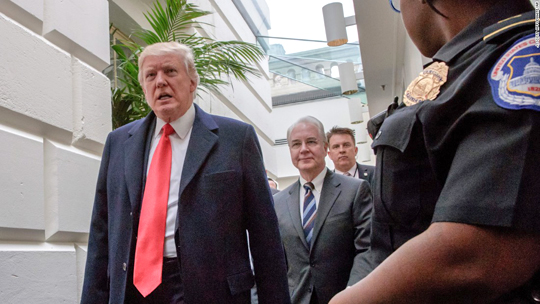
Trump1

If the high-stakes gamble works and the House manages to pass the Obamacare replacement bill, it will be an important win for President Donald Trump and House Speaker Paul Ryan who have formed an uneasy alliance to repeal the health care law.

But if the measure is blocked, it will be an embarrassing setback that casts doubt on the ability of Trump and Ryan to deliver on their ambitious agenda, including a sweeping tax overhaul and infrastructure package, both of which are being closely watched by Wall Street.

“For those who are on the fence one way or another, it's a long night of the soul for them,” Representative Tom Cole of Oklahoma said late Thursday. “It's very much an individual decision now.”

“Success breeds success; failure, you know, tends to compound itself,” he added. “So tomorrow is a very important moment for us and if you don't know that, you don't get it.”

The Trump administration made a last-minute deal with House conservatives to change the bill — by removing Obamacare's requirements that certain essential benefits be covered by insurance — in an effort to win over holdouts, who had forced GOP leaders to delay their vote, originally scheduled for Thursday.

Then Trump aides, including senior strategist Steve Bannon, went to Capitol Hill to deliver a message in person to House leaders and the Republican caucus that the president has run out of patience: Trump wanted a vote on Friday, win or lose, even if that means leaving Obamacare in place.

‘No more negotiations'

“We have to have a vote tomorrow. He expects it to pass,” Representative Chris Collins of New York said, speaking about Trump. “We are done negotiating, there are no more negotiations.”

“If it loses, we just move on to tax reform,” added Collins, a Trump ally.

House conservatives, including Freedom Caucus chairman Mark Meadows, emerged from the meeting saying they were still leaning against the bill, but were still evaluating the final package.

Meadows said late on Thursday “I'm a no” for now, but said members had been given “a binary choice” and that he will talk with other members before making a final decision.

GOP leaders didn't agree to a core demand of the Freedom Caucus to eliminate other insurance regulations, according to a senior Republican aide.

Representative Thomas Massie of Kentucky, who opposes the bill, said Republican leaders are taking a risky bet.

“If they bring this to the floor and it doesn't get to 216 quickly, the momentum could go in the other direction and they could come way short,” he said. “Because you don't want to be the person who fell on your sword and voted yes for a piece of legislation that never passes.”

‘Leaning the other way'

But other House conservatives said they were getting the sense that enough of their colleagues would end up backing it.

“I'm still a no, but it looks like it's leaning the other way,” Freedom Caucus member Ted Yoho said. Representative Mark Sanford of South Carolina agreed, saying he's picking up that it is the “sentiment” of most of the conference now to pass the bill.

The bill has struggled to win over far-right members who have demanded a more complete repeal of Obamacare, but it's also unnerved moderates concerned about projections that millions will lose coverage. A number of moderates came out against the bill this week, giving Republican leaders little room to negotiate changes.

Ryan put a brave face on the upcoming test of whether he and Trump can deliver the votes.

“For seven-and-a-half years, we have been promising the American people that we will repeal and replace this broken law because it is collapsing and hurting families,” he said. “Tomorrow we will see that.”

The GOP bill, H.R. 1628, would reverse massive gains in health coverage under the Affordable Care Act, which brought the uninsured rate to a record low. The proposal would pull hundreds of billions of dollars out of the health system by winding down Obamacare's expansion of Medicaid and limiting its subsidies, threatening revenues for hospitals, doctors and insurance companies.

Signs that the bill was in trouble on Thursday unnerved US markets, helping to erase gains, while sending hospital stocks higher.

Some changes

Meadows and other conservative Freedom Caucus members demanded a provision in the bill — agreed to by Trump and GOP leaders that would scrap the essential benefits portion of the Affordable Care Act, which requires insurers to cover 10 categories of services, for the individual market. Those services include hospitalization, ambulance services, maternitycare, pediatric services, mental health and substance abuse treatment, prescription drugs, rehabilitative care and laboratory services.

Other new provisions described by lawmakers Thursday night include a $15 billion boost to a new state flexibility fund and six more years of a 0.9% Medicare tax on high earners.

That last bit is needed to pay for what is expected to be a surge of people buying lower-cost insurance products, triggering tax credits that run from $2,000 to $4,000 per person for eligible people.

If the bill makes it to the Senate, it is expected to undergo significant changes there as well, including boosts to tax credits for people ages 50 to 64 who are hit with massive premium spikes under the bill.

Outdated CBO score

But the last-minute changes mean that Republicans will be voting on the measure without a final estimate from the Congressional Budget Office about how many millions of Americans will lose coverage or how much the measure will cost.

In another development that could unease conservatives, the CBO issued a new estimate Thursday to account for changes made to the bill earlier in the week. The nonpartisan agency cut its estimate of how much the bill would shrink the federal budget deficit, saying the updated measure would reduce the deficit by $150 billion over the next decade, $186 billion less than the initial forecast of $337 billion.

Of course, if the measure manages to pass the House, it still faces significant hurdles in the Senate.

Representative Kevin Cramer of North Dakota said he fears that even if the Freedom Caucus succeeds at getting its wish and delivers the votes for the bill to pass to the House, the provisions they demand won't pass muster under Senate rules.

“It seems that they want more inclusion on the essential benefits and some of those things that the speaker and others believe” will violate Senate rules, Cramer said. “And for some, I think they're spoiling for a fight. They want to challenge the Senate.”

Comments

Add new comment

  • Coastaldigest.com reserves the right to delete or block any comments.
  • Coastaldigset.com is not responsible for its readers’ comments.
  • Comments that are abusive, incendiary or irrelevant are strictly prohibited.
  • Please use a genuine email ID and provide your name to avoid reject.
Agencies
January 21,2020

Fifty-six journalists were killed in 2019 and most of them died outside conflict zones, a United Nations spokesperson said.

The number dropped by nearly half from the year 2018, but perpetrators enjoyed almost total impunity, Xinhua news agency quoted Stephane Dujarric, spokesperson for UN Secretary-General Antonio Guterres, as saying on Monday citing Unesco figures.

The figure was published in the 'Unesco Observatory of Killed Journalists' on Monday.

In total, Unesco recorded 894 journalist killings in the decade from 2010 to 2019, an average of almost 90 per year. The number in 2019 was 99.

Journalists were murdered in all regions of the world, with Latin America and the Caribbean recording 22 killings, the highest number, followed by 15 in Asia-Pacific, and 10 in Arab States.

"The figures show that journalists not only suffer extreme risks when covering violent conflict, but that they are also targeted when reporting on local politics, corruption and crime - often in their hometowns," the Unesco said.

Almost two thirds (61 per cent) of the cases in 2019 occurred in countries not experiencing armed conflict, a notable spike in a wider trend in recent years, and a reversal of the situation of 2014, when this figure was one third.

More than 90 per cent of cases recorded in 2019 concerned local journalists, consistent with previous years, it added.

In response to these figures, Audrey Azoulay, the Director-General of Unesco, said: "Unesco remains deeply troubled by the hostility and violence directed at all too many journalists around the world.

"As long as this situation lasts, it will undermine democratic debate."

Comments

Add new comment

  • Coastaldigest.com reserves the right to delete or block any comments.
  • Coastaldigset.com is not responsible for its readers’ comments.
  • Comments that are abusive, incendiary or irrelevant are strictly prohibited.
  • Please use a genuine email ID and provide your name to avoid reject.
News Network
February 6,2020

Washington, Feb 6: U.S. president Donald Trump drew on staunch Republican support to defeat the gravest threat yet to his three-year-old presidency on Wednesday, winning acquittal in the Senate on impeachment charges of abuse of power and obstruction of Congress.

Only the third U.S. leader ever placed on trial, Trump readily defeated the Democratic-led effort to expel him from office for having illicitly sought help from Ukraine to bolster his 2020 re-election effort.

Trump immediately claimed "victory" while the White House declared it a full "exoneration" for the president -- even as Democrats rejected the acquittal as the "valueless" outcome of an unfair trial.

Despite being confronted with strong evidence, Republicans stayed loyal and mustered a majority of votes to clear the president of both charges -- by 52 to 48 on abuse of power and 53 to 47 on obstruction of Congress -- falling far short of the two-thirds supermajority required for conviction.

"Two thirds of the senators present not having found him guilty of the charges contained therein, it is therefore ordered and adjudged that the said Donald John Trump be, and he is hereby, acquitted," said Supreme Court chief justice John Roberts, who presided over the trial.

The months-long impeachment of the 45th US leader shone a harsh light on America's political divide, with Trump's core support base united behind him in rejecting it as a "hoax."

One Republican, senator Mitt Romney, a longtime Trump foe, risked White House wrath to vote alongside Democrats on the first count, saying Trump was "guilty of an appalling abuse of public trust." He voted not guilty on the second charge.

But the verdict was never truly in question since the House of Representatives formally impeached Trump in December, and has now cleared out a major hurdle for the president to fully plunge into his campaign for re-election in November.

Trump to speak Thursday

Responding to the verdict, Trump announced he would deliver a formal statement Thursday from the White House "to discuss our Country's VICTORY on the Impeachment Hoax!"

Shortly before, the president tweeted a montage depicting a fake cover of Time magazine declaring him president for all eternity.

The White House declared that Trump had obtained "full vindication and exoneration."

But Nancy Pelosi, the House Speaker and top Democrat in Congress, said that by clearing Trump, the Republicans had "normalized lawlessness."

"There can be no acquittal without a trial, and there is no trial without witnesses, documents and evidence," she said.

"Sadly, because of the Republican Senate's betrayal of the Constitution, the president remains an ongoing threat to American democracy, with his insistence that he is above the law and that he can corrupt the elections if he wants to."

Senate minority leader Chuck Schumer said the acquittal was "virtually valueless" since Republicans refused witnesses at his trial.

'Forever impeached'

The Democrats' intense 78-day House investigation faced public doubts and high-pressure stonewalling from the White House.

Concerned about the political risk for the party, Pelosi rejected a call early last year to impeach Trump on evidence compiled by then-special counsel Robert Mueller that he had obstructed the Russia election meddling investigation.

But her concerns melted after new allegations surfaced in August that Trump had pressured Ukraine for help for his 2020 campaign.

Though doubtful from the outset that they would win support from Republicans, an investigation amassed with surprising speed strong evidence to support the allegations.

The evidence showed that from early in 2019, Trump's private lawyer Rudy Giuliani and a close political ally, Ambassador to the European Union Gordon Sondland, were scheming to pressure Kiev to help smear Democrats, including Trump's potential 2020 rival Joe Biden, by opening investigations into them.

"We must say enough -- enough! He has betrayed our national security, and he will do so again," Adam Schiff, who led the House investigation, argued on the Senate floor this week.

"He has compromised our elections, and he will do so again," Schiff said.

'Colossal' mistake

In the trial, Trump's defence was not seen as having undermined the facts compiled by Schiff's probe, and several Republican senators acknowledged he did wrong.

But his lawyers and Senate defenders argued, essentially, that Trump's behaviour was not egregious enough for impeachment and removal.

And, pointing to the December House impeachment vote, starkly along party lines, they painted it as a political effort to "destroy the president" in an election year and insisted voters should be allowed to decide Trump's fate.

Senate majority leader Mitch McConnell said impeachment will benefit Republicans.

"Right now this is a political loser for them. They initiated it. They thought this was a great idea. At least for the short term, it has been a colossal political mistake."

Comments

Add new comment

  • Coastaldigest.com reserves the right to delete or block any comments.
  • Coastaldigset.com is not responsible for its readers’ comments.
  • Comments that are abusive, incendiary or irrelevant are strictly prohibited.
  • Please use a genuine email ID and provide your name to avoid reject.
News Network
June 19,2020

United Nations, Jun 19: Half of the world's children -- one billion every year -- are affected by physical, sexual or psychological violence, suffering injuries and death because countries have failed to follow established strategies to protect them, the first report of its kind from the UN has said, with experts noting that the coronavirus-related lockdowns have left far too many youngsters stuck with their abusers.

While nearly all countries (88 per cent) have laws in place to protect minors, less than half (47 per cent) say they strongly enforce them, said the Global Status Report on Preventing Violence Against Children 2020 launched on Thursday.

Because countries have failed to follow established strategies to protect children, about one billion are affected each year by physical, sexual or psychological violence, it said.

"There is never any excuse for violence against children," WHO Director-General Tedros Adhanom Ghebreyesus said.

"We have evidence-based tools to prevent it, which we urge all countries to implement. Protecting the health and well-being of children is central to protecting our collective health and well-being, now and for the future," he said.

The report -- launched by the World Health Organisation, the UNICEF, the UNESCO, the Special Representative of the UN Secretary-General on Violence against Children and the End Violence Partnership -- charted progress in 155 countries against the "INSPIRE" framework, a set of seven strategies for preventing and responding to violence against children.

The report signaled a clear need in all countries to scale up efforts to implement them. It included the first ever global homicide estimates specifically for children under 18 years of age -- previous estimates were based on data that included 18 to 19-year olds.

According to the findings, in 2017, around 40,000 children were victims of homicide.

"Violence against children has always been pervasive, and now things could be getting much worse," UNICEF Executive Director Henrietta Fore said.

"Lockdowns, school closures and movement restrictions have left far too many children stuck with their abusers, without the safe space that school would normally offer. It is urgent to scale up efforts to protect children during these times and beyond, including by designating social service workers as essential and strengthening child helplines," she said.

UNESCO Director-General Audrey Azoulay said during the COVID-19 pandemic, and the related school closures, "we have seen a rise in violence and hate online – and this includes bullying".

"Now, as schools begin to re-open, children are expressing their fears about going back to school. It is our collective responsibility to ensure that schools are safe environments for all children. We need to think and act collectively to stop violence at school and in our societies at large," Azoulay said.

Stay-at-home measures including school closures have limited the usual sources of support for families and individuals such as friends, extended family or professionals.

This further erodes victims’ ability to successfully cope with crises and the new routines of daily life. Spikes in calls to helplines for child abuse and intimate partner violence have been observed, the report said.

While online communities have become central to maintain many children's learning, support and play, an increase in harmful online behaviors including cyberbullying, risky online behavior and sexual exploitation have been identified.

“Whilst this report was being finalised, confinement measures and the disrupted provision of already limited child protection services exacerbated the vulnerability of children to various forms of violence," said Najat Maalla M’jid, Special Representative of the UN Secretary-General on Violence against Children.

Of the INSPIRE strategies, only access to schools through enrolment showed the most progress with 54 per cent of the countries reporting that a sufficient number of children in need were being reached in this way.

Between 32 per cent and 37 per cent of the countries considered that victims of violence could access support services, while 26 per cent of the countries provided programmes on parent and caregiver support; 21 per cent of the countries had programmes to change harmful norms; and 15 per cent of the countries had modifications to provide safe physical environments for children, the report said.

Although a majority of countries (83 per cent) have national data on violence against children, only 21 per cent used these to set baselines and national targets to prevent and respond to violence against children, it added.

The report said about 80 per cent of countries have national plans of action and policies but only one-fifth have plans that are fully funded or have measurable targets. A lack of funding combined with inadequate professional capacity are likely contributing factors and a reason why implementation has been slow.

"Ending violence against children is the right thing to do, a smart investment to make - and it's possible. We can and must create a world where every child can thrive," Howard Taylor of the End Violence Partnership said.

Comments

Add new comment

  • Coastaldigest.com reserves the right to delete or block any comments.
  • Coastaldigset.com is not responsible for its readers’ comments.
  • Comments that are abusive, incendiary or irrelevant are strictly prohibited.
  • Please use a genuine email ID and provide your name to avoid reject.