


Trump nominates 2nd Indian woman to top administration post

November 29, 2016

Washington, Nov 29: US President-elect Donald Trump today nominated a second Indian-American woman to a top administration position, putting her in charge of a federal agency within the health department as part of a "dream team" which he said would transform America's healthcare system.
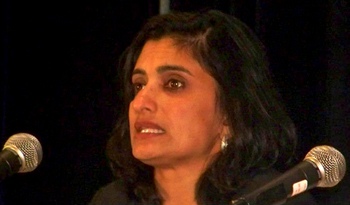
seema"I am pleased to nominate (Dr) Seema Verma to serve as Administrator of the Centers for Medicare and Medicaid Services," Trump said in a statement.

The announcement came along with Trump's nomination of Congressman Tom Price as his Health and Human Services Secretary.

A leading expert in the country on Medicare and Medicaid, Verma would serve as Administrator of Centers for Medicare and Medicaid Services.

"She has decades of experience advising on Medicare and Medicaid policy and helping states navigate our complicated systems. Together, Chairman Price and Seema Verma are the dream team that will transform our healthcare system for the benefit of all Americans," Trump said.

"I am honoured to be nominated by President-elect Trump today," said Verma, who met Trump in New York last week.

"I look forward to helping him tackle our nation's daunting healthcare problems in a responsible and sustainable way," she said.

Her nomination comes days after Indian-American Nikki Haley was named as US envoy to the United Nations by Trump.

Haley had scripted history by becoming the first-ever Indian-American to be appointed to a cabinet-level post in any US administration.

Verma currently is the President, CEO and founder of SVC, Inc, a national health policy consulting company.

Based in Indianapolis, Verma has supported Indiana through development of the historic programme since its inception in 2007, from development of the enabling legislation, negotiating the financing plan with the state's hospital association, developing the federal waiver, supporting federal negotiations and leading the implementation of the programme, including the operational design.

For more than 20 years, she has worked extensively on a variety of policy and strategic projects involving Medicaid, insurance, and public health, working with Governors' offices, state medicaid agencies, state health departments, state departments of insurance, as well as the federal government, private companies and foundations.

"Verma has extensive experience redesigning Medicaid programmes in several states. Verma is the architect of the Healthy Indiana Plan (HIP), the nation's first consumer directed Medicaid programme under Governor Mitch Daniels of Indiana and then-Governor Pence's HIP 2.0 waiver proposal," said the presidential transition team.

Verma received her Master's degree in Public Health, with a concentration in health policy and management from Johns Hopkins University, and her Bachelor's degree in Life Sciences from the University of Maryland.

She served as the state of Indiana's health reform lead following the passage of Obamacare in 2010.

Comments

Add new comment

  • Coastaldigest.com reserves the right to delete or block any comments.
  • Coastaldigset.com is not responsible for its readers’ comments.
  • Comments that are abusive, incendiary or irrelevant are strictly prohibited.
  • Please use a genuine email ID and provide your name to avoid reject.
News Network
February 11,2020

Feb 11: China reported 108 new coronavirus deaths on February 10, the highest daily toll since the outbreak began in Wuhan late last year, as two senior officials in the hard-hit province of Hubei were removed from their jobs.

The total number of deaths on the mainland reached 1,016 in the 24 hours until midnight, the National Health Commission said on Tuesday.

Some 2,478 new cases were confirmed, bringing the total to 42,638.

Of the new deaths, 103 were in the province of Hubei, including 67 in the provincial capital of Wuhan. The virus is thought to have originated there in a market that sold seafood as well as wild animals.

Two senior health officials in the province - Zhang Jin who was Party Secretary of the health commission for Hubei and Ling Yingzi who was director of the Hubei Provincial Health Commission - were both removed from their posts, state media reported on Tuesday,  a day after Chinese President Xi Jinping visited health facilities in Beijing.

In his first public appearance since the outbreak began, Xi donned a face mask and had his temperature checked while visiting medical workers and patients in the capital.

"We have seen very little of Xi Jinping since the outbreak began but he was out and about in Beijing on Monday," Al Jazeera's Katrina Yu said from Beijing. "He has been trying to rally the troops saying: 'We can win this battle.' But it's also a sign that the battle is far from over."

The other fatalities on Monday were in the provinces of Heilongjiang, Anhui and Henan and the cities of Tianjin and Beijing, the National Health Commission said.

During a meeting chaired by Premier Li Keqiang on Monday, a group of leaders tasked with beating the virus said it would work to solve raw material and labour shortages and boost supplies of masks and protective clothing.

They said nearly 20,000 medical personnel from around the country had already been sent to Wuhan, and more medical teams were also on the way.

Comments

Add new comment

  • Coastaldigest.com reserves the right to delete or block any comments.
  • Coastaldigset.com is not responsible for its readers’ comments.
  • Comments that are abusive, incendiary or irrelevant are strictly prohibited.
  • Please use a genuine email ID and provide your name to avoid reject.
News Network
June 4,2020

Jun 4: A malaria drug President Donald Trump took to try to prevent COVID-19 proved ineffective for that in the first large, high-quality study to test it in people in close contact with someone with the disease.

Results published Wednesday by the New England Journal of Medicine show that hydroxychloroquine was no better than placebo pills at preventing illness from the coronavirus.

The drug did not seem to cause serious harm, though -- about 40% on it had side effects, mostly mild stomach problems.

 “We were disappointed. We would have liked for this to work,” said the study leader, Dr. David Boulware, an infectious disease specialist at the University of Minnesota.

“But our objective was to answer the question and to conduct a high-quality study,” because the evidence on the drug so far has been inconclusive, he said.

Hydroxychloroquine and a similar drug, chloroquine, have been the subject of much debate since Trump started promoting them in March.

Hydroxychloroquine has long been used for malaria, lupus, and rheumatoid arthritis, but no large studies have shown it or chloroquine to be safe or effective for much sicker patients with coronavirus, and some studies have suggested the drugs may do harm.

Trump took a two-week course of hydroxychloroquine, along with zinc and Vitamin D, after two staffers tested positive for COVID-19, and had no ill effects, according to results of his latest physical released by his doctor Wednesday.

Federal regulators have warned against hydroxychloroquine's use except in hospitals and formal studies because of the risk of side effects, especially heart rhythm problems.

Boulware's study involved 821 people in the United States and Canada living with someone diagnosed with COVID-19 or at high risk of getting it because of their job -- doctors, nurses, ambulance workers who had significant exposure to a sick patient while not wearing full protective gear.

They were randomly assigned to get either the nutrient folate as a placebo or hydroxychloroquine for five days, starting within four days of their exposure. Neither they nor others involved in the research knew who was getting which pills.

After 14 days in the study, 12 per cent on the drug developed COVID-19 symptoms versus 14 per cent in the placebo group, but the difference is so small it could have occurred by chance, Boulware said.

“There's basically no effect. It does not prevent infection,” he said of the drug. Even if it were to give some slim advantage, “we'd want a much larger effect” to justify its use and risk of side effects for preventing illness, he said.

Results were no different among a subgroup of participants who were taking zinc or vitamin C, which some people believe might help make hydroxychloroquine more effective or fight the coronavirus.

There are some big caveats: The study enrolled people through the Internet and social media, relying on them to report their own symptoms rather than having them tracked in a formal way by doctors.

Participants were not all tested for the coronavirus but were diagnosed as COVID-19 cases based on symptoms in many cases. And not all took their medicines as directed.

The results “are more provocative than definitive,” and the drug may yet have prevention benefits if tried sooner or in a different way, Dr. Myron Cohen of the University of North Carolina at Chapel Hill wrote in a commentary in the journal.

Others were glad to see a study that had a comparison group and good scientific methods after so many weaker reports on hydroxychloroquine.

“This fits with everything else we've seen so far which suggests that it's not beneficial," said Dr. Peter Bach, director of a health policy center at Memorial Sloan Kettering Cancer Center in New York.

This study was in younger relatively healthy people, but the results “would make me very discouraged about trying to use this in older people” who are most vulnerable to serious illness from the coronavirus, Bach said.

“If it does work, it doesn't work very well.” Dr. Dan Culver, a lung specialist at the Cleveland Clinic, said there's still a chance that giving the drug sooner than four days after someone's exposure to the virus may help prevent illness.

But the study “takes 'home run' off the table” as far as hopes for the drug, he said.

The study was mostly funded by David Baszucki, founder of Roblox, a California-based game software company, and other private donors and the Minnesota university.

Boulware also is leading a study testing hydroxychloroquine for treating COVID-19. The study is finished and results are being analyzed now.

On Tuesday, the journal Lancet posted an “expression of concern” about a study it published earlier this month of nearly 15,000 COVID-19 patients on the malaria drugs that tied their use to a higher risk of dying in the hospital or developing a heartbeat problem.

Scientists have raised serious questions about the database used for that study, and its authors have launched an independent audit.

That work had a big impact: the World Health Organization suspended use of hydroxychloroquine in a study it is leading, and French officials stopped the drug's use in hospitals. On Wednesday, the WHO said experts who reviewed safety information decided that its study could resume.

Comments

Add new comment

  • Coastaldigest.com reserves the right to delete or block any comments.
  • Coastaldigset.com is not responsible for its readers’ comments.
  • Comments that are abusive, incendiary or irrelevant are strictly prohibited.
  • Please use a genuine email ID and provide your name to avoid reject.
News Network
April 18,2020

Washington, Apr 18: The United States on Friday passed 700,000 confirmed coronavirus cases, according to a tally maintained by Johns Hopkins University.

With the highest number of cases and deaths of any country in the world, the US had recorded 700,282 cases of COVID-19 and 36,773 deaths as of 8:30 pm (0030 GMT Friday), according to the Baltimore-based university.

That marked an increase of 3,856 deaths in the past 24 hours, but that figure likely includes "probable" virus-linked deaths, which had not previously been counted.

This week, New York City said it would add 3,778 "probable" virus deaths to its official count.

The US Centers for Disease Control and Prevention gave a toll Friday night of 33,049 dead, including 4,226 probable virus-linked deaths.

The United States has seen the highest death toll in the world in the coronavirus pandemic, ahead of Italy (22,745 deaths) although its population is just a fifth of that of the US.

Spain has recorded 19,478 deaths, followed by France with 18,681.

Trump announces $19 billion relief for farmers amid COVID-19 epidemic

President Donald Trump on Friday announced a $19 billion financial rescue package to help the agriculture industry weather the staggering economic downturn sparked by measures to defeat the coronavirus.

Trump told a press conference the government "will be implementing a $19 billion relief program for our great farmers and ranchers as they cope with the fallout of the global pandemic."

The program will include direct payments to farmers, ranchers and producers who Trump said have experienced "unprecedented losses during this pandemic."

Agriculture Secretary Sonny Perdue said US farmers have been hit hard by a sharp shift in demand, as schools and restaurants close and more Americans eat at home.

That has disrupted the food supply chain, forcing farmers in many places to destroy dairy output and plow under crops that no longer have buyers.

"Having to dump milk and plow under vegetables ready to market is not only financially distressing, but it's heartbreaking as well to those who produce them," Perdue said.

Perdue said some $3 billion of the money would go to buying produce and milk from such farmers, and redistribute it to community food banks.

Millions of Americans have recently turned to food pantries for meals and groceries after losing their jobs.

Comments

Add new comment

  • Coastaldigest.com reserves the right to delete or block any comments.
  • Coastaldigset.com is not responsible for its readers’ comments.
  • Comments that are abusive, incendiary or irrelevant are strictly prohibited.
  • Please use a genuine email ID and provide your name to avoid reject.