



Trump shared sensitive information with Russians: Washington Post

May 16, 2017

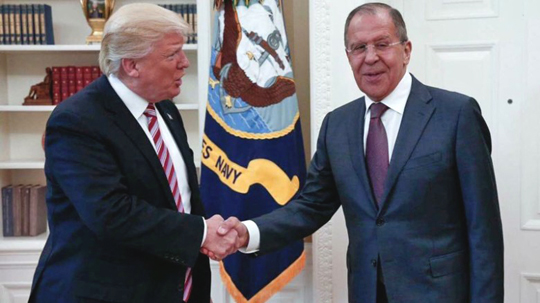
Washington, May 16: President Donald Trump shared highly classified information with the Russian Foreign Minister Sergei Lavrov when the latter met him at the White House last week, The Washington Post has alleged.
trump1

The news report was immediately refuted by both the Secretary of State Rex Tillerson and the National Security Advisor, who said that there was no discussion of specific threats with the Russians.

"This is code-word information," an unnamed US official familiar with the matter, was quoted as saying by The Washington Post.

Code-word information is a terminology that refers to one of the highest classification levels used by American spy agencies, the daily reported.

Trump "revealed more information to the Russian ambassador than we have shared with our own allies," the newspaper said, adding that following this, US officials have gone into damage control mode.

According to the daily, the sensitive classified information was given to the US by one of its allies, which had not given it permission to share this with the Russians.

However, the Trump Administration denied the allegations.

"During President Trump's meeting with Foreign Minister Lavrov, a broad range of subjects were discussed among which were common efforts and threats regarding counter-terrorism.

During that exchange, the nature of specific threats were discussed, but they did not discuss sources, methods or military operations," Tillerson said.

"The President and the (Russian) foreign minister reviewed common threats from terrorist organisations to include threats to aviation," said HR McMaster, the National Security Adviser, who participated in the meeting.

"At no time were any intelligence sources or methods discussed and no military operations were disclosed that were not already known publicly," McMaster said.

"This story is false. The President only discussed the common threats that both countries faced," said Dina Powell, Deputy National Security Advisor for Strategy, who also attended the meeting.

But The Washington Post said the information the President relayed had been provided by a US partner through an intelligence-sharing arrangement considered so sensitive that details have been withheld from allies and tightly restricted even within the US government, officials said.

Talking to reporters, McMaster described the story as false.

"The President and the Foreign Minister reviewed a range of common threats to our two countries, including threats to civil aviation.

"At no time, at no time, were intelligence sources or methods discussed and the President did not disclose any military operations that were not already publicly known," McMaster said.

"Two other senior officials who were present, including the Secretary of State, remember the meeting the same way and have said so. Their on-the-record accounts should outweigh those of anonymous sources. I was in the room. It didn't happen. Thanks, everybody," McMaster said without taking any questions.

In a statement, the Democratic Leader Nancy Pelosi said if news reports are true, Trump has "compromised a key source of intelligence collection" against ISIS and jeopardised the security of the American people.

"Even if President Trump unwittingly blew a highly classified code-word source to the Russians, that would be dangerous enough.

"If the President outed a highly classified code-word source intentionally, that would be even more dangerous," Pelosi said.

She demanded that Congress must be given a full briefing on the extent of the damage President Trump has done in compromising highly classified code-word intelligence to the Russians.

Comments

Add new comment

  • Coastaldigest.com reserves the right to delete or block any comments.
  • Coastaldigset.com is not responsible for its readers’ comments.
  • Comments that are abusive, incendiary or irrelevant are strictly prohibited.
  • Please use a genuine email ID and provide your name to avoid reject.
Agencies
July 9,2020

The new visa regulations requiring international students in the US with an F-1 visa to take at least one in-person course or face the prospect of deportation is likely to "cause uncertainties and difficulties" for some students, the Indian Embassy has said.

"These new modifications at a time when many of the US universities and colleges are yet to announce their plans for the new academic year are likely to cause uncertainties and difficulties for some Indian students wishing to pursue their studies in the US," said a spokesperson of the Indian Embassy.

Responding to media queries, the spokesperson said the Indian government has taken up the matter with concerned US officials.

At the India US Foreign Office Consultations held on July 7, Foreign Secretary Harsh Vardhan Shringla conveyed India's concerns on the matter to Under Secretary of State for Political Affairs David Hale.

According to a recent report of Student and Exchange Visitor Program (SEVP), there were 1,94,556 Indian students enrolled in various academic institutions of the US in January this year. Of these 1,26,132 were males and 68,405 were females.

Noting that partnership in higher education is a key component of the strong people-to-people ties between India and the US, the spokesperson said in the last two decades Indian students in American universities and colleges have been the harbingers of a strong partnership between technology and innovation sectors between the two countries.

The spokesperson hoped that the US authorities would provide adequate flexibility in their visa rule, keeping in mind the extraordinary circumstances created by the COVID-19 pandemic for the Indian students community.

We continue to engage all the stakeholders in the matters, including the US administration officials, Congressional leaders, universities and colleges as well as the Indian students community in the US as we move forward towards the 2020-21 academic year to further strengthen our bilateral partnership in higher education, the spokesperson said.

Announced by the SEVP on July 6, the new rules provide temporary exemptions for nonimmigrant students on F-1 and M-1 visas taking online classes due to the COVID-19 pandemic for the fall semester of the 2020 academic year.

While these modifications do provide some flexibility for US universities and colleges to adopt a hybrid model -- that is a mixture of online and in person classes -- they also restrict international students on F-1 and M-1 visas from taking courses entirely online, the spokesperson said.

Comments

Add new comment

  • Coastaldigest.com reserves the right to delete or block any comments.
  • Coastaldigset.com is not responsible for its readers’ comments.
  • Comments that are abusive, incendiary or irrelevant are strictly prohibited.
  • Please use a genuine email ID and provide your name to avoid reject.
News Network
February 2,2020

Feb 2: The Philippines on Sunday reported the first death from a new virus outside of China, where authorities delayed the opening of schools in the worst-hit province and tightened quarantine measures in a city that allow only one family member to venture out to buy supplies.

The Philippine Department of Health said a 44-year-old Chinese man from Wuhan was admitted on Jan. 25 after experiencing a fever, cough, and sore throat. He developed severe pneumonia, and in his last few days, “the patient was stable and showed signs of improvement, however, the condition of the patient deteriorated within his last 24 hours resulting in his demise.”

The man’s 38-year-old female companion, also from Wuhan, also tested positive for the virus and remains in hospital isolation in Manila.

President Rodrigo Duterte approved a temporary ban on all travelers, except Filipinos, from China and its autonomous regions. The U.S., Japan, Singapore and Australia have imposed similar restrictions despite criticism from China and an assessment from the World Health Organization that they were unnecessarily hurting trade and travel.

The death toll in China climbed by 45 to 304 and the number of cases by 2,590 to 14,380, according to the National Health Commission, well above the number of those infected in in the 2002-03 outbreak of SARS, or severe acute respiratory syndrome, which broke out in southern China and spread worldwide.

Meanwhile, six officials in the city of Huanggang, neighboring the epicenter of Wuhan in Hubei province, have been fired over “poor performance” in handling the outbreak, the official Xinhua News Agency reported.

It cited the mayor as saying the city’s “capabilities to treat the patients remained inadequate and there is a severe shortage in medical supplies such as protective suits and medical masks.”

After Huanggang, the trading center of Wenzhou in coastal Zhejiang province also confined people to homes, allowing only one family member to venture out every other day to buy necessary supplies.

With the outbreak showing little sign of abating, authorities in Hubei and elsewhere have extended the Lunar New Year holiday, due to end this week, well into February. The annual travel crunch of millions of people returning from their hometowns to the cities is thought to pose a major threat of secondary infection at a time when authorities are encouraging people to avoid public gatherings.

All Hubei schools will postpone the opening of the new semester until further notice and students from elsewhere who visited over the holiday will also be excused from classes.

Far away on China’s southeast coast, the manufacturing hub of Wenzhou put off the opening of government offices until Feb. 9, private businesses until Feb. 17 and schools until March 1.

With nearly 10 million people, Wenzhou has reported 241 confirmed cases of the virus, one of the highest levels outside Hubei. Similar measures have been announced in the provinces and cities of Heilongjiang, Shandong, Guizhou, Hebei and Hunan, while the major cities of Shanghai and Beijing were on indefinite leave pending developments.

Despite imposing drastic travel restrictions at home, China has chafed at those imposed by foreign governments, criticizing Washington’s order barring entry to most non-citizens who visited China in the past two weeks. Apart from dinging China’s international reputation, such steps could worsen a domestic economy already growing at its lowest rate in decades.

The crisis is the latest to confront Chinese leader Xi Jinping, who has been beset by months of anti-government protests in the semi-autonomous Chinese city of Hong Kong, the reelection of Taiwan’s pro-independence president and criticism over human rights violations in the traditionally Muslim northwestern territory of Xinjiang. Economically, Xi faces lagging demand and dramatically slower growth at home while the tariff war with the U.S. remains largely unresolved.

Among a growing number of airlines suspending flights to mainland China was Qatar Airways. The Doha-based carrier said on its website that its flights would stop Monday. It blamed “significant operational challenges caused by entry restrictions imposed by a number of countries” for the suspension of flights.

Oman also halted flights to China, as did Saudi Arabia’s flagship national carrier, Saudia.

Saudi Arabia’s state-run TV reported that 10 Saudi students were evacuated from Wuhan on a special flight. It said the students would be screened upon arrival, but did not say whether they would be quarantined for 14 days.

This weekend, South Korea and India flew hundreds of their citizens out of Wuhan. They went into a two-week quarantine.

On Sunday, South Korea reported three more cases for a total of 15. They include an evacuee, a Chinese relative of a man who tested positive and a man who returned from Wuhan. India reported a second case, also in southern Kerala state.

South Korea also barred foreigners who have stayed or traveled to Hubei province within the last 14 days from entering the country.

Indonesia flew back 241 nationals from Wuhan on Sunday and quarantined them on the remote Natuna Islands for two weeks. Several hundred residents protested the move, with one saying, “This is not because we do not have a sense of solidarity with fellow nationals. But because we fear they could infect us with the deadly virus from China.”

A Turkish military transport plane carrying 42 people arrived in Ankara from Wutan Saturday night. The 32 Turkish, six Azerbaijani, three Georgian nationals and an Albanian will remain under observation for 14 days, together with 20 personnel who participated in the evacuation, Health Minister Fahrettin Koca said.

Vietnam counted its seventh case, a Vietnamese-American man who had a two-hour layover in Wuhan on his way from the U.S. to Ho Chi Minh City.

The virus’ rapid spread in two months prompted the WHO on Thursday to declare it a global emergency.

That declaration “flipped the switch” from a cautious attitude to recommending governments prepare for the possibility the virus might spread, said the WHO representative in Beijing, Gauden Galea. Most cases reported so far have been people who visited China or their family members.

WHO said it was especially concerned that some cases abroad involved human-to-human transmission.

“Countries need to get ready for possible importation in order to identify cases as early as possible and in order to be ready for a domestic outbreak control, if that happens,” Galea told The Associated Press.

Both the new virus and SARS are from the coronavirus family, which also includes those that cause the common cold.

The death rate in China is falling, but the number of confirmed cases will keep growing because thousands of specimens from suspected cases have yet to be tested, Galea said.

“The case fatality ratio is settling out at a much lower level than we were reporting three, now four, weeks ago,” he said.

Although scientists expect to see limited transmission of the virus between people with family or other close contact, they are concerned about cases of infection spreading to people who might have less exposure.

Comments

Add new comment

  • Coastaldigest.com reserves the right to delete or block any comments.
  • Coastaldigset.com is not responsible for its readers’ comments.
  • Comments that are abusive, incendiary or irrelevant are strictly prohibited.
  • Please use a genuine email ID and provide your name to avoid reject.
News Network
June 8,2020

Hundreds of thousands of people across the world are joining the anti-racism demonstrations days after the killing of George Floyd in United Sates. 

The protests are being held in cities including London, Manchester, Cardiff, Leicester and Sheffield.

Demonstrators attached ropes to the statue of Edward Colston before pulling it down to cheers and roars of approval from the crowd. Images on social media show the statue was eventually rolled into the city's harbour. 

It was not the only statue targeted on Sunday. In Brussels, protesters clambered onto the statue of former King Leopold II and chanted "reparations".

The word "shame" was also graffitied on the monument, reference perhaps to the fact that Leopold is said to have reigned over the mass death of 10 million Congolese.

In London, thousands of people congregated around the US embassy for the second day running.

While protests were mainly peaceful, there were some scuffles near the office of Prime Minister Boris Johnson and outside the Parliament gates.

In Hong Kong, about 20 people staged a rally in solidarity with the Black Lives Matter movement on Sunday outside the US consulate in the semi-autonomous Chinese city.

"It's a global issue," Quinland Anderson, a 28-year-old British citizen living in Hong Kong, told The Associated Press news agency.

"We have to remind ourselves despite all we see going on in the US and in the other parts of the world, Black lives do indeed matter."

Several dozen demonstrators took part in a Black Lives Matter protest held in Tel Aviv's central Rabin Square.

A rally in Rome's sprawling People's Square was noisy but peaceful, with the majority of protesters wearing masks to protect against coronavirus. Participants listened to speeches and held up handmade placards saying "Black Lives Matter" and "It's a White Problem".

In Spain, several thousand people gathered on the streets of Barcelona and at the US embassy in Madrid.

Many in Madrid carried homemade signs reading "Black Lives Matter", "Human rights for all" and "Silence is pro-racist".

"We are not only doing this for our brother George Floyd," said Thimbo Samb, a spokesman for the group that organised the events in Spain mainly through social media. "Here in Europe, in Spain, where we live, we work, we sleep and pay taxes, we also suffer racism."

Comments

Add new comment

  • Coastaldigest.com reserves the right to delete or block any comments.
  • Coastaldigset.com is not responsible for its readers’ comments.
  • Comments that are abusive, incendiary or irrelevant are strictly prohibited.
  • Please use a genuine email ID and provide your name to avoid reject.