



Eight die in Kabul attack after Obama trip

May 2, 2012

kanul

Kabul, May 2: Eight people were killed and 17 injured in an audacious Taliban attack in the Afghan capital Wednesday, hours after US President Barack Obama's Kabul visit that came exactly a year after Al Qaeda chief Osama bin Laden was gunned down in Pakistan.


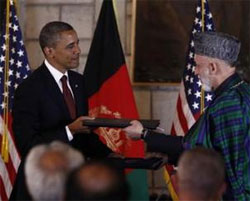
The brazen attacks were mounted after Obama left Kabul following a previously unannounced visit during which he signed a strategic partnership agreement with his Afghan counterpart Hamid Karzai.

Taliban militants resorted to suicide bombings and fought a pitched battle with security forces.

Two blasts took place inside a fortified residential compound used by the foreign staff of international organizations in eastern part of Afghan capital of Kabul.

A suicide car bomb targeted the entrance gate of the compound called Green Village in Pul-i-Charkhi area at about 6.15 a.m., enabling other heavily-armed militants to enter the complex, a police officer near the site told Xinhua.

An intense gunfight broke out in the area.At least one Nepalese security guard and five civilians have been killed and 17 injured in the attack, according to officials. The dead include suicide bombers.

The Pul-i-Charkhi area where the attack occurred is located on Jalalabad road, the main way out of the capital to the east till the border with Pakistan. Several US and NATO military camps are located nearby.

The area was cordoned off by security forces and police were on high alert across Kabul while several helicopters hovered over the area.

This is the second coordinated attack in the insurgency-hit country over the past two weeks.

A total of 51 people including 36 attackers were killed and 74 injured when Taliban launched a major attack in Kabul and three other eastern cities April 15.

Obama signed a cooperation agreement with Afghanistan as he paid an unannounced visit to the war-torn country Tuesday.

"Afghanistan has a friend and a partner in the United States," said Obama before he and Karzai signed the Strategic Partnership Agreement outlining cooperation between their countries once the US-led international force withdraws in 2014, CNN reported.

Obama, on his third trip to Afghanistan since taking office, also addressed troops at Bagram Air Field.

During the signing ceremony, the US president said neither country asked for the war which began over a decade earlier, but now they would work in partnership for a peaceful future.

Addressing concerns in Afghanistan that the US would abandon the country once its troops leave, Obama said: "With this agreement, I am confident that the Afghan people will understand that the United States will stand by them."

"We came here with a very clear mission to destroy Al Qaeda," he said as the day marked a year after Osama was gunned down by US commandos in Pakistan's Abbottabad town.

Obama's visit to Afghanistan came a week after the Afghan and US governments finalised the US-Afghan strategic pact's draft.

The agreement, which paves the way for long-term US military presence in Afghanistan after the withdrawal of the NATO-led coalition force from the country by 2014, has been welcomed by local analysts as a security stabilising factor in Afghanistan.

At present, there are over 90,000 US troops in Afghanistan and the US is expected to draw down that number to 65,000 by the end of 2012 and to less than 20,000 by the end of 2014.



Comments

Add new comment

  • Coastaldigest.com reserves the right to delete or block any comments.
  • Coastaldigset.com is not responsible for its readers’ comments.
  • Comments that are abusive, incendiary or irrelevant are strictly prohibited.
  • Please use a genuine email ID and provide your name to avoid reject.
News Network
January 20,2020

Langkawi, Jan 20: Malaysia will not take retaliatory trade action against India over its boycott of palm oil purchases amid a political row between the two countries, Prime Minister Mahathir Mohamad said on Monday.

India, the world’s largest edible oil buyer, this month effectively halted imports from its largest supplier and the world’s second-biggest producer in response to comments from Mahathir attacking India’s domestic policies.

“We are too small to take retaliatory action,” Mahathir told reporters in Langkawi, a resort island off the western coast of Malaysia. “We have to find ways and means to overcome that,” he added.

The 94-year-old premier of Muslim-majority Malaysia has criticised New Delhi’s new religion-based citizenship law and also accused India of invading the disputed region of Kashmir.

Mahathir again criticised India’s citizenship law on Monday, saying he believed it was “grossly unfair”.

India has been Malaysia’s largest palm oil market for the past five years, presenting the Southeast Asian country with a major challenge in finding new buyers for its palm oil.

Benchmark Malaysian palm futures fell nearly 10% last week, their biggest weekly decline in more than 11 years.

New Delhi is also unhappy with Malaysia’s refusal to revoke permanent resident status for controversial Indian Islamic preacher Zakir Naik, who has lived in Malaysia for about three years and faces charges of money laundering and hate speech in India.

Mahathir said even if the Indian government guarantees a fair trial, Naik faces the real threat of vigilante action and that Malaysia will only relocate the preacher if it can find a third country where he would be safe.

“If we can find a place for him, we will send him out.”

Comments

Add new comment

  • Coastaldigest.com reserves the right to delete or block any comments.
  • Coastaldigset.com is not responsible for its readers’ comments.
  • Comments that are abusive, incendiary or irrelevant are strictly prohibited.
  • Please use a genuine email ID and provide your name to avoid reject.
News Network
February 19,2020

London, Feb 19: UK Home Secretary Priti Patel today announced the launch of the Britain's new points-based visa system, aimed at attracting the "brightest and the best" from the world, including from India, and cutting down numbers of cheap, low-skilled workers coming to the country.

The new system will come into force from January 1, 2021 at the end of the transition period after the UK's exit from the European Union (EU) last month, which will formally end free movement of people within the economic bloc for the UK as a non-member.

The new post-Brexit system, which will apply equally to the EU and non-EU countries like India, is based on assigning points for specific skills, qualifications, salaries and professions, with visas only awarded to those who gain enough points.

"Today is a historic moment for the whole country. We're ending free movement, taking back control of our borders and delivering on the people's priorities by introducing a new UK points-based immigration system, which will bring overall migration numbers down," said Ms Patel, the senior-most Indian-origin Cabinet minister.

"We will attract the brightest and the best from around the globe, boosting the economy and our communities, and unleash this country's full potential," Ms Patel, in charge of the UK's visa and immigration system, said.

The UK Home Office said the new system is a direct response to the 2016 referendum in favour of Brexit, which was seen as a vote to end the country's reliance on cheap migrant labour and reduce overall levels of migration with tighter security.

"The new single global system will treat the EU and non-EU citizens equally. It will give top priority to those with the highest skills and the greatest talents, including scientists, engineers and academics," the Home Office said.

The Global Talent Scheme, a fast-track visa to be in operation from Friday, will also apply to the EU citizens from next year to allow highly-skilled scientists and researchers to come to the UK without a job offer.

Professor Alice Gast, President of Imperial College London, said: "British science is global. The new post-study work and Global Talent visas will help us to attract the world's brightest students and researchers, wherever they come from."

"From the race to develop a coronavirus vaccine to clean energy, British science's international collaborations drive innovation and excellence."

The government said the points threshold for the new system will be carefully set to attract the talent the UK needs. Skilled workers will need to meet a number of relevant criteria, including specific skills and the ability to speak English, to be able to work in the UK. All applicants will be required to have a job offer and, in line with the Migration Advisory Committee''s (MAC) recommendations, the minimum salary threshold will be set at 25,600 pounds - lower than the previous 30,000 pounds level for Tier 2 work visas.

The new points-based system will also expand the skills threshold for skilled workers.

Those looking to live and work in the UK will need to be qualified up to A-level or equivalent, rather than degree-level under the current system. This will provide greater flexibility and ensure UK business has access to a wide pool of skilled workers, the Home Office said.

In line with the British Prime Minister Boris Johnson's manifesto commitment in the December 2019 General Election, there will be no specific route for low-skilled workers.

"It is estimated 70 per cent of the existing EU workforce would not meet the requirements of the skilled worker route, which will help to bring overall numbers down in future," the Home Office said.

Student visa routes will also be points-based and be opened up to EU citizens from next year.

Those wishing to study in the UK will need to demonstrate that they have an offer from an approved educational institution, that they can support themselves financially and that they speak English.

To address the specific labour concerns of the agricultural sector reliant on seasonal workers from the EU, the Seasonal Workers Pilot will be expanded in time for the 2020 harvest from 2,500 to 10,000 places.

EU citizens and other non-visa nationals will not require a visa to enter the UK when visiting the UK for up to six months.

However, the use of national identity cards will be phased out for travel to the UK and the Home Office highlighted that as part of its post-Brexit offer, those EU citizens resident in the UK by December 31 2020 can still apply to settle in the UK through the EU Settlement Scheme until June 2021.

Comments

Add new comment

  • Coastaldigest.com reserves the right to delete or block any comments.
  • Coastaldigset.com is not responsible for its readers’ comments.
  • Comments that are abusive, incendiary or irrelevant are strictly prohibited.
  • Please use a genuine email ID and provide your name to avoid reject.
News Network
May 15,2020

May 15: Global tensions simmered over the race for a coronavirus vaccine Thursday, as the United States and China traded jabs, and France slammed pharmaceuticals giant Sanofi for suggesting the US would get any eventual vaccine first.

Scientists are working at breakneck speed to develop a vaccine for COVID-19, the disease caused by the virus, which has killed more than 300,000 people worldwide and pummelled economies.

From the US to Europe to Asia, national and local governments are easing lockdown orders to get people back to work -- while fretting over a possible second wave of infections.

Increased freedom of movement means an increased risk of contracting the virus, and so national labs and private firms are labouring to find the right formula for a vaccine.

The European Union's medicines agency offered some hope when it said one could be ready in a year, based on data from clinical trials already underway.

But Marco Cavaleri, the EMA's head of vaccines strategy, acknowledged that timeline was a "best-case scenario," and cautioned that "there may be delays."

The race for a vaccine has exposed a raw nerve in relations between the United States and China, where the virus was first detected late last year in the central city of Wuhan.

Two US agencies warned Wednesday that Chinese hackers were trying to steal COVID-19 vaccine research -- a claim Beijing rejected as "smearing" its reputation.

US President Donald Trump, who has ratcheted up the rhetoric against China, said he doesn't even want to engage with Chinese leader Xi Jinping -- potentially imperilling a trade deal between the world's top two economies.

"I'm very disappointed in China. I will tell you that right now," he said in an interview with Fox Business.

"There are many things we could do. We could do things. We could cut off the whole relationship."

On Capitol Hill, an ousted US health official told Congress that the Trump government had no strategy in place to find and distribute a vaccine to millions of Americans, warning of the "darkest winter" ahead.

"We don't have a single point of leadership right now for this response, and we don't have a master plan," said Rick Bright, who was removed last month as head of the US agency charged with developing a coronavirus vaccine.

The United States has registered nearly 86,000 deaths linked to COVID-19 -- the highest toll of any nation.

World leaders were among 140 signatories to a letter published Thursday saying any vaccine should not be patented and that the science should be shared among nations.

"Governments and international partners must unite around a global guarantee which ensures that, when a safe and effective vaccine is developed, it is produced rapidly at scale and made available for all people, in all countries, free of charge," it said.

But a row erupted in France after drugmaker Sanofi said it would reserve first shipments of any vaccine it discovered to the United States.

The comments prompted a swift rebuke from the French government -- President Emmanuel Macron's office said any vaccine should be treated as "a global public good, which is not submitted to market forces."

Sanofi chief executive Paul Hudson said the US had a risk-sharing model that allowed for manufacturing to start before a vaccine had been finally approved -- while Europe did not.

"The US government has the right to the largest pre-order because it's invested in taking the risk," Hudson told Bloomberg News.

Macron's top officials are scheduled to meet with Sanofi executives about the issue next week.

The search for a vaccine became even more urgent after the World Health Organization said the disease may never go away and the world would have to learn to live with it for good.

"This virus may become just another endemic virus in our communities and this virus may never go away," said Michael Ryan, the UN body's emergencies director.

The prospect of the disease lingering leaves governments facing a delicate balancing act between suppressing the pathogen and getting their economies up and running.

In the US, more grim economic data emerged Thursday, with nearly three million more Americans applying for unemployment benefits.

That takes the overall total to 36.5 million -- more than 10 percent of the US population.

Further signs of the damage to businesses emerged when Lloyd's of London forecast the pandemic will cost the global insurance industry about $203 billion.

European markets closed down, but Wall Street rallied despite the new jobless claims. In a sign of progress, the New York Stock Exchange trading floor was due to reopen on May 26.

The reopening of economies continued in earnest across Europe, where the EU has set out proposals for a phased restart of travel and the eventual lifting of border controls.

"Maybe it's a mistake, but we have no choice. Without tourists, we won't get by!" Enrico Facchetti, a 61-year-old former goldsmith, said of Venice's reopening.

Japan -- the world's third largest economy -- lifted a state of emergency across most of the country except for Tokyo and Osaka.

And Canadian Prime Minister Justin Trudeau said national parks would partially reopen on June 1.

But in Latin America, the virus continued to surge, with a 60 percent leap in cases in the Chilean capital of Santiago.

Authorities said 2,000 new graves were being dug at the main cemetery.

South Sudan reported its first COVID-19 death on Thursday.

And in Bangladesh, the first case was confirmed in the teeming Rohingya refugee camps in Bangladesh, which are home to nearly one million people.

Comments

Add new comment

  • Coastaldigest.com reserves the right to delete or block any comments.
  • Coastaldigset.com is not responsible for its readers’ comments.
  • Comments that are abusive, incendiary or irrelevant are strictly prohibited.
  • Please use a genuine email ID and provide your name to avoid reject.