


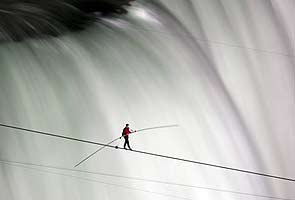
Nik Wallenda, first man to complete 1800-feet tightrope walk across Niagara Falls

June 16, 2012

niagara_falla_tightrope_walk.295

Ontario, Canada, June 16: Daredevil Nik Wallenda became the first person to walk on a tightrope across the Niagara Falls, taking steady, measured steps Friday night for 1,800 feet across the mist-fogged brink of the roaring falls separating the U.S. and Canada.

"I feel like I'm on cloud nine right now," an exuberant Wallenda told reporters after accomplishing what he said was his childhood dream before an estimated 112,000 people crowding the shores of both countries and millions more who watched a live television broadcast.

He described wind "coming from every which way," mist so powerful he had to blink it away to maintain his vision and a breathtaking view during the nighttime walk illuminated by spotlights that "compared to nothing."

"There was no way to focus on the movement of the cable," said Wallenda, 33. "If I looked down at the cable there was water moving everywhere. And if I looked up there was heavy mist blowing in front of my face. So it was a very unique, a weird sensation."

He said he accomplished the feat through "a lot of praying, that's for sure. But, you know, it's all about the concentration, the focus, and the training."

The seventh-generation member of the famed Flying Wallendas had long dreamed of pulling off the stunt, never before attempted. Other daredevils have wire-walked over the Niagara River but farther downstream and not since 1896.


"This is what dreams are made of, people," said Wallenda, who wore a microphone for the broadcast, shortly after he stepped off from a platform on the American shore.

Along the way, he calmly prayed aloud.

After passing the halfway mark, Wallenda expressed fatigue. "I'm strained, I'm drained," he said. "This is so physical, not only mental but physical."

Toward the end, as he neared the Canadian shore, Wallenda dropped to one knee and pumped his fist while the spectators cheered.


He broke into a playful run about 15 feet from the finish line, where his wife and three children waited.

"I am so blessed," he said later. "How blessed I am to have the life that I have."

ABC televised the walk and insisted Wallenda use a tether to keep him from falling in the river. Wallenda said he agreed because he wasn't willing to lose the chance to perform the walk it took him well over a year to win permission from two countries to do. Such stunts are normally illegal. ABC's sponsorship helped offset some of the $1.3 million cost of the spectacle.

Wallenda said he thought about the tether, which was secured at his waist and dragged behind him, at several points along the 30-minute walk but wasn't hindered by it as he'd feared.

"Awesome! The whole thing is awesome," 8-year-old William Clements of Dresden, Ontario, said after watching the walk with his family from the Canadian side, adding he wouldn't want to walk "even over something not high."

"He was meant to do it. The weather was perfect," said Glenda Rutherford of Ontario. "It was amazing."

For Wallenda, who has grown up on the high wire and holds six Guinness records for various stunts, the Niagara Falls walk was unlike anything he'd ever done. Because it was over water, the 2-inch wire didn't have the usual stabilizer cables to keep it from swinging. Pendulum anchors were designed to keep it from twisting under the elkskin-soled shoes designed by his mother.

The Wallendas trace their roots to 1780 Austria-Hungary, when ancestors traveled as a band of acrobats, aerialists, jugglers, animal trainers and trapeze artists. The clan has been touched by tragedy, notably in 1978 when patriarch Karl Wallenda, Nik's great-grandfather, fell to his death during a stunt in Puerto Rico.

Wallenda said that at one point in the middle of the walk, he thought about his great-grandfather and the walks he had taken:


"That's what this is all about, paying tribute to my ancestors, and my hero, Karl Wallenda."

About a dozen other tightrope artists have crossed the Niagara Gorge downstream, dating to Jean Francois Gravelet, aka The Great Blondin, in 1859. But no one had walked directly over the falls, and authorities hadn't allowed any tightrope acts in the area since 1896. It took Wallenda two years to persuade U.S. and Canadian authorities to allow it, and many civic leaders hoped to use the publicity to jumpstart the region's struggling economy, particularly on the U.S. side of the falls.



Comments

Add new comment

  • Coastaldigest.com reserves the right to delete or block any comments.
  • Coastaldigset.com is not responsible for its readers’ comments.
  • Comments that are abusive, incendiary or irrelevant are strictly prohibited.
  • Please use a genuine email ID and provide your name to avoid reject.
Agencies
March 14,2020

Nairobi, Mar 14: Kenya and Ethiopia on Friday announced their first confirmed cases of coronavirus, as East Africa, which has so far been unscathed by the global pandemic, scaled up emergency measures to contain its spread.

In Kenya, a 27-year-old Kenyan woman tested positive for the virus on Thursday in Nairobi, a week after returning from the United States via London.

She was in a stable condition and recovering, Health Minister Mutahi Kagwe told reporters.

"We wish to assure all Kenyans that the government will use all the resources available to fight coronavirus," he said, as the government rolled out a raft of new containment measures.

The government had traced all the contacts of the patient since she arrived back in Kenya on March 5, he said.

"At the moment, there is absolutely no need for panic and worry," he said.

Kenya, with a population of 50 million people, saw a spree of panic buying among the middle-class in Nairobi supermarkets, in the wake of the announcement.

Meanwhile Ethiopia, Africa's second most populous nation with over 100 million people, said a 48-year-old Japanese man who had arrived in the country on March 4 from Burkina Faso was confirmed to have contracted the virus.

"He is undergoing medical follow-up and is in a stable condition. Those who have been in contact with this person are being traced and quarantined," the health ministry said in a statement.

Burkina Faso only confirmed its first case on Tuesday -- a couple returning from France -- and the Japanese patient had been in that country since February 24.

Ethiopian Health Minister Lia Tadesse said three other patients were in isolation.

Ethiopia becomes the 15 country in Africa with a confirmed case of the virus that has swept the globe, infecting more than 130,000 people and killing nearly 5,000 since it first emerged in China.

But to date the continent has been spared the worst of the pandemic.

Only five people have succumbed to coronavirus so far -- all in north Africa -- with the sub-Saharan region recording no deaths and very low numbers of confirmed cases.

But countries in East Africa -- which until the positive case in Kenya, had only recorded negative test results -- have been taking precautions.

Some flights have been restricted, with Kenya Airways suspending its route to Rome, and charter flights from Italy to the Kenyan coast on hold.

It has also suspended international conferences, a top earner in Nairobi, a hub for such events in the region, and non-essential travel abroad for politicians.

The government announced more expansive restrictions on Friday, including a temporary ban on major public gatherings, prison visits and activities between schools.

Other countries in the region have been rolling out their own measures.

In Rwanda, which shares a border with the Democratic Republic of Congo, which has confirmed cases, washing basins with soap and sanitiser have been placed on streets for commuters to use before boarding buses.

Authorities in Kigali, the capital, have also banned concerts, rallies and trade fairs -- although like in Kenya and Uganda, church services have been proceeding and bars, restaurants and entertainment precincts remain open.

Neighbouring Burundi, meanwhile, has quarantined 34 people in a hotel in Bujumbura as a precaution.

Uganda has ordered that visitors from a number of affected countries self quarantine for 14 days, or consider simply not visiting at all.

South Sudan's health ministry said meanwhile that it was "temporarily suspending direct flights between South Sudan and all affected countries".

Kagwe, the Kenyan health minister, also addressed a rumour circulating on social media that people with black skin cannot contract the virus.

"I would like to disabuse that notion. The lady (confirmed with coronavirus in Kenya) is an African, like you and I," he said.

Comments

Add new comment

  • Coastaldigest.com reserves the right to delete or block any comments.
  • Coastaldigset.com is not responsible for its readers’ comments.
  • Comments that are abusive, incendiary or irrelevant are strictly prohibited.
  • Please use a genuine email ID and provide your name to avoid reject.
News Network
July 11,2020

Singapore, Jul 11: Singapore Prime Minister Lee Hsien Loong has secured a “clear mandate” with his ruling People’s Action Party (PAP) winning 83 of the 93 contested parliamentary seats in the general election held amidst the Covid-19 pandemic, with the Opposition gaining ground by winning a record 10 seats.

The ruling party, in power since independence in 1965, secured 61.24 percent of the total votes cast in the election, down from 69.9 percent in 2015. About 2.6 million Singaporeans voted on Friday.

“We have a clear mandate, but the percentage of the popular vote is not as high as I had hoped for,” 68-year old Lee told a PAP’s post-results press conference on Saturday morning.

The opposition Workers’ Party secured 10 seats and defeated a team in the Group Representation Constituency of Sengkang led by former Minister in the Prime Minister’s Office Ng Chee Meng who is also the Secretary-General of the power National Trades Union Congress (NTUC).

The Prime Minister assured it is “only right” that Workers’ Party’s Indian-origin secretary-general Pritam Singh be “formally designated” as the Leader of the Opposition, and that he will be provided with “appropriate staff support and resources to perform his duties”.

Lee took the results in “these circumstances” as an “endorsement” of the party’s policies and plans as he had called the elections amidst Covid-19 pandemic.

For latest updates and live news on coronavirus, click here

“We’ll take this forward and work with Singapore to realise those plans and solve the problems which we have,” Channel News Asia quoted the premier as saying.

Lee, who leads the PAP as secretary-general, said, “Singaporeans understand what’s at stake and why we must come together to uphold our national interests.”

He pledged to use this mandate “responsibly” to deal with the Covid-19 situation and economic downturn, to take Singapore “safely through the crisis and beyond”.

“The results reflect the pain and uncertainty that Singaporeans feel in this crisis, the loss of income, the anxiety about jobs, the disruption caused by the circuit breaker and the safe distancing restrictions,” he said.

This was not a “feel-good” election, said Lee, Singapore’s third prime minister who faces the city state’s worst recession with the economy projected to shrink between 7 and 4 per cent.

Lee acknowledged that the result also showed a “clear desire” for a diversity of voices in Parliament.

“Singaporeans want the PAP to form the government, but they, and especially the younger voters, also want to see more opposition presence in parliament,” he noted.

Lee added that he looks forward to the participation and contribution of the Opposition in parliament.

Singh, whose Workers’ Party team retained Aljunied Group Representation Constituency (GRC), will have 10 elected MPs now, up from six previously. His fellow member also retained the Hougang single-member constituency seat.

“Whether it works out… and whether it’s seen as a strengthening of Singapore will depend not only on what the PAP does but also on what the Opposition does because the Opposition now has 10 MPs elected from constituencies,” said Lee.

He assured that the ruling party will listen to Singaporeans and do its best to address their concerns, and “try to win” their support, whether or not they voted for the PAP.

When asked by the media if the party had lost the youth vote, he noted that different generations have different life experiences, and the young have significantly different life aspirations and priorities compared to the older generations.

“That’ll have to be reflected in our political process and in the government’s policies because, in the end, the government’s policies must be to achieve the aspirations of every generation of Singaporeans,” Lee said, assuring Singaporeans.

He hoped that the new generations of Singaporeans “look critically, but with an open mind” at what previous generations have done, “examine what’s relevant and what continues to make sense to them in a new environment” and “learn from these experiences hard-won by their parents and grandparents”.

This is so that they do not have to “learn them all over again and pay a high price which has already been paid”.

Lee added that he was, naturally, disappointed at the loss of the newly formed Sengkang GRC, which the Workers’ Party won with 52.13 percent of the valid votes.

“Ng Chee Meng and his team -- Lam Pin Min, Amrin Amin and Raymond Lye -- always knew it was going to be a tough fight,” he said.

“They gave it their all, but Sengkang voters have spoken, and we respect their decision.”

Lee described it as a “major loss to my team” and to the fourth-generation leaders, especially as Ng is the secretary-general of the Labour Movement, the NTUC.

Singh, 43, told a press conference following the results that his team would “continue to endeavour for good outcomes on the ground” and to represent voters “faithfully in parliament”.

“Today’s results are positive, but we have to hit the ground running. We should not get over our head with the results. There’s much work to do. And I can assure you this Workers’ Party team is committed to serve Singapore,” he stressed.

The PAP contested all 93 seats and the Workers’ Party 21 seats. Nine other political parties also contested the elections.

A total of 192 candidates contested for seats through 17 Group Representation Constituencies (GRCs).

Comments

Add new comment

  • Coastaldigest.com reserves the right to delete or block any comments.
  • Coastaldigset.com is not responsible for its readers’ comments.
  • Comments that are abusive, incendiary or irrelevant are strictly prohibited.
  • Please use a genuine email ID and provide your name to avoid reject.
News Network
February 4,2020

Kuala Lumpur, Feb 4: Malaysia said on Tuesday that India's move to cut back on palm oil purchases is "temporary" and will be resolved amicably between the two nations.

Last month, India restricted imports of refined palm oil and asked importers to avoid purchases from Malaysia after its criticism of actions in Kashmir and a new citizenship law.

"Having long-standing bilateral ties, the two nations will overcome the current challenges, and prevail towards mutual and beneficial outcomes," the Malaysian Palm Oil Council said in a statement, citing Primary Industries Minister Teresa Kok.

Malaysia's push to implement B20 biodiesel starting this month will also help sustain high crude palm oil prices, the statement read.

Comments

Add new comment

  • Coastaldigest.com reserves the right to delete or block any comments.
  • Coastaldigset.com is not responsible for its readers’ comments.
  • Comments that are abusive, incendiary or irrelevant are strictly prohibited.
  • Please use a genuine email ID and provide your name to avoid reject.