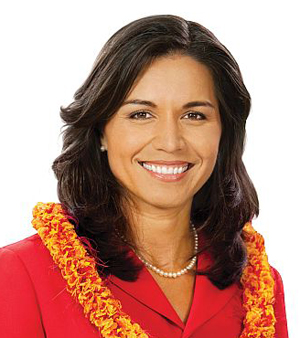
Tulsi Gabbard set to become first Hindu in US Congress

August 13, 2012

tulsi

Washington, August 13: Honolulu City Councilwoman Tulsi Gabbard has a great chance to become the first Hindu member of the US House of Representatives in 2013 with her primary victory in a safe Democratic seat.


Though a practicing Hindu and a strict vegetarian, Gabbard is not of Indian origin. Her father Mike Gabbard, who is a state senator, is from American Samoa. Her mother Carol Porter Gabbard, a white American, is a practicing Hindu. Her father is a Catholic.


Gabbard, 31, won the Democratic Party nomination in Hawaii's 2nd Congressional District Sunday with a decisive 55 percent vote in the primary with closest rival former Honolulu Mayor Mufi Hannemann getting 34 percent.


Four other candidates divided the remainder of the vote. Democratic Representative Mazie Hirono left the seat open when she decided to run for the Senate.


Born in 1981 in Leloaloa, American Samoa, she the fourth of five Gabbard children. When she was two, the family moved to Hawai'i, also the birthplace of President Barack Obama.


Dalip Singh Saund, the first Indian-American to be elected to the US in 1956, was a Sikh. Current Louisiana governor Bobby Jindal who became the second in 2004 had converted to Christianity while in high school.


Though not of Indian origin, Gabbard promises to be a representative for all the Indians in the US.


"Based on my strong affinity for India and Indian culture, as well as my warm love for the country and its people, I will always make myself available to hear the concerns of the Indian Diaspora and do my best to be of assistance," she said.


Comments

Add new comment

  • Coastaldigest.com reserves the right to delete or block any comments.
  • Coastaldigset.com is not responsible for its readers’ comments.
  • Comments that are abusive, incendiary or irrelevant are strictly prohibited.
  • Please use a genuine email ID and provide your name to avoid reject.
News Network
January 27,2020

Shanghai, Jan 27: The death toll from a coronavirus outbreak in China rose to 81 on Monday, as the government extended the Lunar New Year holiday and more big businesses shut down or told staff to work from home in an effort to curb the spread.

Chinese Premier Li Keqiang visited the central city of Wuhan, the epicenter of the outbreak, as the government sought to signal it was responding seriously to the crisis.

The total number of confirmed cases in China rose about 30% to 2,744, about half of them in Hubei province, whose capital is Wuhan.

As worries grew around the world, Chinese-ruled Hong Kong, which has had eight confirmed cases, banned entry to people who had visited Hubei in the past 14 days. The ban did not cover Hong Kong residents.

The number of deaths from the flu-like virus in Hubei climbed to 76 from 56, health officials said, with five deaths elsewhere in China, including the southern island province of Hainan, which reported its first fatality on Monday.

While a small number of cases have been confirmed in more than 10 countries, linked to people who traveled from Wuhan, no deaths have been reported elsewhere.

Li is the most senior leader to visit Wuhan since the outbreak began. Clad in a blue protective suit and mask, he inspected efforts to contain the epidemic and spoke to patients and medical staff, the government said.

The government is extending the week-long Lunar New Year holiday by three days to February 2, in a bid to slow the spread of the virus. The Lunar New Year is usually a time for millions of people to travel, but many have had to cancel their plans because of travel curbs over the virus.

Incubation

Wuhan is already in virtual lockdown and severe limits on movement are in place in several other Chinese cities.

The city of 11 million clamped down further on Monday, announcing the suspension of visa and passport services until January 30.

Despite the curbs, the mayor of Wuhan said on Sunday that five million people had left the city for holidays and other reasons.

Images from Wuhan showing hospital corridors packed with people seeking treatment have circulated on social media, along with complaints of soaring prices for essentials such as vegetables.

Chinese leaders have urged transparency in the crisis, after public trust was eroded by the cover-up of the spread of Severe Acute Respiratory Syndrome (SARS), a coronavirus that originated in China and killed nearly 800 people globally in 2002 and 2003.

Much is not known about the newly identified coronavirus, including how easily it spreads and just how dangerous it is. It can cause pneumonia, which has been deadly in some cases.

National Health Commission minister Ma Xiaowei said on Sunday the incubation period could range from one to 14 days, and the virus was infectious during incubation, unlike SARS.

That compares with a World Health Organization (WHO) estimate of two to 10 days for the incubation period.

“Understanding the time when infected patients may transmit the virus to others is critical for control efforts,” the WHO said.

The virus is believed to have originated late last year in a Wuhan market illegally selling wildlife. It has spread to other cities, including Beijing and Shanghai, as well as more than 10 countries including France, Japan and the United States.

‘Overwhelmed’

Australia confirmed its fifth case on Monday involving a woman on the last flight out of Wuhan to Sydney before China’s travel ban.

Health minister Greg Hunt told the Australian Broadcasting Corporation (ABC) authorities aimed to get about 100 Australian children and young people out of Wuhan.

One father of two, Nathan Wang, told the ABC his wife was stuck in Wuhan with the children. “We absolutely want the children to come back, because hospitals in Wuhan are overwhelmed,” he said.

Airports around the world have stepped up screening of passengers from China, although some health experts have questioned its effectiveness.

Last week the WHO stopped short of calling the outbreak a global health emergency, but some health experts question whether China can contain the epidemic.

WHO Director-General Tedros Adhanom Ghebreyesus is due to travel to Beijing to meet officials and health experts.

Australia, France, Italy, Japan and the United States have all said they are working to evacuate citizens from Wuhan.

Some of China’s biggest companies have been affected, with hotpot restaurant chain Haidilao International Holding shutting branches nationwide from Sunday until Friday.

Gaming giant Tencent Holdings Ltd advised staff to work from home until February 7, and e-commerce firm Alibaba removed vendors’ offers of overpriced face masks from its online Taobao marketplace as prices surged.

Comments

Add new comment

  • Coastaldigest.com reserves the right to delete or block any comments.
  • Coastaldigset.com is not responsible for its readers’ comments.
  • Comments that are abusive, incendiary or irrelevant are strictly prohibited.
  • Please use a genuine email ID and provide your name to avoid reject.
Agencies
June 27,2020

Washington, Jun 27: Facebook has said that it will flag all "newsworthy" posts from politicians that break its rules, including those from President Donald Trump.

Separately, Facebook's stock dropped more than 8 per cent, erasing roughly USD 50 billion from its market valuation, after the European company behind brands such as Ben & Jerry's and Dove announced it would boycott Facebook ads through the end of the year over the amount of hate speech and divisive rhetoric on its platform.

Later in the day, Coca-Cola also announced it joined the boycott for at least 30 days.

CEO Mark Zuckerberg had previously refused to take action against Trump posts suggesting that mail-in ballots will lead to voter fraud, saying that people deserved to hear unfiltered statements from political leaders.

Twitter, by contrast, slapped a "get the facts" label on them.

Until Friday, Trump's posts with identical wording to those labelled on Twitter remained untouched on Facebook, sparking criticism from Trump's opponents as well as current and former Facebook employees.

Now, Facebook is all but certain to face off with the president the next time he posts something the company deems to be violating its rules.

"The policies we're implementing today are designed to address the reality of the challenges our country is facing and how they're showing up across our community," Zuckerberg wrote on his Facebook page announcing the changes.

Zuckerberg said the social network is taking additional steps to counter election-related misinformation.

In particular, the social network will begin adding new labels to all posts about voting that will direct users to authoritative information from state and local election officials.

Facebook is also banning false claims intended to discourage voting, such as stories about federal agents checking legal status at polling places.

The company also said it is increasing its enforcement capacity to remove false claims about local polling conditions in the 72 hours before the US election.

Ethan Zuckerman, director of the Massachusetts Institute of Technology's Center for Civic Media, said the changes are a "reminder of how powerful Facebook may be in terms of spreading disinformation during the upcoming election".

He said the voting labels will depend on how good Facebook's artificial intelligence is at identifying posts to label.

"If every post that mentions voting links, people will start ignoring those links. If they're targeted to posts that say things like 'Police will be checking warrants and unpaid traffic tickets at polls' a classic voter suppression disinfo tactic and clearly mark posts as disinfo, they might be useful," he said.

But Zuckerman noted that Facebook "has a history of trying hard not to alienate right-leaning users, and given how tightly President Trump has aligned himself with voter-suppressing misinfo, it seems likely that Facebook will err on the side of non-intrusive and ignorable labels, which would minimize impact of the campaign."

Earlier in the day, shares of Facebook and Twitter dropped sharply after consumer-product maker Unilever announced a new ad boycott on Facebook, Twitter and Instagram through at least the end of the year.

The European company said it took the move to protest the amount of hate speech online.

Unilever said the polarised atmosphere in the United States ahead of November's presidential election placed responsibility on brands to act.

In addition to the decline in Facebook shares, Twitter ended the day more than 7 per cent lower.

Unilever, which is based in the Netherlands and Britain, joins a raft of other advertisers pulling back from online platforms.

Facebook in particular has been the target of an escalating movement to withhold advertising dollars to pressure it to do more to prevent racist and violent content from being shared on its platform.

"We have decided that starting now through at least the end of the year, we will not run brand advertising in social media newsfeed platforms Facebook, Instagram and Twitter in the U.S.," Unilever said.

"Continuing to advertise on these platforms at this time would not add value to people and society."

Facebook did not immediately respond to a request for comment. On Thursday, Verizon joined others in the Facebook boycott.

Unilever "has enough influence to persuade other brand advertisers to follow its lead," said eMarketer analyst Nicole Perrin.

She noted that Unilever pulled back spending "for longer, on more platforms (including Twitter) and for more expansive reasons" in particular, by citing problems with "divisiveness" as well as hate speech.

Sarah Personette, vice president of global client solutions at Twitter, said the company's "mission is to serve the public conversation and ensure Twitter is a place where people can make human connections, seek and receive authentic and credible information, and express themselves freely and safely."

She added that Twitter is "respectful of our partners' decisions and will continue to work and communicate closely with them during this time."


Comments

Add new comment

  • Coastaldigest.com reserves the right to delete or block any comments.
  • Coastaldigset.com is not responsible for its readers’ comments.
  • Comments that are abusive, incendiary or irrelevant are strictly prohibited.
  • Please use a genuine email ID and provide your name to avoid reject.
Agencies
May 31,2020

Washington, May 31: US President Donald Trump said Saturday he will delay the G7 summit scheduled to take place in June and invite other countries -- including India and Russia -- to join the meeting.

"I don't feel that as a G7 it properly represents what's going on in the world. It's a very outdated group of countries," Trump told reporters on Air Force One.

He said he would like to invite Russia, South Korea, Australia and India to join an expanded summit in the fall.

It could happen in September, either before or after the UN General Assembly, Trump said, adding that "maybe I'll do it after the election."

Americans head to the polls in early November to choose a new president, with Trump keen for a return to normalcy after the coronavirus pandemic and a healthy economy as voters cast their ballots.

Describing the event as a "G-10 or G-11", Trump said he had "roughly" broached the topic with leaders of the four other countries.

Leaders from the Group of Seven, which the United States heads this year, had been scheduled to meet by videoconference in late June after COVID-19 scuttled plans to gather in-person at Camp David, the US presidential retreat outside Washington.

Trump created suspense last week, however, when he announced that he might hold the huge gathering in-person after all, "primarily at the White House" but also potentially parts of it at Camp David.

German Chancellor Angela Merkel became the first leader to decline the in-person invitation outright.

"Considering the overall pandemic situation, she cannot agree to her personal participation, to a journey to Washington," her spokesman said Saturday.

Her response followed ambivalent to positive reactions to the invitation from Britain, Canada and France.

The 65-year-old chancellor is the oldest G7 leader after Trump, who is 73. Japan's Shinzo Abe, also 65, is several months younger than Merkel. Their age puts them at higher risk from the coronavirus.

The G7 major advanced countries -- Britain, Canada, France, Germany, Italy, Japan and the United States -- hold annual meetings to discuss international economic coordination.

Russia was thrown out of what was the G8 in 2014 after it seized Ukraine's Black Sea peninsula of Crimea, an annexation never recognized by the international community.

The work of the G7 is now more important than ever as countries struggle to repair coronavirus-inflicted damage.

The White House had previously said the huge diplomatic gathering would be a "show of strength" when world economies are gradually reemerging from shutdowns.

The United States is the worst-hit country for COVID-19 infections, recording more than 1.7 million cases and over 103,680 deaths.

Comments

Add new comment

  • Coastaldigest.com reserves the right to delete or block any comments.
  • Coastaldigset.com is not responsible for its readers’ comments.
  • Comments that are abusive, incendiary or irrelevant are strictly prohibited.
  • Please use a genuine email ID and provide your name to avoid reject.