


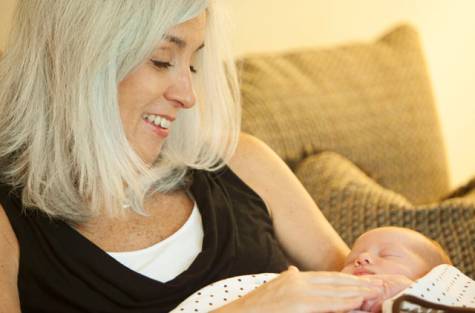
Grandma gives birth to her own grandchild

September 8, 2012

Cindy

Chicago, September 8: ?Setting foot in a hospital again, Emily and Mike Jordan couldn't help but feel anxious.

More than two years before, at age 29, Emily had been diagnosed with cervical cancer. But just before she was to undergo a radical hysterectomy, she was told that she was pregnant.

Faced with saving her own life or their unborn child's, the young couple made the excruciating decision to go forward with her surgery. It meant losing the baby, and forfeiting any chance at having their own children.

Or so they thought.

“I can't describe what that was like after finding out you have cancer, after finding out your chance of ever carrying a baby is gone,” Emily says, still stammering at times as she recounts that painful day in 2010.

Simply put, her body no longer had a place where a baby could grow.

But now, more than two years later, she and Mike had come from their suburban Chicago home to the labour and delivery department of a downtown hospital to realise the dream they thought was lost — to become parents, though not the way they, or most people, would have imagined.

Alongside them that day was Emily's mother, Cindy Reutzel — a fit, silver-haired 53-year-old grandmother whose profile revealed a round belly, a pregnant belly.

Reutzel was about to give birth to her own grandchild.

Just 34 years ago, Louise Brown, the first “test tube” baby, was born in Great Britain. The result? A veritable in-vitro baby boom.

It started with would-be mothers in their 20s and 30s. “Then people started pushing the envelope,” says Dr Helen Kim, director of the in vitro

fertilisation programme at the University of Chicago. “If you could help a menopausal woman in her 30s, could you help a menopausal woman in her 40s? And then it became, ‘Can you help a menopausal woman in her 50s?'

“And the answer is yes.”

Some older women were having their own babies. But more often, they were using egg donors to have their own children, or serving as surrogates or “gestational carriers”.

There was the 51-year-old grandmother in Brazil who gave birth to her twin grandchildren in 2007. There've been others, grandmothers in their 40s or 50s and even 60s.

Cindy Reutzel, Emily's mom, had a vague recollection of those stories. So when doctors shared the good news that they had been able to keep Emily's ovaries intact, Reutzel immediately made the offer.

“What if I carried your baby for you?” she asked.

Emily and Mike didn't take it too seriously at first. “We didn't really think that was a realistic option,” says Emily, who works in hospital administration.

It turned out, though, that it wasn't really that far-fetched after all, particularly for a young grandmother who's in good health, like Reutzel.

After a process that included psychological evaluation and hormonal manipulation to prepare their bodies, Kim eventually implanted Reutzel's uterus with an embryo created with an egg from Emily and Mike's sperm.

It was no easy process, with a regimen of hormonal shots. Work schedules were interrupted and vacations postponed. But Reutzel was committed.

“The thought of Emily and Mike not being able to have children and share that piece of their lives with someone just broke my heart,” says Reutzel, who lives in Chicago and is executive director at medical foundation. “I want Emily to have that connection with another human being like I had with her.”

As her belly grew, people started asking about “her baby”. But she was quick to tell them the story. This was not her baby, she was Grandma.

Admittedly, she says, she worried about the physical toll pregnancy might take, though her body handled it better than she expected. She also wondered how well she'd bounce back from a Caesarean section. That's how she had delivered Emily and her older brother, but that had been three decades ago.

Still, she reassured Emily and Mike throughout the pregnancy that the baby was fine, she was fine, everything would be fine.

Humour helped. Mike often teased his mother-in-law each time they'd take her to dinner or do something nice for her.

“Are we even yet?” he'd ask.

“Not yet,” she'd reply, laughing.

In truth, Mike and Emily knew there'd really be no way to repay this kind of gesture.

“This is a continuation of everything that she has done her entire life for me, which is to make sure that I have the best life possible,” Emily says.

All they could do, they said, was to promise to raise their baby as best they could. And that was enough for Reutzel.

“I know I gave a gift,” she says. “But I'm also getting so much in return.”

Last week, a few days after Emily's 32nd birthday, daughter sat next to mother, holding hands in the delivery room.

And Elle Cynthia Jordan was born.

“She looks just like you! She looks just like you!” Emily shouted, running from the delivery room to introduce their newborn to Mike.

Reutzel is recovering well. She even says she'd consider doing it again.

“When I watch both of them hold that baby and look into her face, it's like everything I could have imagined wanting for them — better than I could have imagined,” she says, her eyes filling with tears.

“This is what it was all about for me.”

Comments

Add new comment

  • Coastaldigest.com reserves the right to delete or block any comments.
  • Coastaldigset.com is not responsible for its readers’ comments.
  • Comments that are abusive, incendiary or irrelevant are strictly prohibited.
  • Please use a genuine email ID and provide your name to avoid reject.
Agencies
March 29,2020

A shrimp seller at the wet market in the Chinese city of Wuhan believed to be the centre of the coronavirus pandemic, may be the first person to have tested positive for the disease, a media report said on Saturday.

The report by the London-based Metro newspaper said that 57-year-old woman, named by the Wall Street Journal as Wei Guixian, was selling shrimp at the Huanan Seafood Market when she developed what she thought was a cold last December.

Chinese digital news outlet, The Paper has said that she may be epatient zero'.

Wei was told by doctors her illness was "ruthless" and other workers at the market had come to the Wuhan Union Hospital with the same symptoms, the Metro newspaper report quoted the outlet as saying.

"Every winter, I suffer from the flu, so I thought it was the flu," the woman was quoted as saying by The Paper news outlet.

The shrimp seller added that she believed she contracted the coronavirus from the shared toilet in the market.

She said the fatal disease would have killed fewer people if the government had acted sooner.

Wuhan Municipal Health Commission has confirmed that Wei was among the first 27 people to test positive for the coronavirus.

It said she was one of 24 cases with direct links to the market, the Metro newspaper reported.

Though Wei may be "patient zero", it does not mean she is the first person to have contracted the virus, added the Metro report.

Chinese researchers have claimed that the first person diagnosed with the airborne virus had no contact with the seafood market and was identified on December 1, 2019.

Wei was later quarantined when a connection was made between the bug and the market before recovering in January.

As of Saturday, the global number of coronavirus cases stood at 104,837 with 27,862 deaths, according to the latest update by the Washington-based Johns Hopkins University.

The US has the highest number of cases at 104,837, followed by Italy 86,498 and China 81,948.

Italy has recorded the highest number of fatalities with 9,134 deaths, followed by Spain and China, at 5,138 and 3,299, respectively.

Comments

Add new comment

  • Coastaldigest.com reserves the right to delete or block any comments.
  • Coastaldigset.com is not responsible for its readers’ comments.
  • Comments that are abusive, incendiary or irrelevant are strictly prohibited.
  • Please use a genuine email ID and provide your name to avoid reject.
News Network
April 30,2020

London, Apr 30: The coronavirus is roiling global job markets, but the picture is not all gloomy. Finance, technology and consumer goods firms are hiring tens of thousands in the United States and other countries, according to data from Microsoft Corp's professional networking site LinkedIn.

Across seven countries in North America, Europe and Asia, healthcare providers are among the busiest recruiters given the ongoing battle against the novel coronavirus, which has killed over 200,000 people and infected over 3 million people worldwide, LinkedIn said. But lifestyle changes during lockdown are also driving demand for financial consultants, factory workers, animators and game designers, and delivery workers.

Overall, the hiring rate has plunged in the first quarter from the year-ago period, and in late April remains lower than a year ago across most countries surveyed by the platform. But the data offer a glimmer of hope with a gradual uptick in China, where the coronavirus emerged last year and which leads the world in surfacing from a months-long lockdown.

LinkedIn, with over 690 million users worldwide, counts new hires when people add a new employer to their profile. The rate is the number of new hires divided by the total number of LinkedIn members in a country.

The figures, tracked since mid-February, are not corroborated by official jobs data and do not represent the actual number of jobs in an economy. Government figures are usually released with a time-lag of several weeks.

"We are confident that our data is directionally correct in that there has been a huge decline in hiring in the U.S. and abroad," Guy Berger, principal economist at LinkedIn in California, told Reuters.

Hiring in China plummeted 50% during the height of its coronavirus crisis in mid-February from 12 months earlier. Since restrictions were eased in early April, the hiring rate has inched up, and for the week ending April 24 was 3% lower than the same period in 2019.

Hiring in the United States, United Kingdom, France and Italy - which lead the world in coronavirus-related deaths - remains hugely depressed, but is falling less rapidly than a few weeks ago as the countries pass the peak of their epidemics.

Retailers including Walmart Inc, Amazon.com Inc and Instacart have said they would hire a total of over 700,000 workers to meet a surge in demand for groceries and household essentials during the coronavirus outbreak.

Coronavirus state-wise India update: Total number of confirmed cases, deaths on April 30

Consumer goods manufacturers such as Unilever, whose products include soap and shampoo, confirmed on Wednesday it was hiring to fill 300 jobs globally, but declined to elaborate.

Nestle told Reuters it was looking to fill 5,000 full-time U.S. positions in "a variety of levels across corporate and frontline."

Fidelity Investments, a Boston-based financial services firm, said it had accelerated recruitment because of the pandemic and was looking to fill at least 2,000 full-time roles for financial consultants, software engineers and customer service staff in the United States in 2020.

Companies hiring in the United States and other countries also include Apple Inc; ByteDance, the Chinese parent of video-sharing social network TikTok; Takeda Pharmaceutical Co Ltd; and aerospace and defence company Lockheed Martin Corp. These companies did not immediately respond to requests for comment.

DIRE WARNINGS

The International Labour Organization warned on Wednesday that 1.6 billion workers, or nearly half of the global workforce, especially in the informal economy, could lose their livelihoods.

Record numbers of people have applied for U.S. jobless benefits since mid-March, and the unemployment rate is expected to soar to 16%, White House economic adviser Kevin Hasset said this week, from a 50-year low of 3.5% before the pandemic hit.

Both Italy and France, in lockdown for nearly two months, have seen hiring rates drop by around 70% from a year ago, according to LinkedIn.

Since China is ahead of other countries on the pandemic timeline, improvements there could suggest the same is in store elsewhere, Berger said. Several American states and European countries have begun allowing some non-essential businesses and schools to reopen in the hopes of restarting the economy and allowing a gradual return to normal life.

"It's still slightly early to call it a firm recovery," Berger said, referring to improving prospects in China. "We're not expecting a full recovery but rather it's an indication that parts of the economy will switch on as lockdowns are eased, at least relative to the worst point of the pandemic."

Comments

Add new comment

  • Coastaldigest.com reserves the right to delete or block any comments.
  • Coastaldigset.com is not responsible for its readers’ comments.
  • Comments that are abusive, incendiary or irrelevant are strictly prohibited.
  • Please use a genuine email ID and provide your name to avoid reject.
News Network
April 10,2020

Melbourne, Apr 10: Scientists have identified six drug candidates from more than 10,000 compounds that may help treat COVID-19.

The research, published in the journal Nature, tested the efficacy of approved drugs, drug candidates in clinical trials and other compounds.

"Currently there are no targeted therapeutics or effective treatment options for COVID-19," said Professor Luke Guddat from the University of Queensland in Australia.

"In order to rapidly discover lead compounds for clinical use, we initiated a programme of high-throughput drug screening, both in laboratories and also using the latest computer software to predict how different drugs bind to the virus," Guddat said.

The project targeted the main COVID-19 virus enzyme, known as the main protease or Mpro, which plays a pivotal role in mediating viral replication, the researchers said.

This makes it an attractive drug target for this virus, and as people don't naturally have this enzyme, compounds that target it are likely to have low toxicity, they said.

"We add the drugs directly to the enzyme or to cell cultures growing the virus and assess how much of each compound is required to stop the enzyme from working or to kill the virus. If the amount is small, then we have a promising compound for further studies," said Guddat.

After assaying thousands of drugs, researchers found of the six that appear to be effective in inhibiting the enzyme, one is of particular interest.

"We're particularly looking at several leads that have been subjected to clinical trials including for the prevention and treatment of various disorders such as cardiovascular diseases, arthritis, stroke, atherosclerosis and cancer," Guddat said.

Researchers said compounds that are already along the pipeline to drug discovery are preferred, as they can be further tested as antivirals at an accelerated rate compared to new drug leads that would have to go through this process from scratch.

"With continued and up-scaled efforts we are optimistic that new candidates can enter the COVID-19 drug discovery pipeline in the near future," Guddat said.

Comments

Add new comment

  • Coastaldigest.com reserves the right to delete or block any comments.
  • Coastaldigset.com is not responsible for its readers’ comments.
  • Comments that are abusive, incendiary or irrelevant are strictly prohibited.
  • Please use a genuine email ID and provide your name to avoid reject.