



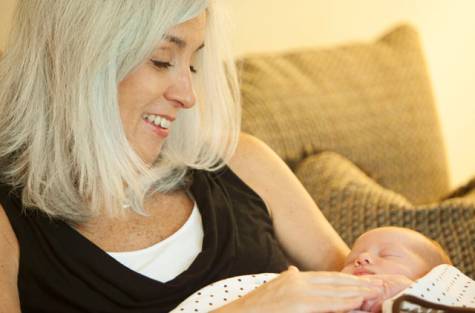
Grandma gives birth to her own grandchild

September 8, 2012

Cindy

Chicago, September 8: ?Setting foot in a hospital again, Emily and Mike Jordan couldn't help but feel anxious.

More than two years before, at age 29, Emily had been diagnosed with cervical cancer. But just before she was to undergo a radical hysterectomy, she was told that she was pregnant.

Faced with saving her own life or their unborn child's, the young couple made the excruciating decision to go forward with her surgery. It meant losing the baby, and forfeiting any chance at having their own children.

Or so they thought.

“I can't describe what that was like after finding out you have cancer, after finding out your chance of ever carrying a baby is gone,” Emily says, still stammering at times as she recounts that painful day in 2010.

Simply put, her body no longer had a place where a baby could grow.

But now, more than two years later, she and Mike had come from their suburban Chicago home to the labour and delivery department of a downtown hospital to realise the dream they thought was lost — to become parents, though not the way they, or most people, would have imagined.

Alongside them that day was Emily's mother, Cindy Reutzel — a fit, silver-haired 53-year-old grandmother whose profile revealed a round belly, a pregnant belly.

Reutzel was about to give birth to her own grandchild.

Just 34 years ago, Louise Brown, the first “test tube” baby, was born in Great Britain. The result? A veritable in-vitro baby boom.

It started with would-be mothers in their 20s and 30s. “Then people started pushing the envelope,” says Dr Helen Kim, director of the in vitro

fertilisation programme at the University of Chicago. “If you could help a menopausal woman in her 30s, could you help a menopausal woman in her 40s? And then it became, ‘Can you help a menopausal woman in her 50s?'

“And the answer is yes.”

Some older women were having their own babies. But more often, they were using egg donors to have their own children, or serving as surrogates or “gestational carriers”.

There was the 51-year-old grandmother in Brazil who gave birth to her twin grandchildren in 2007. There've been others, grandmothers in their 40s or 50s and even 60s.

Cindy Reutzel, Emily's mom, had a vague recollection of those stories. So when doctors shared the good news that they had been able to keep Emily's ovaries intact, Reutzel immediately made the offer.

“What if I carried your baby for you?” she asked.

Emily and Mike didn't take it too seriously at first. “We didn't really think that was a realistic option,” says Emily, who works in hospital administration.

It turned out, though, that it wasn't really that far-fetched after all, particularly for a young grandmother who's in good health, like Reutzel.

After a process that included psychological evaluation and hormonal manipulation to prepare their bodies, Kim eventually implanted Reutzel's uterus with an embryo created with an egg from Emily and Mike's sperm.

It was no easy process, with a regimen of hormonal shots. Work schedules were interrupted and vacations postponed. But Reutzel was committed.

“The thought of Emily and Mike not being able to have children and share that piece of their lives with someone just broke my heart,” says Reutzel, who lives in Chicago and is executive director at medical foundation. “I want Emily to have that connection with another human being like I had with her.”

As her belly grew, people started asking about “her baby”. But she was quick to tell them the story. This was not her baby, she was Grandma.

Admittedly, she says, she worried about the physical toll pregnancy might take, though her body handled it better than she expected. She also wondered how well she'd bounce back from a Caesarean section. That's how she had delivered Emily and her older brother, but that had been three decades ago.

Still, she reassured Emily and Mike throughout the pregnancy that the baby was fine, she was fine, everything would be fine.

Humour helped. Mike often teased his mother-in-law each time they'd take her to dinner or do something nice for her.

“Are we even yet?” he'd ask.

“Not yet,” she'd reply, laughing.

In truth, Mike and Emily knew there'd really be no way to repay this kind of gesture.

“This is a continuation of everything that she has done her entire life for me, which is to make sure that I have the best life possible,” Emily says.

All they could do, they said, was to promise to raise their baby as best they could. And that was enough for Reutzel.

“I know I gave a gift,” she says. “But I'm also getting so much in return.”

Last week, a few days after Emily's 32nd birthday, daughter sat next to mother, holding hands in the delivery room.

And Elle Cynthia Jordan was born.

“She looks just like you! She looks just like you!” Emily shouted, running from the delivery room to introduce their newborn to Mike.

Reutzel is recovering well. She even says she'd consider doing it again.

“When I watch both of them hold that baby and look into her face, it's like everything I could have imagined wanting for them — better than I could have imagined,” she says, her eyes filling with tears.

“This is what it was all about for me.”

Comments

Add new comment

  • Coastaldigest.com reserves the right to delete or block any comments.
  • Coastaldigset.com is not responsible for its readers’ comments.
  • Comments that are abusive, incendiary or irrelevant are strictly prohibited.
  • Please use a genuine email ID and provide your name to avoid reject.
News Network
April 27,2020

London, Apr 27: British Prime Minister Boris Johnson returns to work on Monday more than three weeks after being hospitalised for the coronavirus and spending three days in intensive care.

Johnson, one of the highest-profile people to have contracted the virus, returned to 10 Downing Street on Sunday evening and will chair a meeting on Monday morning of the coronavirus "war cabinet", his colleagues confirmed.

Dominic Raab, the foreign secretary who has deputised in Johnson's absence, told the BBC on Sunday that his return would be a "boost for the government and a boost for the country".

Raab also claimed the prime minister was "raring to go".

Johnson, 55, was admitted to hospital on April 5 suffering from "persistent symptoms" of the deadly disease.

His condition worsened and he later admitted after being put in intensive care that "things could have gone either way".

He was discharged on April 12 and has been recuperating at his official residence, west of London.

In a video message after leaving hospital, Johnson thanked "Jenny from New Zealand and Luis from Portugal" for helping him recover.

On medical advice, he has not been doing official government work during his convalescence but has spoken to Queen Elizabeth and US President Donald Trump on the phone.

The British leader was diagnosed with the virus late last month but initially stayed at Downing Street and was filmed taking part in a round of applause for health workers in the days before he went to hospital.

Comments

Add new comment

  • Coastaldigest.com reserves the right to delete or block any comments.
  • Coastaldigset.com is not responsible for its readers’ comments.
  • Comments that are abusive, incendiary or irrelevant are strictly prohibited.
  • Please use a genuine email ID and provide your name to avoid reject.
News Network
April 24,2020

Toronto, Apr 25: Canadian Prime Minister Justin Trudeau on Thursday (local time) announced a new CAD 1.1 billion package supporting vaccine research and clinical trials as well as expanded testing capacity.

"We are putting in place an additional CAD 1.1 billion dollars for a national medical and research strategy to address COVID-19," Trudeau said during his daily novel coronavirus pandemic briefing on Thursday.

"This plan has three pillars -- research on vaccines and other treatments, support for clinical trials and expanding national testing and modelling," he added.

Trudeau pointed out that CAD 82 million of the total sum will be directed to the development of a vaccine and treatments against the virus, while CAD 471 million will go towards supporting clinical trials.

A further CAD 249 million is being allocated for expanding testing capacity and modelling, the Prime Minister added.

According to Trudeau, this funding will be allotted to a new "immunity task force" commissioned with conducting serology testing -- blood tests looking for the presence of antibodies indicative of exposure to the virus and subsequent immune response.

He said the taskforce, comprising the country's top medical experts, including Chief Public Health Officer Dr Theresa Tam, will test at least a million Canadians over the next two years.

The funding announced today comes in addition to the CAD 200 million committed for COVID-19-related research on March 11.

Trudeau has repeatedly stressed the daily constraints that much of the population is adhering to will be the new normal until a vaccine is developed.

As of Thursday, Canada has confirmed a total of 40,824 COVID-19 cases since the onset of the outbreak, out of which more than 2,000 have proven to be fatal, according to the latest figures from the country's public health agency.

Comments

Add new comment

  • Coastaldigest.com reserves the right to delete or block any comments.
  • Coastaldigset.com is not responsible for its readers’ comments.
  • Comments that are abusive, incendiary or irrelevant are strictly prohibited.
  • Please use a genuine email ID and provide your name to avoid reject.
Agencies
May 26,2020

UN, May 26: Countries could see a "second peak" of coronavirus cases during the first wave of the pandemic if lockdown restrictions were lifted too soon, the World Health Organization (WHO) has warned.

Mike Ryan, the WHO's head of emergencies, told a briefing on Monday that the world was "right in the middle of the first wave", the BBC reported.

He said because the disease was "still on the way up", countries need to be aware that "the disease can jump up at any time".

"We cannot make assumptions that just because the disease is on the way down now that it's going to keep going down," Ryan said.

There would be a number of months to prepare for a second peak, he added.

The stark warning comes as countries around the world start to gradually ease lockdown restrictions, allowing shops to reopen and larger groups of people to gather.

Experts have said that without a vaccine to give people immunity, infections could increase again when social-distancing measures are relaxed.

Ryan said countries where cases are declining should be using this time to develop effective trace-and-test regimes to "ensure that we continue on a downwards trajectory and we don't have an immediate second peak".

Also on Monday, Tedros Adhanom Ghebreyesus, WHO Director-General, said that a clinical trial of hydroxychloroquine (HCQ) on COVID-19 patients has come to "a temporary pause", while the safety data of the the anti-malaria drug was being reviewed.

According to the WHO chief, The Lancet medical journal on May 22 had published an observational study on HCQ and chloroquine and its effects on COVID-19 patients that have been hospitalized, reports Xinhua news agency.

The authors of the study reported that among patients receiving the drug, when used alone or with a macrolide, they estimated a higher mortality rate.

"The Executive Group of the Solidarity Trial, representing 10 of the participating countries, met on Saturday (May 23) and has agreed to review a comprehensive analysis and critical appraisal of all evidence available globally," Tedros said in a virtual press conference.

The developments come as the total number of global COVID-19 cases has increased to 5,508,904, with 346,508 deaths, according to the Johns Hopkins University.

Comments

Add new comment

  • Coastaldigest.com reserves the right to delete or block any comments.
  • Coastaldigset.com is not responsible for its readers’ comments.
  • Comments that are abusive, incendiary or irrelevant are strictly prohibited.
  • Please use a genuine email ID and provide your name to avoid reject.