



Two Americans killed in confused Afghan shootout

October 1, 2012

American_killed

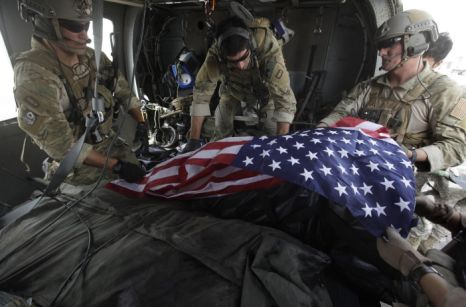
Kabul, October 1: Two Americans were killed in Afghanistan during an exchange of fire between NATO-led forces and the Afghan army that may have been the result of a misunderstanding, as the death toll of US military and civilian personnel passed 2,000.

A US official, who asked not to be identified, said on Sunday that an American soldier and a civilian contractor had been killed in the incident in eastern Afghanistan, the circumstances of which remain unclear.

The coalition initially said the incident may have been the result of an “insider attack” and another example of a member of the Afghan national security force turning on coalition troops in a war that began in 2001.

But it later said that nearby insurgent gunfire may have led to a misunderstanding.

“The circumstances were somewhat confused … There was a report of insurgent firing taking place in this incident which we believe may have been a factor,” Lt. General Adrian Bradshaw, deputy commander of the NATO-led coalition, said.

It was the latest setback for the coalition after the United States said joint operations with Afghan forces were returning to normal.

Joint operations were halted two weeks ago after a surge of attacks on the NATO-led International Security Assistance Force (ISAF) by its Afghan allies. At least 52 ISAF service members have been killed this year in so-called “green-on-blue” attacks.

The suspension of joint operations was a blow for NATO which wants to train the 350,000 members of the Afghan security forces so that they can try to ensure stability after coalition forces withdraw.

Pentagon data listing the number of U.S. troops and U.S. contractors killed in Afghanistan since combat began 11 years ago showed the two new deaths pushed the total combined number of U.S. personnel killed past the 2,000 mark.

The attack took place in the Sayed Abad district of the Wardak province, according to local police sources, who said a gun battle had broken out between coalition soldiers and Afghans when an Afghan National Army member opened fire on American troops.

Three members of the Afghan National Army were also killed in the firefight, while three other U.S. citizens and one Afghan were wounded, police spokesman Wali Mohammad said on Sunday.

“We appreciate the sacrifice of our fallen heroes, every death is tragic and important – none more than any other,” ISAF said in a statement after the incident on Saturday.

Tension between coalition forces and their Afghan allies has been rising due to an escalation of so-called “insider” attacks, but Bradshaw denied the incident was a reflection of growing mistrust between Afghan and coalition forces.

“There is a very strong relationship between ISAF (the International Security Assistance Force) and our Afghan colleagues,” Bradshaw told a press conference late on Sunday.

Separately on Saturday, police in eastern Kunar province said they had found the beheaded bodies of three male civilians in a forest.

The Taliban had kidnapped the men three days ago for allegedly spying for the government and NATO forces, Kunar police chief Shirwah Sameen said.


Comments

Add new comment

  • Coastaldigest.com reserves the right to delete or block any comments.
  • Coastaldigset.com is not responsible for its readers’ comments.
  • Comments that are abusive, incendiary or irrelevant are strictly prohibited.
  • Please use a genuine email ID and provide your name to avoid reject.
Agencies
June 12,2020

Kabul, Jun 12: A blast in a mosque during Friday prayers in the western part of capital Kabul has killed at least four people and wounded many more, Afghanistan's interior ministry said.

"Explosives placed inside the Sher Shah Suri Mosque exploded during Friday prayers," said a statement issued by the ministry, which added that the mosque's prayer leader Mofleh Frotan was among those killed.

Interior ministry spokesman Tariq Arian said police have cordoned off the area and helped move the wounded to ambulances and nearby hospitals.

No group immediately claimed responsibility for the attack but a mosque attack earlier this month was claimed by an ISIL (or ISIS) group affiliate, headquartered in eastern Afghanistan's Nangarhar province.

"Interestingly, every time you have the peace process gaining some momentum and pace, you have these kinds of attacks in the country," Habib Wardak, a national security analyst based in Kabul, told Al Jazeera.

"The Islamic State group claimed responsibility for the attack that happened last week on a mosque in Kabul, so despite the fact that you have these news and press conference from the government that they have eliminated ISIL, how can they conduct such sophisticated operations?"

Friday's blast had parallels to one earlier this month, when an explosion tore apart a famous Kabul mosque and led to the death of renowned Afghan cleric Maulvi Ayaz Niazi.

"In this attack, the imam seems to be the target, not the rest of the crowd. These are the imams who have supported the peace process with the Taliban movement," Wardak said.

"The other political aspect for these kinds of attacks is that there are peace spoilers trying to convey a message that peace with the Taliban will not eradicate violence in the country because you have ISIL."

Violence has spiked in recent weeks in Afghanistan with most of the attacks claimed by the ISIL affiliate.

The United States blamed the armed group for a horrific attack last month on a maternity hospital in the capital that killed 24 people, including two infants and several new mothers.

The ISIL affiliate also took responsibility for an attack on a bus carrying journalists in Kabul on May 30, killing two.

It also claimed credit for an attack on the funeral of a strongman loyal to the government last month that killed 35 people.

Meanwhile, the US is attempting to broker peace talks between the Afghan government and the Taliban to end 18 years of war.

Washington's peace envoy Zalmay Khalilzad was in the region earlier this week trying to resuscitate a US peace deal with the Taliban.

The peace deal signed in February calls for the withdrawal of the US and NATO troops from Afghanistan in return for a commitment by the Taliban to not launch attacks on the US or its allies.

Comments

Add new comment

  • Coastaldigest.com reserves the right to delete or block any comments.
  • Coastaldigset.com is not responsible for its readers’ comments.
  • Comments that are abusive, incendiary or irrelevant are strictly prohibited.
  • Please use a genuine email ID and provide your name to avoid reject.
News Network
May 30,2020

Washington, May 30: The United States will end its relationship with the World Health Organization over the body’s handling of the coronavirus pandemic, U.S. President Donald Trump said on Friday, accusing the U.N. agency of becoming a puppet of China.

The move to quit the Geneva-based body, which the United States formally joined in 1948, comes amid growing tensions between Washington and Beijing over the coronavirus outbreak. The virus first emerged in China’s Wuhan city late last year.

Speaking in the White House Rose Garden, Trump said Chinese officials “ignored their reporting obligations” to the WHO about the virus - that has killed hundreds of thousands of people globally - and pressured the agency to “mislead the world.”

“China has total control over the World Health Organization despite only paying $40 million per year compared to what the United States has been paying which is approximately $450 million a year,” he said.

Trump’s decision follows a pledge last week by Chinese President Xi Jinping to give $2 billion to the WHO over the next two years to help combat the coronavirus. The amount almost matches the WHO’s entire annual program budget for last year.

Trump last month halted funding for the 194-member organization, then in a May 18 letter gave the WHO 30 days to commit to reforms.

“Because they have failed to make the requested and greatly needed reforms, we will be today terminating our relationship with the World Health Organization and redirecting those funds to other worldwide and deserving urgent global public health needs,” Trump said on Friday.

It was not immediately clear when his decision would come into effect. A 1948 joint resolution of Congress on U.S. membership of the WHO said the country “reserves its right to withdraw from the organization on a one-year notice.”

The World Health Organization did not immediately respond to a request for comment on Trump’s announcement. It has previously denied Trump’s assertions that it promoted Chinese “disinformation” about the virus.

“It’s important to remember that the WHO is a platform for cooperation among countries,” said Donna McKay, executive director of Physicians for Human Rights. “Walking away from this critical institution in the midst of an historic pandemic will hurt people both in the United States and around the world.”

‘ABSOLUTELY CRITICAL’

The United States currently owes the WHO more than $200 million in assessed contributions, according to the WHO website. Washington also gives several hundred million dollars annually in voluntary funding tied to specific WHO programs such as polio eradication, HIV, hepatitis and tuberculosis.

Amesh A. Adalja, a senior scholar at Johns Hopkins Center for Health Security, said that in practice Trump’s decision was unlikely to change the operations of the WHO.

“From a symbolic or moral standpoint it’s the wrong type of action to be taking in the middle of a pandemic and seems to deflect responsibility for what we in the U.S. failed to do and blame the WHO,” said Adalja.

When Trump halted funding to the WHO last month, two Western diplomats said the U.S. suspension was more harmful politically to the WHO than to the agency’s current programs, which are funded for now.

The WHO is an independent international body that works with the United Nations. U.N. Secretary-General Antonio Guterres said last month that the WHO is “absolutely critical to the world’s efforts to win the war against COVID-19.”

When asked about Trump’s decision, a U.N. spokesman said: “We have consistently called for all states to support WHO.”

Trump has long scorned multilateralism as he focuses on an “America First” agenda. Since taking office, he has quit the U.N. Human Rights Council, the U.N. cultural agency, a global accord to tackle climate change and the Iran nuclear deal. He has also cut funding for the U.N. population fund and the U.N. agency that aids Palestinian refugees.

“The WHO is the world’s early warning system for infectious diseases,” said U.S. Representative Nita Lowey, a Democrat who chairs the House Committee on Appropriations. “Now, during a global pandemic that has cost over 100,000 American lives, is not the time to put the country further at risk.”

Comments

Add new comment

  • Coastaldigest.com reserves the right to delete or block any comments.
  • Coastaldigset.com is not responsible for its readers’ comments.
  • Comments that are abusive, incendiary or irrelevant are strictly prohibited.
  • Please use a genuine email ID and provide your name to avoid reject.
News Network
June 16,2020

Beijing, Jun 16: The coronavirus situation in China's capital is "extremely severe", a city official warned Tuesday, as 27 new infections were reported from Beijing where a new cluster has sparked a huge trace-and-test programme.

The COVID-19 resurgence -- believed to have started at the sprawling Xinfadi wholesale food market in the capital -- has sparked alarm as China had largely brought its outbreak under control through mass testing and lockdowns imposed earlier in the year.

The new cases took the number of confirmed infections in Beijing over the past five days to 106, as authorities locked down almost 30 communities in the city and tested tens of thousands of people.

"The epidemic situation in the capital is extremely severe," Beijing city spokesman Xu Hejian warned at a press conference.

The World Health Organization had already expressed concern about the cluster, pointing to Beijing's size and connectivity.

Officials in the capital have said they will test stall owners and managers at all of the city's food markets, restaurants and government canteens.

Beijing's coronavirus testing capacity has been expanded to 90,000 a day, according to China's official news agency Xinhua.

On Tuesday, the capital's transport commission banned taxi- and ride-hailing services from driving out of the city, Xinhua reported, in another move to try and contain the new outbreak.

All indoor sports and entertainment venues in Beijing were ordered to shut on Monday, and some other cities across China warned they would quarantine those arriving from the capital.

The National Health Commission also reported four new domestic infections in Hebei province, which surrounds Beijing, and a case reported in southwestern Sichuan province was linked to the Beijing cluster.

Authorities were also racing to track people from Beijing who had travelled to other parts of China, and those who visited the capital have been encouraged to get tested.

Beijing spokesman Xu said: "High-risk people who have left Beijing must inform local authorities immediately."

Market inspections

Authorities shut down another market on Tuesday -- Tiantaohonglian in the central Xicheng district -- after one employee there was diagnosed with COVID-19, state broadcaster CCTV reported.

Seven residential estates surrounding that market were also locked down.

In total, Beijing officials said Tuesday they have disinfected 276 agricultural markets, closed 11 markets, and disinfected more than 33,000 food and beverage businesses in a bid to stamp out the new cluster.

Officials had warned Sunday that since May 30, 200,000 people had visited the Xinfadi market -- the original site of the new outbreak.

More than 8,000 workers from Xinfadi have been tested and sent to centralised quarantine facilities.

Until this recent outbreak, most of China's cases in recent months were nationals returning home as the pandemic spread to other countries.

China's Center for Disease Control and Prevention said Monday that the virus strain found in the Beijing outbreak was a "major epidemic strain in the European countries".

While the virus was detected on chopping boards used to handle imported salmon at Xinfadi, "it does not clearly or definitely indicate it's from imported seafood", Wu Zunyou, the body's chief epidemiologist, said in an interview with state broadcaster CCTV.

"Ever since new cases suddenly emerged in Beijing, we have tried to figure out the reasons for the outbreak since there were no COVID-19 cases found over the past two months," Wu Zunyou said.

"We came up with several possibilities, and the most likely one is that the carrier of the novel coronavirus comes from outside China or other parts of China and brought it here."

On Tuesday, another eight imported cases were reported.

Comments

Add new comment

  • Coastaldigest.com reserves the right to delete or block any comments.
  • Coastaldigset.com is not responsible for its readers’ comments.
  • Comments that are abusive, incendiary or irrelevant are strictly prohibited.
  • Please use a genuine email ID and provide your name to avoid reject.