


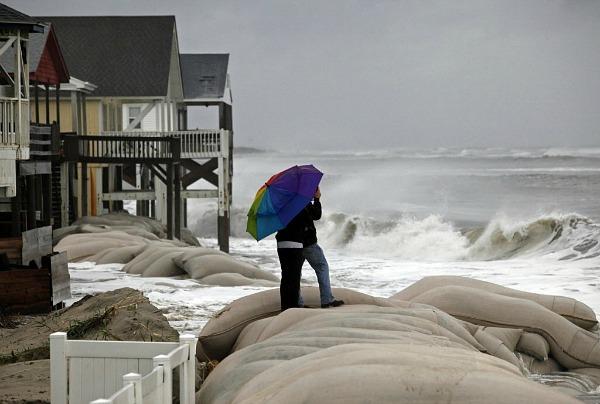
Hurricane Sandy: Emergency declared in New York

[email protected] (New York Times)
October 29, 2012

hurricane-sandy

New York, October 29: Hurricane Sandy, a menacing monster of a storm that forecasters said would bring "life-threatening" flooding, churned toward some of the nation's most densely populated areas on Sunday, prompting widespread evacuations and the shutdown of the New York City transit system.

Officials warned that the hurricane, pushing north from the Caribbean after leaving more than 60 people dead in its wake, could disrupt life in the Northeast for days.

New York went into emergency mode, ordering the evacuations of more than 370,000 people in low-lying communities from Coney Island in Brooklyn to Battery Park City in Manhattan and giving 1.1 million schoolchildren a day off on Monday. The city opened evacuation shelters at 76 public schools.


The National Hurricane Center said it expected the storm to swing inland, probably on Monday evening. The hurricane center reported that the storm had sustained winds of almost 75 miles an hour.

"We're going to have a lot of impact, starting with the storm surge," said Craig Fugate, the administrator of the Federal Emergency Management Agency. "Think, 'Big.' "


The subway closing began at 7 p.m. to darken every one of the city's 468 stations for the second time in 14 months, as officials encouraged the public to stay indoors and worked to prevent a storm surge from damaging tracks and signal equipment in the tunnels. A suspension of bus service was ordered for 9 p.m.

The closing this year seemed more ominous. The shutdown before Tropical Storm Irene last year began at noon on a Saturday, and service resumed before the workweek started on Monday. This time, officials warned, it might be Wednesday before trains were running again.

Another fear in the Northeast was that winds from the storm might knock down power lines, and that surging waters could flood utility companies' generators and other equipment.

Forecasters said the hurricane was a strikingly powerful storm that could reach far inland. Hurricane-force winds from the storm stretched 175 miles from the center, an unusually wide span, and tropical storm winds extended outward 520 miles. Forecasters said they expected high-altitude winds to whip every state east of the Mississippi River.

President Obama, who attended a briefing with officials from FEMA in Washington called Hurricane Sandy "a big and serious storm." He said federal officials were "making sure that we've got the best possible response to what is going to be a big and messy system."

"My main message to everybody involved is that we have to take this seriously," the president said.

The hurricane center said through the day on Sunday that Hurricane Sandy was "expected to bring life-threatening storm surge flooding to the mid-Atlantic Coast, including Long Island Sound and New York Harbor."

The storm preparations and cancellations were not confined to New York.

Amtrak said it would cancel most trains on the Eastern Seaboard, and Philadelphia shut down its mass transit system.

In the New York area, the Metropolitan Transportation Authority's commuter rail lines, which suffered the heaviest damage during Tropical Storm Irene, were suspended beginning at 7 p.m. on Sunday.

New Jersey Transit began rolling back service gradually at 4 p.m., with a full shutdown expected by 2 a.m.

The Staten Island Ferry was scheduled to stop running by 8:30 p.m., PATH trains at midnight.

The nation's major airlines canceled thousands of flights in the Northeast. The Port Authority of New York and New Jersey, which operates the three major airports in the New York City area, said it expected major carriers to cease operations entirely by Sunday evening. The Coast Guard closed New York Harbor - cruise ships were told to go elsewhere - and the Northeast faced the possibility of being all but shut down on Monday.


Federal offices in the Washington area will be closed; only emergency employees will be on the job. The Washington transit system - its Metrorail subway and its buses - will also be shut down.

The United Nations canceled all meetings at its headquarters in Manhattan.

Broadway shows were canceled on Sunday and Monday, as were performances at Carnegie Hall.

Schools in Baltimore, Boston and Washington called off classes for Monday.

Many public libraries said their reading rooms would be closed for the day, and parks department workers in Central Park told people to leave on Sunday and to stay away until the storm passed.

The New York Stock Exchange, which initially said its trading floor would be open on Monday, decided to close the floor and handle trading electronically. The closing was the first caused by bad weather since Hurricane Gloria in 1985, although the opening bell has been delayed a number of times - once during a blizzard in January 1996 - and the exchange was closed for three days after the Sept. 11 attacks. The Nasdaq exchange, which has long relied on electronic trading, said it would open as usual on Monday.

The hurricane center said the surges could reach 11 feet in New York Harbor, Long Island Sound and Raritan Bay in New Jersey - significantly higher than previous forecasts and significantly above the levels recorded during the tropical storm last year.

Forecasters said the water could top 8 feet from Ocean City, Md., to the border between Connecticut and Rhode Island. They predicted the waves would rise to 6 feet on the south shore of Cape Cod.

Hour after hour on Sunday, long before high tide, high waves pounded the dunes that protect the boardwalk in Rehoboth Beach, Del.

And in East Hampton, N.Y., where Mabel Harmon and her neighbors had spent the day tying down patio furniture, the wind was already "blowing like crazy," she said Sunday afternoon.

Forecasters also warned that rain could saturate the ground and that trees could tumble across roads or onto power lines.

From North Carolina to Connecticut, officials declared emergencies and directed residents to leave areas near the shore.

Delaware ordered coastal communities evacuated by 8 p.m. Sunday.

In New Jersey, gamblers scrambled to play a few last rounds of blackjack before leaving the Atlantic City casinos under orders from Gov. Chris Christie.

He also ordered residents to leave barrier islands from Sandy Hook to Cape May.

In beachfront towns from North Carolina to New Jersey, the surf was spitting, and crews were rushing to build sand walls in places where the beaches had been rebuilt after 2011, when many places were hit by what was still Hurricane Irene.

In Red Hook, Brooklyn, many residents along the streets closest to New York Harbor were in their basements checking sump pumps.

Gino Vitale, a builder and landlord there, was delivering sandbags piled high in the back of his white Ford pickup truck to tenants along Conover Street, a block from New York Bay.

"We dodged most of it with Irene," he said, referring to the storm that flooded basements in Red Hook but not much else. "I'm hoping we can do that again."

For the most part, residents appeared to follow officials' advice to stock up on bottled water, canned food and flashlights - so much so that stores ran low on batteries. Some gas stations in Connecticut had little gasoline left - no regular, and not much premium.

In a flood-prone neighborhood in Philadelphia, Michael Dornblum did something he did not do during Tropical Storm Irene or earlier storms that brought high water - he put 80-pound sandbags outside his family's furniture store. In the past, he has lined them up only inside. He put the additional protection in place as employees prepared to lift carpets and sofas off the showroom floor. Some went to a storage area on the second floor.

Con Edison did not provide an estimate of how long customers in the New York City area might be without power if the storm played havoc with its network; by contrast, the parent company of Jersey Central Power and Light warned as long ago as Friday that repairs could take 10 days after the storm passed through. Another utility in New Jersey, the Public Service Electric and Gas Company, said that restoring power could take a week.

Forecasters said Hurricane Sandy could deliver something besides wind and rain: snow. That is because a system known as a midlatitude trough - which often causes severe winter storms - was moving across the country from the west. It was expected to draw in Hurricane Sandy, giving it added energy.


A blast of arctic air is expected to sweep down through the Canadian Plains just as the two storms converge. That could lead to several feet of heavy, wet snow in West Virginia and lighter amounts in Pennsylvania and Ohio that could bring down trees and power lines if already chilly temperatures drop below freezing.

The full moon on Monday could cause even greater flooding, because tides will be at their peak.

The possibility of a higher surge was one reason that Mayor Michael R. Bloomberg of New York ordered mandatory evacuations in low-lying areas, just as he did before Tropical Storm Irene. One city official said there was particular concern about Con Edison's Lower Manhattan infrastructure, noting that if the storm surge washed over the bulkheads, it could damage the utility's electrical and steam networks. If the surge runs as high as forecast, Con Ed will shut off two electrical networks in Lower Manhattan,

As for the subway shutdown, Mr. Bloomberg said that if the Metropolitan Transportation Authority had not suspended service, but instead had left itself vulnerable to the storm, the city would have risked being without its mass transit network for even longer.

"They do have to make sure that their equipment doesn't get damaged," Mr. Bloomberg said. "Otherwise we would not have subway trains when this is over or buses when it's over."

Joseph J. Lhota, the chairman of the authority, said he expected the transit systems to restore at least some service about 12 hours after the storm ended. But he warned that the city could be without mass transit for as many as two full work days. "I do think Monday and Tuesday are going to be difficult days," Mr. Lhota said.

But while the mayor said schoolchildren could take Monday off, city workers could not: He said that city offices would be open for business.



Comments

Add new comment

  • Coastaldigest.com reserves the right to delete or block any comments.
  • Coastaldigset.com is not responsible for its readers’ comments.
  • Comments that are abusive, incendiary or irrelevant are strictly prohibited.
  • Please use a genuine email ID and provide your name to avoid reject.
Agencies
June 28,2020

Paris, Jun 28: More than 10 million cases of the new coronavirus have been officially declared around the world, half of them in Europe and the United States, according to an AFP tally on Sunday based on official sources.

At least 10,003,942 infections, including 498,779 deaths, have been registered globally.

Europe remains the hardest hit continent with 2,637,546 cases including 195,975 fatalities, while the United States has 2,510,323 infections including 125,539 deaths.

The rate of infections worldwide continues to rise, with one million new cases recorded in just six days.

The tallies, using data collected by AFP from national authorities and information from the World Health Organization (WHO), probably reflect only a fraction of the actual number of infections.

Many countries are testing only symptomatic or the most serious cases and some do not have the capacity to carry out widescale testing.

Comments

Add new comment

  • Coastaldigest.com reserves the right to delete or block any comments.
  • Coastaldigset.com is not responsible for its readers’ comments.
  • Comments that are abusive, incendiary or irrelevant are strictly prohibited.
  • Please use a genuine email ID and provide your name to avoid reject.
News Network
April 21,2020

New York, Apr 21: Oil prices plunged below zero on Monday as demand for energy collapses amid the coronavirus pandemic and traders don't want to get stuck owning crude with nowhere to store it.

Stocks were also slipping on Wall Street in afternoon trading, with the S&P 500 down 0.9%, but the market's most dramatic action was by far in oil, where benchmark U.S. crude for May delivery plummeted to negative $3.70 per barrel, as of 2:15 pm. Eastern time.

Much of the drop into negative territory was chalked up to technical reasons — the May delivery contract is close to expiring so it was seeing less trading volume, which can exacerbate swings. But prices for deliveries even further into the future, which were seeing larger trading volumes, also plunged.

Demand for oil has collapsed so much due to the coronavirus pandemic that facilities for storing crude are nearly full.

Tanks could hit their limits within three weeks, according to Chris Midgley, head of analytics at S&P Global Platts.

Benchmark U.S. crude oil for June delivery, which shows a more ”normal” price, fell 14.8% to $21.32 per barrel, as factories and automobiles around the world remain idled. Big oil producers have announced cutbacks in production in hopes of better balancing supplies with demand, but many analysts say it's not enough.

“Basically, bears are out for blood,” analyst Naeem Aslam of Avatrade said in a report. “The steep fall in the price is because of the lack of sufficient demand and lack of storage place given the fact that the production cut has failed to address the supply glut.”

Halliburton swung between gains and sharp losses, even though it reported stronger results for the first three months of 2020 than analysts expected. The oilfield engineering company said that the pandemic has created so much turmoil in the industry that it “cannot reasonably estimate” how long the hit will last. It expects a further decline in revenue and profitability for the rest of 2020, particularly in North America.

Brent crude, the international standard, was down $1.78 to $26.30 per barrel. .

In the stock market, the mild drops ate into some of the big gains made since late March, driven lately by investors looking ahead to parts of the economy possibly reopening as infections level off in hard-hit areas.

Pessimists have called the rally overdone, pointing to the severe economic pain sweeping the world and continued uncertainty about how long it will last.

The Dow Jones Industrial Average was down 364 points, or 1.5%, to 23,887. The Nasdaq was down 0.1%..

More gains from companies that are winners in the new stay-at-home economy helped limit the market's losses Amazon rose 1.4%, and Netflix jumped 3.8% as people shut in at home buy staples and look to fill their time. Clorox likewise rose toward a new record and was up 1% as households and businesses that remain open look to stay clean.

In Tokyo the Nikkei 225 fell 1.1% after Japan reported that its exports fell nearly 12% in March from a year earlier as the pandemic hammered demand in its two biggest markets, the U.S. and China.

The Hang Seng index in Hong Kong lost 0.2%, and South Korea's Kospi fell 0.8%.

European markets were modestly higher The German DAX was up 0.5%, the French CAC 40 was up 0.7% and the FTSE 100 in London gained 0.7%.

In a sign of continued caution in the market, Treasury yields remained extremely low. The yield on the 10-year Treasury slipped to 0.64% from 0.65% late Friday. It started the year near 1.90%. Bond yields drop when their prices rise, and investors tend to buy Treasurys when they're worried about the economy.

Stocks have been on a generally upward swing recently, and the S&P 500 just closed out its first back-to-back weekly gain since the market began selling off in February. Promises of massive aid for the economy and markets by the Federal Reserve and U.S. government ignited the rally, which sent the S&P 500 up as much as 28.5% since a low on March 23.

More recently, countries around the world have tentatively eased up on business-shutdown restrictions put in place to slow the spread of the virus.

But health experts warn the pandemic is far from over and new flareups could ignite if governments rush to allow ”normal” life to return prematurely.

The S&P 500 remains about 15% below its record high in February as millions more U.S. workers file for unemployment every week amid the shutdowns.

Many analysts also warn that a significant part of the recent recovery in stocks is due to the expectation among some investors that the economy will rebound sharply once economic quarantines are lifted. They're essentially predicting that a line chart of the economy will ultimately resemble the letter “V,” with a wild ride down but then a quick pivot to a vigorous recovery.

That may be to optimistic. “We caution that a U-shaped recovery is also quite likely,” where the economy bottoms out and stays at that low level for a while before recovering, strategists at Barclays warned in a recent report.

Without strong testing programs for COVID-19, businesses likely won't feel comfortable bringing back their full workforces for a while.

”With risk assets now overbought, the chance for a correction has increased,” Morgan Stanley strategists wrote in a report.

Comments

Add new comment

  • Coastaldigest.com reserves the right to delete or block any comments.
  • Coastaldigset.com is not responsible for its readers’ comments.
  • Comments that are abusive, incendiary or irrelevant are strictly prohibited.
  • Please use a genuine email ID and provide your name to avoid reject.
News Network
April 28,2020

Washington, Apr 28: After nearly three weeks in an intensive care unit in Los Angeles, doctors treating 41-year-old Broadway actor Nick Cordero for COVID-19 were forced to amputate his right leg.

The flow of blood had been impeded by a blood clot: yet another dangerous complication of the disease that has been bubbling up in frontline reports from China, Europe and the United States.

To be sure, so-called "thrombotic events" occur for a variety of reasons among intensive care patients, but the rates among COVID-19 patients are far higher than would be otherwise expected.

"I have had 40-year-olds in my ICU who have clots in their fingers that look like they'll lose the finger, but there's no other reason to lose the finger than the virus," Shari Brosnahan, a critical care doctor at NYU Langone said.

One of these patients is suffering from a lack of blood flow to both feet and both hands, and she predicts an amputation may be necessary, or the blood vessels may get so damaged that an extremity could drop off by itself.

Blood clots aren't just dangerous for our limbs, but can make their way to the lungs, heart or brain, where they may cause lethal pulmonary embolisms, heart attacks, and strokes.

A recent paper from the Netherlands in the journal Thrombosis Research found that 31 percent of 184 patients suffered thrombotic complications, a figure that the researchers called "remarkably high" -- even if extreme consequences like amputation are rare.

Behnood Bikdeli, a doctor at New York-Presbyterian Hospital, assembled an international consortium of experts to study the issue. Their findings were published in the Journal of The American College of Cardiology.

The experts found the risks were so great that COVID-19 patients "may need to receive blood thinners, preventively, prophylactically," even before imaging tests are ordered, said Bikdeli.

What exactly is causing it? The reasons aren't fully understood, but he offered several possible explanations.

People with severe forms of COVID-19 often have underlying medical conditions like heart or lung disease -- which are themselves linked to higher rates of clotting.

Next, being in intensive care makes a person likelier to develop a clot because they are staying still for so long. That's why for example people are encouraged to stretch and move around on long haul flights.

It's also now clear the COVID-19 illness is associated with an abnormal immune reaction called "cytokine storm" -- and some research has indicated this too is linked to higher rates of clotting.

There could also be something about the virus itself that is causing coagulation, which has some precedent in other viral illnesses.

A paper in the journal The Lancet last week showed that the virus can infect the inner cell layer of organs and of blood vessels, called the endothelium. This, in theory, could interfere with the clotting process.

According to Brosnahan, while thinners like Heparin are effective in some patients, they don't work for all patients because the clots are at times too small.

"There are too many microclots," she said. "We're not sure exactly where they are."

Autopsies have in fact shown some people's lungs filled with hundreds of microclots.

The arrival of a new mystery however helps solve a slightly older one.

Cecilia Mirant-Borde, an intensive care doctor at a military veterans hospital in Manhattan, told AFP that lungs filled with microclots helped explain why ventilators work poorly for patients with low blood oxygen.

Earlier in the pandemic doctors were treating these patients according to protocols developed for acute respiratory distress syndrome, sometimes known as "wet lung."

But in some cases, "it's not because the lungs are occupied with water" -- rather, it's that the microclotting is blocking circulation and blood is leaving the lungs with less oxygen than it should.

It has just been a little under five months since the virus emerged in Wuhan, China, and researchers are learning more about its impact every day.

"While we react surprised, we shouldn't be as surprised as we were. Viruses tend to do weird things," said Brosnahan.

While the dizzying array of complications may seem daunting, "it's possible there'll be one or a couple of unifying mechanisms that describe how this damage happens," she said.

"It's possible it's all the same thing, and that there'll be the same solution."

Comments

Add new comment

  • Coastaldigest.com reserves the right to delete or block any comments.
  • Coastaldigset.com is not responsible for its readers’ comments.
  • Comments that are abusive, incendiary or irrelevant are strictly prohibited.
  • Please use a genuine email ID and provide your name to avoid reject.