



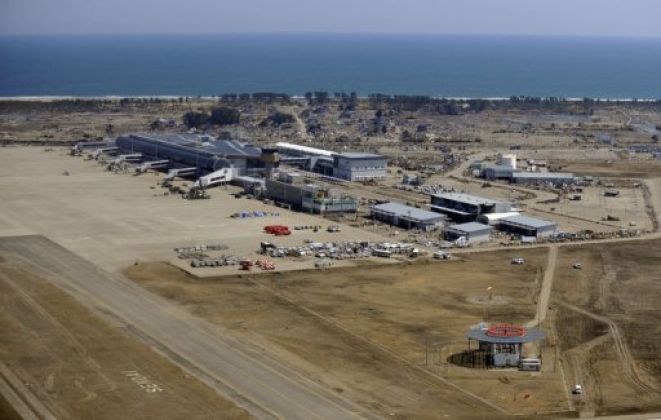
Japan airport reopens with WWII bomb still there

October 31, 2012
sandai_airport

Tokyo, October 31: A huge World War II bomb uncovered near a busy runway was underneath a shield of concrete and sandbags today as flights resumed at an airport in northern Japan, a government official said.

A worker rebuilding drainage systems at Sendai Airport -- which was swamped by last year's tsunami -- on Monday uncovered the 500-pound bomb, believed to have been dropped by US forces.

Bomb disposal experts ordered the construction of three-metre-high concrete walls, supported by soil up to the same height, to protect the bomb.

Crews piled some 300 sandbags, each weighing a tonne, on top of the mound to construct a casing that stands six metres high.

The 110 centimetres long bomb is now sitting at the bottom of the structure, waiting for military experts to defuse and remove it once legal and logistical details are worked out, the transport ministry official said.

"The work to defuse it will start after we discuss the matter with local municipalities and residents," he said.

Troops believe the bomb is unlikely to explode unless unusually strong force is applied, according to local media.

The airport resumed operations, using one of its two runways, after having cancelled all 92 domestic and international flights yesterday.

"We are using our main 3,000-metre runway. So far we are not experiencing any delay to our flight schedule," the land ministry official said around midday.

Nearly 70 years after the war ended, unexploded bombs and shells are still occasionally found in Japan, particularly on the southern island of Okinawa, the site of an extremely bloody battle towards the end of World War II.

Less than two weeks ago, Japanese troops defused a similar 500-pound WWII bomb found in a busy business district of Tokyo.

Sendai Airport was devastated in the quake-triggered tsunami that hit Japan in March 2011. Footage posted on YouTube of waves covering the runway has been seen by more than 20 million people.



Comments

Add new comment

  • Coastaldigest.com reserves the right to delete or block any comments.
  • Coastaldigset.com is not responsible for its readers’ comments.
  • Comments that are abusive, incendiary or irrelevant are strictly prohibited.
  • Please use a genuine email ID and provide your name to avoid reject.
News Network
June 19,2020

London, Jun 19: Malala Yousafzai, the youngest Nobel Peace Prize winner who once took a bullet for campaigning for girls' education in Pakistan, was over the moon on Friday after completing her degree in Philosophy, Politics and Economics at Britain's prestigious Oxford University.

Malala, 22, who attended Oxford's Lady Margaret Hall college, took to Twitter to share two pictures that show her celebrating the milestone with her family.

"Hard to express my joy and gratitude right now as I completed my Philosophy, Politics and Economics degree at Oxford," she said in the tweet, accompanied by two pictures - one showing her sitting with her family in front of a cake that says: 'Happy Graduation Malala', and the other in which she is covered with cake smiling for the camera.

In the tweet, the famed human rights activist also revealed her plans for the immediate future - Netflix, reading and sleeping.

"I don't know what's ahead. For now, it will be Netflix, reading and sleep," she wrote.

Malala was shot in the head by the Taliban militants in December 2012 for campaigning for female education in the Swat Valley in northeastern Pakistan.

Severely wounded, she was airlifted from one military hospital in Pakistan to another and later flown to the UK for treatment.

After the attack, the Taliban released a statement saying that they would target Malala again if she survived.

At the age of 17, Malala became the youngest recipient of the Nobel Peace Prize for her education advocacy in 2014 when she shared the coveted honour with India's social activist Kailash Satyarthi.

Unable to return to Pakistan after her recovery, she moved to Britain, setting up the Malala Fund and supporting local education advocacy groups with a focus on Pakistan, Nigeria, Jordan, Syria and Kenya.

The Taliban, who are against girls' education, have destroyed many schools in Pakistan.

Comments

Add new comment

  • Coastaldigest.com reserves the right to delete or block any comments.
  • Coastaldigset.com is not responsible for its readers’ comments.
  • Comments that are abusive, incendiary or irrelevant are strictly prohibited.
  • Please use a genuine email ID and provide your name to avoid reject.
News Network
June 15,2020

Stockholm, Jun 15: Nuclear powers continue to modernise their arsenals, researchers said Monday, warning that tensions were rising and the outlook for arms control was "bleak".

"The loss of key channels of communication between Russia and the USA... could potentially lead to a new nuclear arms race," said Shannon Kile, director of the nuclear arms control programme at the Stockholm International Peace Research Institute (SIPRI) and co-author of the report.

Russia and the US account for more than 90 percent of the world's nuclear weapons.

Kile was referring to the future of the New START treaty between the US and Russia, which is set to expire in February 2021.

It is the final nuclear deal still in force between the two superpowers, aimed at maintaining their nuclear arsenals below Cold War levels.

"Discussions to extend New START or to negotiate a new treaty made no progress in 2019," the SIPRI researchers noted.

At the same time, nuclear powers continue to modernise their weapons while China and India are increasing the size of their arsenals.

"China is in the middle of a significant modernisation of its nuclear arsenal. It is developing a so-called nuclear triad for the first time, made up of new land- and sea-based missiles and nuclear-capable aircraft," SIPRI said.

The country has repeatedly rejected Washington's insistence that it join any future nuclear arms reduction talks.

The number of nuclear warheads declined in the past year.

At the start of 2020, the United States, Russia, Britain, China, India, Pakistan, Israel and North Korea together had 13,400 nuclear arms, according to SIPRI's estimates, 465 fewer than at the start of 2019.

The decline was attributed mainly to the United States and Russia.

While the future of the New START treaty remains uncertain, Washington and Moscow have continued to respect their obligations under the accord.

"In 2019, the forces of both countries remained below the limits specified by the treaty," the report said. But both nations "have extensive and expensive programmes underway to replace and modernise their nuclear warheads, missile and aircraft delivery systems, and nuclear weapon production facilities," it added.

"Both countries have also given new or expanded roles to nuclear weapons in their military plans and doctrines, which marks a significant reversal of the post-Cold War trend towards the gradual marginalisation of nuclear weapons."

The Treaty on the Non-Proliferation of Nuclear Weapons (NPT), a cornerstone of the global nuclear non-proliferation regime, celebrates its 50th anniversary this year.

The number of nuclear arms worldwide has declined since hitting a peak of almost 70,000 in the mid-1980s.

The five original nuclear powers -- Washington, Beijing, Moscow, Paris and London -- in March reiterated their commitment to the treaty.

Comments

Add new comment

  • Coastaldigest.com reserves the right to delete or block any comments.
  • Coastaldigset.com is not responsible for its readers’ comments.
  • Comments that are abusive, incendiary or irrelevant are strictly prohibited.
  • Please use a genuine email ID and provide your name to avoid reject.
News Network
July 25,2020

Madrid, Jul 25: Spain is witnessing a new surge in virus" coronavirus infections with nearly a thousand cases daily, a month after lifting the pandemic lockdown.

The country is reinstating both voluntary guidelines and mandatory restrictions that it had lifted on June 21, The Washington Post reported.

Spain on Wednesday reported over 224 outbreaks and 2,622 virus" coronavirus cases. According to a report in Washington Post, the new surge is attributed primarily to seasonal farmworkers, people attending family get-togethers and nightclub partyers.

On Thursday, the health ministry reported an additional 971 cases.

"The majority are related to fruit collection and also to the spaces where measures to avoid contact are relaxed," Spain Health Minister Salvador Illa told parliament. "We have to call on citizens to not lose respect for the virus not to be afraid of it, but not to lose respect for it either."

The government of Spain lifted all restrictions put in place to combat virus" coronavirus on June 21 and declared 'a new normal'. 

The virus" coronavirus pandemic till then had killed 24,000 people and infected more than 2,70,166.

Countries around the world are witnessing the second surge of virus" coronavirus. The resurgence could threaten the economic bounce Spain was hoping to get from vacationers eager for summer fun.

The surge in cases has been greatest in the northeastern region of Catalonia with more than 7,953 new confirmed cases since July 10.

Spain's National Epidemiological Survey has predicted that the rate of increase more than doubled in the past three weeks.

Meanwhile, the Catalan government reverted to pre-June 21 confinement rules in Barcelona and a dozen other municipalities in the metropolitan area, as well as in Figueras, Vilafant, La Noguera and Lleida.

Authorities have ordered bars and restaurants to limit indoor occupancy to 50 per cent, reduced sports to fewer than 10 people, closed night clubs and gyms and blocked some cultural activities.

The epidemiologist in charge of the region's biggest hospital warned in an interview last week with the Spanish daily El Pais that the situation in the agricultural hub of Lleida, located about 100 miles west of Barcelona, "had clearly gotten out of hand."

"Nobody foresaw that there would be a number of people coming from abroad to pick fruit in unfavourable conditions and that they might be infected," said epidemiologist Magda Campins of Vall d'Hebron in Barcelona. "And when the infections began to be detected, it was hard to keep tabs on the cases and their contacts because some of them, although they should have been in isolation, got away because they needed to earn money."

Catalonia's Department of Labour, Social Affairs and Family is using a hotel in Lleida to quarantine fruit workers who test positive for COVID-19 but are unable to isolate at home.

In the capital of Madrid, which was the epicentre during the pandemic's first wave in the spring, authorities reported 710 new cases in the past week. The use of face masks is widespread, but the region has shied away from making them mandatory in public.

Madrid's regional health secretary, Enrique Ruiz Escudero, defended that position while citing an uptick in infections in the under-40 age group. He told young people not to let down their guard.

"We can't take even one step backwards. Young people have to be aware of the responsibility they have," Ruiz Escudero said in a news conference Thursday. "I ask them to use the face mask and to maintain a safe distance."

Comments

Add new comment

  • Coastaldigest.com reserves the right to delete or block any comments.
  • Coastaldigset.com is not responsible for its readers’ comments.
  • Comments that are abusive, incendiary or irrelevant are strictly prohibited.
  • Please use a genuine email ID and provide your name to avoid reject.