



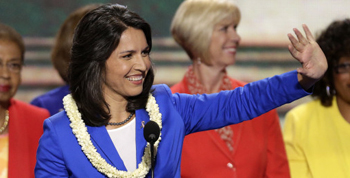
Hindu-American Tulsi Gabbard elected to US Congress

November 7, 2012

TULSI-GABBARD-CONGRESS

Washington, November 7: Tulsi Gabbard today created history by becoming the first Hindu-American to be elected to the the US House of Representatives, winning her Hawaii seat by trouncing her Republican rival in a one-sided contest.

An Iraq war veteran, 31-year-old Gabbard defeated K Crowley of the Republican Party with a handsome margin. Her victory has been cheered by the Hindu-American community across the country.

Though just 50 per cent of the votes had been counted when reports came in, Gabbard had taken a massive unassailable lead of 120,000 votes over her Republican rival in her bid to represent Hawaii's 2nd Congressional District in the US House.

She is also the first female combat veteran to serve in the Congress.

"Although there are not very many Hindus in Hawaii, I never felt discriminated against. I never really gave it a second thought growing up that any other reality existed, or that it was not the same everywhere," Tulsi said in a statement, soon after she took an inaccessible lead over her Republican challenger.

"On my last trip to the mainland I met a man who told me that his teenage daughter felt embarrassed about her faith, but after meeting me, she's no longer feeling that way. He was so happy that my being elected to Congress would give hope to hundreds and thousands of young Hindus in America, that they can be open about their faith, and even run for office, without fear of being discriminated against or attacked because of their religion," Gabbard said.

She was endorsed by US President Barack Obama, during the election campaign.

Proud of her Hindu religion, she is not Indian or of Indian heritage. Her father Mike Gabbard, is currently Hawaii State Senator and mother Carol Porter Gabbard is an educator and business owner.

At 21, she became the youngest person elected to the Hawaii Legislature. At 23, she was the state's first elected official to voluntarily resign to go to war. At 28, she was the first woman to be presented with an award by the Kuwait Army National Guard.

Early during the Democratic National Convention, Gabbard spoke from stage along with Nancy Pelosi, the Democratic Party leader in the US House of Representatives.

"Aloha! I'm Tulsi Gabbard, candidate for Congress in Hawaii and a captain in the Army National Guard," she had said, amidst rounds of applause and cheer from the audience.

Currently a Company Commander with the Hawaii Army National Guard, who has volunteered to serve on two deployments to the Middle East, Gabbard served as Hawaii's youngest state representative in 2002 and is the youngest woman in the US to be elected into such a position.

Having never visited India so far, Tulsi says she is looking to make her first trip to India as an elected member of the House of Representatives.

"As a Vaishnava, I especially look forward to visiting the holy sites of Vrindavan," she said in an earlier interview.

Notably Hawaii is comprised of a majority of Christians with a significant number of Buddhists (10-15 percent of the population).

The number of Hindus living in Hawaii is relatively small, with only two Hindu temples in the entire state, the Iskcon Temple on Oahu and the Aadheenam Temple on Kauai.

Her religion, Tulsi said is not an issue for the election, neither it has been a negative factor in her electoral campaign, she noted.

Tulsi was born in 1981 in Leloaloa, American Samoa, the fourth of five children born to a Hindu mother and a Christian (Catholic) father.

At the age of two, the family moved to Hawaii, the 50th state of the US, also known as the "Aloha State"; which is also the birth place of Obama.

Comments

Add new comment

  • Coastaldigest.com reserves the right to delete or block any comments.
  • Coastaldigset.com is not responsible for its readers’ comments.
  • Comments that are abusive, incendiary or irrelevant are strictly prohibited.
  • Please use a genuine email ID and provide your name to avoid reject.
News Network
July 2,2020

Los Angeles, Jul 2: New daily coronavirus cases in the United States soared past 50,000 for the first time Wednesday, as the World Health Organization delivered a grave warning that the global pandemic is accelerating.

Restaurants, bars and beaches in the world's worst-hit nation closed from California to Florida, as states reeling from yet another surge in the deadly virus braced for Independence Day festivities.

Global infections have hit their highest level in the past week, WHO data showed, with chief Tedros Adhanom Ghebreyesus saying new cases topped "160,000 on every single day."

The grim milestone came as the European Union left the United States, Brazil and Russia off its final list of nations safe enough to allow residents to enter its borders.

With more than 52,000 new COVID-19 cases in the United States alone in the past 24 hours, according to a Johns Hopkins University tally, several US states imposed 14-day quarantines on visitors in the buildup to the long weekend's July 4 celebrations.

California suspended indoor dining at restaurants in Los Angeles and several counties, while New York scrapped plans to allow restaurants to seat customers inside from next week.

President Donald Trump reiterated his belief that the contagion will "at some point... sort of just disappear, I hope."

But the US leader who has yet to be seen in public wearing a face mask during the pandemic added he would have "no problem" doing so.

EU travel ban eased

The rollbacks came as the European Union reopened its borders to visitors from 15 countries.

The bloc hopes relaxing restrictions on countries from Algeria to Uruguay will breathe life into its tourism sector, choked by a ban on non-essential travel since mid-March.

Travelers from China, where the virus first emerged late last year, will be allowed to enter the EU only if Beijing reciprocates.

And Brazil -- which has suffered the most deaths globally for the last week, and is the second-worst affected country overall -- was excluded entirely.

It topped 60,000 total fatalities Wednesday, after suffering 1,000 deaths in just 24 hours.

However, with over 10 million known infections worldwide and more than 500,000 deaths, the pandemic is "not even close to being over", the WHO warned.

Data provided by the UN health agency for the seven days from June 25-July 1 showed the highest number of new daily cases ever recorded came on June 28, when over 189,500 new cases were registered worldwide.

'Dutch brothels reopen'

According to the United Nations, the coronavirus crisis could cost global tourism and related sectors from $1.2 to $3.3 trillion in lost revenue.

Greece, which has suffered fewer than 200 virus deaths, has seen its economy hit hard by lockdowns and travel restrictions -- all but ending its lucrative tourism season before it began.

Romanian Cojan Dragos was "the first tourist" in one Corfu hotel after driving there with his wife and daughter.

"We have the whole hotel just for us," he told news agency.

Separately, Spain and Portugal held a ceremony as they reopened their land border.

The Netherlands also confirmed the reopening Wednesday of another tourist draw -- its brothels and red-light districts.

"I'm totally booked," said sex worker Foxxy, adding that she had held a "little party" when she heard restrictions would be lifted.

Clusters spur new lockdowns

Russia did not make the EU's list of approved countries so its citizens will be absent from the bloc's tourist hot-spots.

The country, however, enjoyed a public holiday Wednesday as it voted in a referendum to approve constitutional changes allowing President Vladimir Putin to stay in power for another 16 years.

Putin was forced to postpone the vote in April as his government tackled an outbreak that has infected almost 650,000 people -- the third-highest in the world.

In other countries, clusters are still causing problems.

Parts of the Australian city of Melbourne suffered sharp rises in infections, spurring new stay-at-home measures.

The Palestinian Authority announced a five-day lockdown across the West Bank after a surge in confirmed cases.

And textile factories in the central British city of Leicester were suggested as the reason for a spike in infections that has prompted the reimposition of local restrictions.

Americas spike

In the United States, spikes across southern and western states are driving a surge in national infections.

Texas, which again smashed its daily COVID-19 record with over 8,000 new cases, joined Florida and California in closing some beaches for the upcoming holiday weekend.

Apple announced it would close another 30 US stores on Thursday, half of them in California.

A further 700 deaths nationwide took the US past 128,000 deaths in total.

The Pan American Health Organization warned that the death count in Latin America and the Caribbean could quadruple to more than 400,000 by October without stricter public health measures.

The US government announced this week it had bought 92 percent of all remdesivir production -- the first drug to be shown to be relatively effective in treating COVID-19.

Britain and Germany, however, said Wednesday they had sufficient stocks of the drug.

'Corona baby'

In Britain, some 1,500 acts from Ed Sheeran and Coldplay to Paul McCartney and The Rolling Stones urged the county's government to save the live music industry, which has been collapsing because of the coronavirus.

But while lockdown measures have been a disaster for many, some have welcomed the chance to spend more quality time with hard-working partners.

Comments

Add new comment

  • Coastaldigest.com reserves the right to delete or block any comments.
  • Coastaldigset.com is not responsible for its readers’ comments.
  • Comments that are abusive, incendiary or irrelevant are strictly prohibited.
  • Please use a genuine email ID and provide your name to avoid reject.
News Network
March 6,2020

New York, Mar 6: A 23-year-old Indian with a student visa in the US has pleaded guilty to sexual enticement of a minor girl, prosecutors have said.

Sachin Aji Bhaskar faces a maximum penalty of life in prison.

He pleaded guilty before Senior US District Judge William M Skretny to sexual enticement of a minor.

The charge carries a minimum penalty of 10 years in prison, a maximum penalty of life in prison, a fine of USD 250,000 or both, US Attorney James P Kennedy said.

Prosecutors alleged that Bhaskar communicated by text and email with an 11-year-old girl for the purpose of engaging in sexual activity.

Through those communications, Bhaskar enticed the victim to engage in a sexual activity with him in August, 2018, they said.

The sentencing in the case is scheduled for June 17.

Comments

Add new comment

  • Coastaldigest.com reserves the right to delete or block any comments.
  • Coastaldigset.com is not responsible for its readers’ comments.
  • Comments that are abusive, incendiary or irrelevant are strictly prohibited.
  • Please use a genuine email ID and provide your name to avoid reject.
Agencies
January 20,2020

For the first time in the 15 years of the Global Risks Report, the climate change and environment risk has occupied all the top five slots.

According to the 15th edition of the World Economic Forum's (WEF) Global Risks Report, the top five risks in terms of likelihood are extreme weather, climate action failure, natural disasters, biodiversity loss and human-made environmental disasters. They all fall in the one category of climate change and related environmental disasters.

WEF President Borge Brende said the world was feeling long-mounting and interconnected risks.

The report also points to how citizens are protesting across the world as discontent rises with failed systems that are creating inequality. The citizens' discontent had hardened with systems that had failed to promote advancement, it said.

"Disapproval of how governments are addressing profound economic and social issues has sparked protests throughout the world, potentially weakening the ability of governments to take decisive action should a downturn occur. Without economic and social stability, countries could lack the financial resources, fiscal margin, political capital or social support needed to confront key global risks," it said.

Listing the grim scenario, Borge said the global economy was faced with "synchronised slowdown", the past five years had been the warmest on record and cyber attacks were expected to increase this year.

The report warns that while the myriad risks were rising, time was running out on how to prevent them.

Borge said the growing palpability of shared economic, environmental and societal risks indicated that the horizon had shortened for preventing "or even mitigating" some of the direst consequences of global risks.

"It's sobering that in the face of this development, when the challenges before us demand immediate collective action, fractures within the global community appear to only be widening," he said.

The report points to grave concern about the consequences of continued environmental degradation, including the record pace of species decline.

Pointing to an unsettled geopolitical environment, the report said today's risk landscape was one in which new centres of power and influence were forming and old alliance structures and global institutions were being tested.

"While these changes can create openings for new partnership structures in the immediate term, they are putting stress on systems of coordination and challenging norms around shared responsibility. Unless stakeholders adapt multilateral mechanisms for this turbulent period, the risks that were once on the horizon will continue to arrive," it said.

Calling it a "an unsettled world", the WEF report notes that powerful economic, demographic and technological forces were shaping a new balance of power. "The result is an unsettled geopolitical landscape in which states are increasingly viewing opportunities and challenges through unilateral lenses," it said.

"What were once givens regarding alliance structures and multilateral systems no longer hold as states question the value of long-standing frameworks, adopt more nationalist postures in pursuit of individual agendas and weigh the potential geopolitical consequences of economic decoupling. Beyond the risk of conflict, if stakeholders concentrate on immediate geo-strategic advantage and fail to re-imagine or adapt mechanisms for coordination during this unsettled period, opportunities for action on key priorities may slip away," the WEF said.

In a chapter on risks to economic stability and social cohesion, it said a challenging economic climate might persist this year and members of the multi-stakeholder community saw "economic confrontations" and "domestic political polarisation" as the top risks in 2020.

The report also warned of downward pressure on the global economy from macroeconomic fragilities and financial inequality. These pressures continued to intensify in 2019, increasing the risk of economic stagnation.

Low trade barriers, fiscal prudence and strong global investment, once seen as fundamentals for economic growth, are fraying as leaders advance nationalist policies. The margins for monetary and fiscal stimuli are also narrower than before the 2008-2009 financial crisis, creating uncertainty about how well countercyclical policies will work.

The strategic partners for the WEF report included Marsh & McLennan and Zurich Insurance Group. The academic advisers were National University of Singapore, Oxford Martin School, University of Oxford and Wharton Risk Management and Decision Processes Center, University of Pennsylvania.

Comments

Add new comment

  • Coastaldigest.com reserves the right to delete or block any comments.
  • Coastaldigset.com is not responsible for its readers’ comments.
  • Comments that are abusive, incendiary or irrelevant are strictly prohibited.
  • Please use a genuine email ID and provide your name to avoid reject.