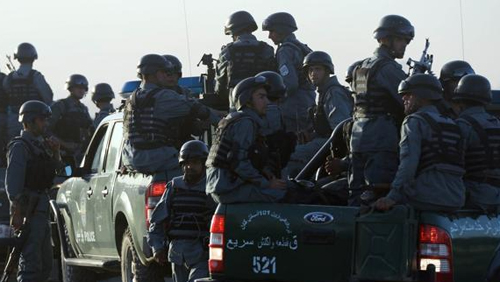
All seven militants dead at end of Kabul airport attack

June 10, 2013

Kabul_airport_attack

Kabul, Jun 10: All seven militants who launched an attack on Monday on Kabul airport died in the assault, Afghan police said, adding that no civilian and security force casualties had yet been reported.

"There were seven assailants — two (suicide bombers) died detonating themselves and five others were killed in fighting," Mohammad Ayoub Salangi, chief of Kabul police, told reporters.

"There have not been any casualties to the security forces, and we have not (received) any report of civilian casualties so far."

Comments

Add new comment

  • Coastaldigest.com reserves the right to delete or block any comments.
  • Coastaldigset.com is not responsible for its readers’ comments.
  • Comments that are abusive, incendiary or irrelevant are strictly prohibited.
  • Please use a genuine email ID and provide your name to avoid reject.
News Network
June 4,2020

New York, Jun 4: The Minneapolis police officer who used his knee to pin down George Floyd's neck before his death was the most experienced of the four officers involved in the arrest, with a record that included medals for bravery and 17 complaints against him, including one for pulling a woman out of her car during a speeding stop.

New details about Derek Chauvin and the other now-fired officers emerged Wednesday after prosecutors upgraded Chauvin's charge to second-degree murder and charged the others with aiding and abetting in a case that has convulsed the nation with protests over race and police brutality.

Heavily redacted personnel files show that Chauvin, a 19-year veteran of the force, was initially trained as a cook and served in the Army as a military police officer.

Eleven-year veteran and native Hmong speaker Tou Thao began as a community service officer and was the subject of six complaints.

The other two officers were relative newcomers to the department, including Thomas Lane, a former juvenile detention guard who did volunteer work with Somali refugees, and J. Alexander Kueng, who got his start in law enforcement by patrolling his college campus and a department store.

The files were notable for what they didn't include. Only one of the 17 complaints against Chauvin was detailed, none of the six against Thao were mentioned and there was no further detail about a 2017 excessive force lawsuit against Thao.

Records show that the 44-year-old Chauvin initially studied cooking before taking courses in law enforcement and doing two stints in the Army as a military police officer in the late 1990s, serving at Fort Benning, Georgia, and in Germany.

Chauvin became a Minneapolis police officer in 2001 and the lone reprimand in his file involved a 2007 incident when he was accused of pulling a woman out of her car after stopping her for going 10 mph (16 kph) over the speed limit.

Investigators found it was not necessary for Chauvin to remove the woman from the car and noted that his squad car video was turned off during the stop.

But Chauvin was also singled out for bravery. Files show he won two medals of valor, one in 2006 for being part of a group of officers who opened fire on a stabbing suspect who pointed a shotgun at them, and another in 2008 for a domestic violence incident in which Chauvin broke down a bathroom door and shot a suspect in the stomach.

He also won medals of commendation in 2008 after he and his partner tackled a fleeing suspect who had a pistol in his hand, and in 2009 for single-handedly apprehending a group of gang members while working as an off-duty security guard at the El Nuevo Rodeo, a Minneapolis nightclub.

Since his arrest, the former owner of the club, Maya Santamaria, said Chauvin and Floyd both worked as security guards there at various times but that she wasn't sure if they had known one another.

She said Chauvin was unnecessarily aggressive on nights when the club had a black clientele, quelling fights by dousing the crowd with pepper spray and calling in several police squad cars as backup, a tactic she called “overkill.”

Chauvin's wife, Kellie, a Laotian immigrant who became the first Hmong winner of the Mrs. Minnesota pageant, said shortly after his arrest last week that she intends to divorce him.

Before news of the upgraded charges, an attorney for Chauvin said he was not making any statements at this time. Lawyers for the others did not return messages seeking comment.

In cellphone video of the May 25 arrest of Floyd, Chauvin is shown pressing his knee onto Floyd's neck for more than eight minutes while Floyd cries out “I can't breathe” and eventually stops moving.

During much of the arrest, Kueng and Lane were helping Chauvin restrain Floyd. Thao was standing nearby keeping onlookers back.

According the complaint, at one point during the arrest, as Chauvin held Floyd down with his knee, Lane asked Chauvin twice whether they should roll Floyd over.

“No, staying put where we got him,” Chauvin replied, “I am worried about excited delirium or whatever,” Lane said. And Chauvin replied again, “That's why we have him on his stomach.” None of the three officers moved from their positions.

Lane joined the police early last year as a 35-year-old cadet — much older than most rookies — and became a full-fledged officer last December. He had no complaints in his file during his short time on the force.

On employment forms, the University of Minnesota graduate said he done volunteer work tutoring Somali youth and as a mentor helping at-risk elementary school students with reading and homework.”

Kueng, at 26 the youngest of the four officers, was also a recent recruit to the police force. He completed his year's probation just three months before the Floyd arrest.

His personnel file, which notes that he speaks, reads and writes Russian, did not include any commendations or disciplinary actions during his short time on force.

Kueng was a 2018 graduate of the University of Minnesota, where he worked part-time as part of the campus security force. He also worked nearly three years as a theft-prevention officer at Macy's.

Thao joined the police force part-time in 2008 while attending a community college. Before that, he worked as a security guard, a supermarket stocker and trainer at McDonald's.

City records show six complaints were filed against Thao, but there was no mention of that in the records released Wednesday. There also was no mention of a 2017 federal lawsuit accusing him and another officer of excessive force.

According to the lawsuit, Lamar Ferguson claimed that in 2014, Thao and his partner stopped him and beat him up while he was on his way to his girlfriend's house. The lawsuit was settled for $25,000 ___

Richmond reported from Madison, Wisconsin. Associated Press writer Scott Bauer in Madison and researcher Rhonda Shafner in New York contributed to this report.


Comments

Add new comment

  • Coastaldigest.com reserves the right to delete or block any comments.
  • Coastaldigset.com is not responsible for its readers’ comments.
  • Comments that are abusive, incendiary or irrelevant are strictly prohibited.
  • Please use a genuine email ID and provide your name to avoid reject.
Agencies
January 20,2020

For the first time in the 15 years of the Global Risks Report, the climate change and environment risk has occupied all the top five slots.

According to the 15th edition of the World Economic Forum's (WEF) Global Risks Report, the top five risks in terms of likelihood are extreme weather, climate action failure, natural disasters, biodiversity loss and human-made environmental disasters. They all fall in the one category of climate change and related environmental disasters.

WEF President Borge Brende said the world was feeling long-mounting and interconnected risks.

The report also points to how citizens are protesting across the world as discontent rises with failed systems that are creating inequality. The citizens' discontent had hardened with systems that had failed to promote advancement, it said.

"Disapproval of how governments are addressing profound economic and social issues has sparked protests throughout the world, potentially weakening the ability of governments to take decisive action should a downturn occur. Without economic and social stability, countries could lack the financial resources, fiscal margin, political capital or social support needed to confront key global risks," it said.

Listing the grim scenario, Borge said the global economy was faced with "synchronised slowdown", the past five years had been the warmest on record and cyber attacks were expected to increase this year.

The report warns that while the myriad risks were rising, time was running out on how to prevent them.

Borge said the growing palpability of shared economic, environmental and societal risks indicated that the horizon had shortened for preventing "or even mitigating" some of the direst consequences of global risks.

"It's sobering that in the face of this development, when the challenges before us demand immediate collective action, fractures within the global community appear to only be widening," he said.

The report points to grave concern about the consequences of continued environmental degradation, including the record pace of species decline.

Pointing to an unsettled geopolitical environment, the report said today's risk landscape was one in which new centres of power and influence were forming and old alliance structures and global institutions were being tested.

"While these changes can create openings for new partnership structures in the immediate term, they are putting stress on systems of coordination and challenging norms around shared responsibility. Unless stakeholders adapt multilateral mechanisms for this turbulent period, the risks that were once on the horizon will continue to arrive," it said.

Calling it a "an unsettled world", the WEF report notes that powerful economic, demographic and technological forces were shaping a new balance of power. "The result is an unsettled geopolitical landscape in which states are increasingly viewing opportunities and challenges through unilateral lenses," it said.

"What were once givens regarding alliance structures and multilateral systems no longer hold as states question the value of long-standing frameworks, adopt more nationalist postures in pursuit of individual agendas and weigh the potential geopolitical consequences of economic decoupling. Beyond the risk of conflict, if stakeholders concentrate on immediate geo-strategic advantage and fail to re-imagine or adapt mechanisms for coordination during this unsettled period, opportunities for action on key priorities may slip away," the WEF said.

In a chapter on risks to economic stability and social cohesion, it said a challenging economic climate might persist this year and members of the multi-stakeholder community saw "economic confrontations" and "domestic political polarisation" as the top risks in 2020.

The report also warned of downward pressure on the global economy from macroeconomic fragilities and financial inequality. These pressures continued to intensify in 2019, increasing the risk of economic stagnation.

Low trade barriers, fiscal prudence and strong global investment, once seen as fundamentals for economic growth, are fraying as leaders advance nationalist policies. The margins for monetary and fiscal stimuli are also narrower than before the 2008-2009 financial crisis, creating uncertainty about how well countercyclical policies will work.

The strategic partners for the WEF report included Marsh & McLennan and Zurich Insurance Group. The academic advisers were National University of Singapore, Oxford Martin School, University of Oxford and Wharton Risk Management and Decision Processes Center, University of Pennsylvania.

Comments

Add new comment

  • Coastaldigest.com reserves the right to delete or block any comments.
  • Coastaldigset.com is not responsible for its readers’ comments.
  • Comments that are abusive, incendiary or irrelevant are strictly prohibited.
  • Please use a genuine email ID and provide your name to avoid reject.
News Network
February 19,2020

Washington, Feb 19: US President Donald Trump has said he is "saving the big deal" with India for later and he "does not know" if it will be done before the presidential election in November, clearly indicating that a major bilateral trade deal during his visit to Delhi next week might not be on the cards.

"We can have a trade deal with India. But I'm really saving the big deal for later," he told reporters at Joint Base Andrews Tuesday afternoon (local time).

The US and India could sign a "trade package" during the visit, according to media reports.

Asked whether he expects a trade deal with India before the visit, Trump said, "We're doing a very big trade deal with India. We'll have it. I don't know if it'll be done before the election, but we'll have a very big deal with India."

US Trade Representative Robert Lighthizer, the point-person for trade negotiations with India, is likely to not accompany Trump to India, sources said. However, officials have not ruled it out altogether.

In an apparent dissatisfaction over US-India trade ties, Trump said, "We're not treated very well by India." But he praised Prime Minister Narendra Modi and said he is looking forward to his visit to India.

"I happen to like Prime Minister Modi a lot," Trump said.

"He told me we'll have seven million people between the airport and the event. And the stadium, I understand, is sort of semi under construction, but it's going to be the largest stadium in the world. So it's going to be very exciting... I hope you all enjoy it," he told reporters.

Meanwhile, the US-India Strategic and Partnership Forum (USISPF) in a report said the latest quarterly data depict continuation of overall positive bilateral trade trends. The third quarter data reflects some downslide in growth rates.

"It may be due to several reasons, including the unexpected economic slowdown in India's economic growth, impact of US-China trade war, GSP withdrawal from the US side and retaliatory tariffs on specific US goods from the Indian side," USISPF said.

According to the report, the data available for the first three quarters of 2019 (January-September) pulled the overall growth rate in cumulative bilateral trade down to 4.5 percent from 8.4 percent registered for the first two quarters.

Goods and services trade performance in third quarter was dismal at -2.3 percent, in contrast with the impressive 9.6 percent growth witnessed for the first two quarters of the year; while trade in services was up two percent goods trade dropped five percent, the report said.

The cumulative US-India trade in goods and services (USD 110.9 billion) for the first three quarters of 2019 increased 4.5 percent with US exports and imports growing at four percent and five percent respectively.

The US exported USD 45.3 billion worth of goods and services to India in the first three quarters 2019, up 4 percent from the corresponding period in the previous year; and the US imported USD 65.6 billion worth of goods and services from India, up five percent from the previous year's USD 62.5 billion level for the same period, it said.

The USISPF has projected that the total bilateral trade can touch USD 238 billion by 2025 if the current 7.5 percent average annual rate of growth sustains; however, higher growth rates can result in bilateral trade in the range of USD 283 billion and USD 327 billion.

The US remains the top trading partner for India in terms of trade in goods and services, followed by China. While the bilateral trade between US and India is approximately 62 percent in goods and 38 percent in services, the bilateral trade between India and China is dominated by goods.

China had a huge trade surplus of USD 58 billion with India, indicating Beijing's strength in the Indian market, especially in sectors, such as electronics, machinery, organic chemicals, plastics and medical devices.

The US goods exports to India, in comparison, were mainly concentrated in mineral fuels, precious stones, and aircraft. The US faces tough competition with China in the Indian market in areas such as electronics, machinery, organic chemicals and medical devices.

Comments

Add new comment

  • Coastaldigest.com reserves the right to delete or block any comments.
  • Coastaldigset.com is not responsible for its readers’ comments.
  • Comments that are abusive, incendiary or irrelevant are strictly prohibited.
  • Please use a genuine email ID and provide your name to avoid reject.