



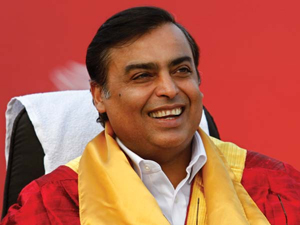
With $21-bn networth, Mukesh Ambani India's richest for 6th yr

October 29, 2013

Mukesh_AmbaniNew York, Oct 29: With a networth of USD 21 billion, Mukesh Ambani has retained his title as India's wealthiest for sixth year in a row, while the country's 100 richest persons saw their collective wealth soar by a modest 3 per cent in a year.

NRI steel tycoon Lakshmi Mittal (USD 16 billion) also continues to hold the second position, while Sun Pharma's Dilip Shanghvi has jumped to third place with about 50 per cent surge in his wealth to USD 13.9 billion, pushing IT czar Azim Premji to fourth place (USD 13.8 billion).

As per US-based business magazine Forbes' annual list of India's 100 richest, released today, their total wealth grew by a modest 3 per cent from a year ago to USD 259 billion.

"Growth in wealth was lacklustre due to India's stumbling economy, which has been hit by inflation and a falling rupee," Forbes said.

Amid the sluggishness, Reliance Industries chief Mukesh Ambani and ArcelorMittal's Lakshmi Mittal saw no change in their respective networths, but pharmaceutical industry titan Shanghi managed to buck the trend with a surge of USD 4.7 billion in his wealth to USD 13.9 billion.

Premji's wealth also rose by USD 1.6 billion, but he could not retain his third slot.

Pallonji Mistry, patriarch of construction giant Shapoorji Pallonji Group which is the biggest shareholder in Tata Sons, has moved down one place to fifth rank with a networth of USD 12.5 billion. His younger son Cyrus Mistry last year succeeded Ratan Tata as new Tata group head.

NRI businessmen Hinduja brothers have moved up to sixth place (USD 9 billion), from their 9th position last year.

Shiv Nadar (USD 8.6 billion) have moved into top-ten at the 7th place, while Sunil Mittal has also returned to this league at 10th place (USD 6.6 billion). On the other hand, Essar group's Ruia brothers and Jindal group's Savitri Jindal have moved out from the group.

Adi Godrej has slipped two places to 8th rank (USD 8.3 billion), while Aditya Birla group Chairman Kumar Mangalam Birla has gained one position to 9th (USD 7.6 billion).

Anil Ambani has also retained his 11th rank, although his wealth rose to USD 6.2 billion, from USD 6 billion a year ago.

In the top-20, he is followed by Shashi and Ravi Ruia (USD 5.5 billion), Micky Jagtiani (USD 5 billion), Savitri Jindal (USD 4.9 billion), Uday Kotak (USD 4.1 billion), Cyrus Poonawalla (USD 4 billion), Anand Burman (USD 3.7 billion), Kushal Pal Singh (USD 3.4 billion), Desh Bandhu Gupta (USD 3.2 billion) and Bajaj Family (USD 3.1 billion).

There are a total of 65 billionaires on the list, four more than last year. Some of these have made their fortunes in the Middle East, including Bahrain resident Ravi Pillai (richest newcomer with USD 1.7 billion) of Saudi construction group, Nasser S Al-Hajri Corp, and retail mogul M A Yusuff Ali (USD 1.6 billion) of Abu Dhabi-based Lulu Group.

As many as 15 new members have entered the top-100 list even as more than half of last year's rich listers, including Savitri Jindal whose wealth declined by USD 3.3 billion, have seen a fall in their fortunes.

The minimum net worth to make to the list has increased to USD 635 million from USD 460 million last year.

Forbes said that the list has been compiled using shareholder and financial information obtained from families, individuals, stock exchanges, analysts and regulators.

The ranking lists family fortunes, including those shared among extended families such as the Bajaj family, while the wealth figures were calculated based on stock prices and exchange rates as of October 18, 2013.

Privately-held companies were valued based on the valuation of similar publicly-traded companies.

Others on the list include Vedanta group's Anil Agarwal at 21st position (USD 3 billion), Gautam Adani (22, USD 2.65 billion), Kalanithi Maran (23, USD 2.6 billion), Venugopal Dhoot (30, USD 1.8 billion), Ajay Piramal (41, USD 1.55 billion), Nandan Nilekani (50, USD 1.3 billion), Rakesh Jhunjhunwala (61, USD 1.15 billion) and Anu Aga (86, USD 730).

The youngest on the list is 38-year old Shivinder Mohan Singh, who along with his 40-year-old brother Malvinder Mohan Singh have been ranked at 26th place (USD 2.3 billion).

Besides, 40-year old Ranjan Pai of Manipal group is at 51st place (USD 1.25 billion).

Others aged below 50 include Glenn Saldanha ranked 57 with net worth of USD 1.19 billion, Nirav Modi (64, USD 1.01 billion) and Vikas Oberoi (79, USD 780 billion) among others.

Women on the list include Savitri Jindal, Anu Aga, Kiran Mazumdar-Shaw and Shobhana Bhartia.

Those aged above 80 years of age include Brij Mohan Lal Munjal (90 years), Samprada Singh (87 yrs), Pallonji Mistry (84 yrs), Devendra Jain (84 yrs) and Kushal Pal Singh (82 yrs).

On Mukesh Ambani, Forbes said he plans to invest USD 25 billion in his businesses over the next 3 years.

Regarding L N Mittal, the magazine said "no turnaround yet for troubled steel baron Lakshmi Mittal whose ArcelorMittal is facing weak demand amid supply glut."

Mittal has put one of three houses he owns on London's billionaires' row up for sale, the magazine said.

Meanwhile, his son-in-law Amit Bhatia's family has partnered Air Asia's Tony Fernandes and the Tata group, for a new budget airline.

The list forms part of Forbes India edition which would hit the stands on November 7.

Shanghvi, who moved into the top five last year, is the third richest for the first time. Despite the rise, Sun reported a USD 210 million loss in the last quarter, after making a provision for settling a patent dispute over Pfizer's acid-reflux drug Protonix.

"Wipro chairman Azim Premji, whose fortune is up USD 1.6 billion in past year, got boost after spinning off its (the company's) consumer products business in March," Forbes said.

Comments

Add new comment

  • Coastaldigest.com reserves the right to delete or block any comments.
  • Coastaldigset.com is not responsible for its readers’ comments.
  • Comments that are abusive, incendiary or irrelevant are strictly prohibited.
  • Please use a genuine email ID and provide your name to avoid reject.
Agencies
January 4,2020

Stockholm, Jan 4: “I’m not the kind of person who celebrates birthdays,” Greta Thunberg said as she turned 17 on Friday, marking the occasion in inimitable style - with a seven-hour hour protest outside the Swedish parliament.

The climate activist braved winter conditions in her native Stockholm to continue the weekly Friday School Strike for the Climate campaign that helped catapult her to international fame.

“I stand here striking from 8am until 3pm as usual ... then I’ll go home,” Thunberg, Time magazine’s Person of the Year for 2019, told Reuters.

“I won’t have a birthday cake but we’ll have a dinner.”

It’s been a busy 12 months for Thunberg, who crisscrossed the globe by car, train and boat - but not plane - to demand action on climate change.

“It has been a strange and busy year, but also a great one because I have found something I want to do with my life and what I am doing is having an impact,” she said.

When she was 15, Thunberg began skipping school on Fridays to demonstrate outside the Swedish parliament to push her government to curb carbon emissions. Her campaign gave rise to a grassroots movement that has gone global, inspiring millions of people to take action.

Comments

Add new comment

  • Coastaldigest.com reserves the right to delete or block any comments.
  • Coastaldigset.com is not responsible for its readers’ comments.
  • Comments that are abusive, incendiary or irrelevant are strictly prohibited.
  • Please use a genuine email ID and provide your name to avoid reject.
News Network
June 15,2020

Stockholm, Jun 15: Nuclear powers continue to modernise their arsenals, researchers said Monday, warning that tensions were rising and the outlook for arms control was "bleak".

"The loss of key channels of communication between Russia and the USA... could potentially lead to a new nuclear arms race," said Shannon Kile, director of the nuclear arms control programme at the Stockholm International Peace Research Institute (SIPRI) and co-author of the report.

Russia and the US account for more than 90 percent of the world's nuclear weapons.

Kile was referring to the future of the New START treaty between the US and Russia, which is set to expire in February 2021.

It is the final nuclear deal still in force between the two superpowers, aimed at maintaining their nuclear arsenals below Cold War levels.

"Discussions to extend New START or to negotiate a new treaty made no progress in 2019," the SIPRI researchers noted.

At the same time, nuclear powers continue to modernise their weapons while China and India are increasing the size of their arsenals.

"China is in the middle of a significant modernisation of its nuclear arsenal. It is developing a so-called nuclear triad for the first time, made up of new land- and sea-based missiles and nuclear-capable aircraft," SIPRI said.

The country has repeatedly rejected Washington's insistence that it join any future nuclear arms reduction talks.

The number of nuclear warheads declined in the past year.

At the start of 2020, the United States, Russia, Britain, China, India, Pakistan, Israel and North Korea together had 13,400 nuclear arms, according to SIPRI's estimates, 465 fewer than at the start of 2019.

The decline was attributed mainly to the United States and Russia.

While the future of the New START treaty remains uncertain, Washington and Moscow have continued to respect their obligations under the accord.

"In 2019, the forces of both countries remained below the limits specified by the treaty," the report said. But both nations "have extensive and expensive programmes underway to replace and modernise their nuclear warheads, missile and aircraft delivery systems, and nuclear weapon production facilities," it added.

"Both countries have also given new or expanded roles to nuclear weapons in their military plans and doctrines, which marks a significant reversal of the post-Cold War trend towards the gradual marginalisation of nuclear weapons."

The Treaty on the Non-Proliferation of Nuclear Weapons (NPT), a cornerstone of the global nuclear non-proliferation regime, celebrates its 50th anniversary this year.

The number of nuclear arms worldwide has declined since hitting a peak of almost 70,000 in the mid-1980s.

The five original nuclear powers -- Washington, Beijing, Moscow, Paris and London -- in March reiterated their commitment to the treaty.

Comments

Add new comment

  • Coastaldigest.com reserves the right to delete or block any comments.
  • Coastaldigset.com is not responsible for its readers’ comments.
  • Comments that are abusive, incendiary or irrelevant are strictly prohibited.
  • Please use a genuine email ID and provide your name to avoid reject.
News Network
June 2,2020

London/Milan, Jun 2: World Health Organization experts and a range of other scientists said on Monday there was no evidence to support an assertion by a high profile Italian doctor that the coronavirus causing the COVID-19 pandemic has been losing potency.

Professor Alberto Zangrillo, head of intensive care at Italy's San Raffaele Hospital in Lombardy, which bore the brunt of Italy's COVID-19 epidemic, on Sunday told state television that the new coronavirus "clinically no longer exists".

But WHO epidemiologist Maria Van Kerkhove, as well as several other experts on viruses and infectious diseases, said Zangrillo's comments were not supported by scientific evidence.

There is no data to show the new coronavirus is changing significantly, either in its form of transmission or in the severity of the disease it causes, they said.

"In terms of transmissibility, that has not changed, in terms of severity, that has not changed," Van Kerkhove told reporters.

It is not unusual for viruses to mutate and adapt as they spread, and the debate on Monday highlights how scientists are monitoring and tracking the new virus. The COVID-19 pandemic has so far killed more than 370,000 people and infected more than 6 million.

Martin Hibberd, a professor of emerging infectious disease at the London School of Hygiene & Tropical Medicine, said major studies looking at genetic changes in the SARS-CoV-2 virus that causes COVID-19 did not support the idea that it was becoming less potent, or weakening in any way.

"With data from more than 35,000 whole virus genomes, there is currently no evidence that there is any significant difference relating to severity," he said in an emailed comment.

Zangrillo, well known in Italy as the personal doctor of former Prime Minister Silvio Berlusconi, said his comments were backed up by a study conducted by a fellow scientist, Massimo Clementi, which Zangrillo said would be published next week.

Zangrillo told Reuters: "We have never said that the virus has changed, we said that the interaction between the virus and the host has definitely changed."

He said this could be due either to different characteristics of the virus, which he said they had not yet identified, or different characteristics in those infected.

The study by Clementi, who is director of the microbiology and virology laboratory of San Raffaele, compared virus samples from COVID-19 patients at the Milan-based hospital in March with samples from patients with the disease in May.

"The result was unambiguous: an extremely significant difference between the viral load of patients admitted in March compared to" those admitted last month, Zangrillo said.

Oscar MacLean, an expert at the University of Glasgow's Centre for Virus Research, said suggestions that the virus was weakening were "not supported by anything in the scientific literature and also seem fairly implausible on genetic grounds."

Comments

Add new comment

  • Coastaldigest.com reserves the right to delete or block any comments.
  • Coastaldigset.com is not responsible for its readers’ comments.
  • Comments that are abusive, incendiary or irrelevant are strictly prohibited.
  • Please use a genuine email ID and provide your name to avoid reject.