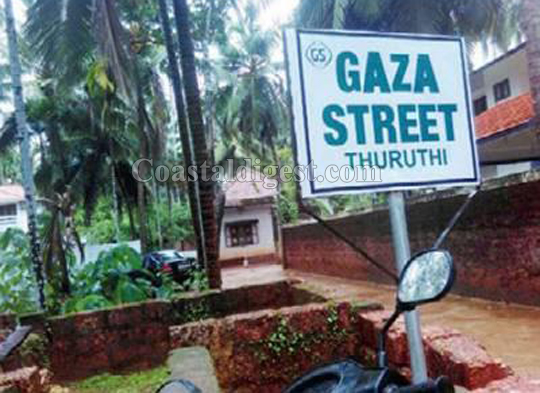
Kasaragod’s newly named 'Gaza Street' on the radar of IB, NIA

News Network
June 19, 2017

Kasaragod, Jun 19: A street in Thuruthi ward of Kasaragod municipality that was recently named 'Gaza', a reference to a part of the Palestinian territory, has got intelligence agencies interested.

gaza street

The agencies are looking at possible “radical” influence behind the naming, considering the locality's proximity to Padane from where the majority of the 21 youths from Kerala, who have gone missing since 2016 and are suspected to have joined the Islamic State terror outfit, hail.

The road adjacent to Thuruthi Juma Masjid was named 'Gaza' last month and was inaugurated by Kasaragod district panchayat president AGC Basheer. "I was not the person who was supposed to inaugurate the street as the area falls under the municipality's jurisdiction. But I had to step in at the last moment," Basheer said.

Though municipality funds were believed to have been used to concretise the street, municipal authorities claim they are clueless about the naming. Municipal chairperson Beefathima Ibrahim said she does not have any knowledge about such a street under her jurisdiction.

But local BJP leaders said, "There is a deliberate attempt to change the names of various areas in Kasaragod. When such matters come to the municipal council, there will be a debate and if the name is not of public acceptance, it will be rejected. For the same reason, many such names are not brought to the attention of the council," said Kasaragod municipality opposition leader P Ramesh.

Kasaragod district has been under the radar of central agencies like Intelligence Bureau and National Investigation Agency following the case of the missing youths.

"Kasaragod is a district where communal divisions are deepening along with inroads being made organisations like the IS. Though this particular incident has not come to our attention, the watchful eyes of central agencies capture even minor developments happening in the district for the above reason", a top police official said.

Comments

Abdullah
 - 
Monday, 19 Jun 2017

If RSS, BJP changes names all over India then no matter!!!!

Izuddin Mohamm…
 - 
Monday, 19 Jun 2017

If named isreal.... No issues

Add new comment

  • Coastaldigest.com reserves the right to delete or block any comments.
  • Coastaldigset.com is not responsible for its readers’ comments.
  • Comments that are abusive, incendiary or irrelevant are strictly prohibited.
  • Please use a genuine email ID and provide your name to avoid reject.
Media Release
February 14,2020

Veteran journalist P. Sainath has said that the nation is in a crisis. And this crisis is not limited to just the rural area. It has become a national crisis at various areas such as agriculture, education, economy, job creation etc.

He was delivering the endowment lecture on the topic ‘Indian democracy at the post-liberalization and post-truth era’ at Media Manthan 2020 organized by the PG department of journalism and mass communication at St Aloysius College (Autonomous). 

Mr Sainath said that the many policies adopted in the 90s led to India becoming unusually unequal. Referring to the speech Ambedkar had made at the Constituent Assembly while handing over the draft of the Constitution, Mr Sainath said, “Ambedkar had warned about the weakness of Indian democracy that liberty without equality allows the supremacy of a few over the multitude. Liberty, equality and fraternity must be kept together as we cannot have one without the other.” 

Mr Sainath stated that the agrarian crisis was no longer about the loss of productivity, employment or about farmer suicide; it was a societal, civilizational crisis. Commenting on the lopsided policies such as cow-slaughter ban, he explained how cow slaughter ban had adversely affected many industries due to their interdependency. While Muslims who slaughtered cows were rendered helpless, the cattle traders who were mostly OBCs lost their earnings as the cattle prices crashed. An important industry like Kolhapur sandals industry in Maharashtra went bankrupt as a result of the cow slaughter ban in Maharashtra. He said the policymakers had no idea how the rural industries were interconnected. Demonetisation too devastated the rural economy as 98 percent of rural transactions happen through cash. 

Mr Sainath also spoke about the crisis of inequality which affects the Dalits and the Adivasis far more than anyone else as 90 percent of the rural households take home less than Rs 10,000/- per month. “Women are yet another group whose labour is never counted in the gross domestic product. Women and girls globally do unpaid work which amounts to about 12.5 billion working hours per year. Monetarily speaking, this is worth 10.8 trillion dollars,” Mr Sainath added. 

Speaking about the crisis of jobs Mr Sainath said that major companies were laying off employees just to create more profits for the investors and the adoption of artificial intelligence in the industry would further destroy millions of jobs.

Rector of St Aloysius College Institutions Fr Dionysius Vaz SJ, Principal Dr (Fr) Praveen Martis SJ, HOD of Journalism and Mass Communication department Dr (Fr) Melwyn Pinto SJ were present.

‘Veerappan and Vijay Mallya’s business models are interesting!’

Addressing the gathering during his endowment lecture on Friday, Mr Sainath made an interesting comment on the so called ‘revenue model’. “Whenever I visit IIMs and IITs for lectures on my PARI project, the students there ask me what my revenue model for my project is. I tell them that I do not have a revenue model. In fact, journalism does not begin with a revenue model. Gandhiji, Ambedkar, Bhagat Singh were all great journalists. But they did not have a revenue model,” Mr Sainath said.

On a lighter note, he said that the best revenue model that he liked was that of forest brigand Veerappan and liquor baron Vijay Mallya. “Veerappan ruled the forest for forty years and from the top ministers to the villagers he could dictate terms and liver royally. Similarly, Mallya’s revenue model was to steal the banks and run away abroad and live like a king,” Mr Sainath added.

Journalism is not and can never be a business. It is a calling, he opined. While newspaper can be a business, television can be a business, journalism per se cannot be reduced to a business. “Unfortunately today, journalists are recruited on a contract basis and they have no bargaining power; and there are no unions to fight for their cause. Hence, they are at the mercy of the corporate media houses for their survival and are made to write stories that cannot be called journalism,” Mr Sainath said.

Answering a question as to the pressures he faced as a journalist, he said that external pressures from the government or others could be very well handled. It is the internal pressures from once own media house that journalists find it difficult to manage.


 

Comments

Add new comment

  • Coastaldigest.com reserves the right to delete or block any comments.
  • Coastaldigset.com is not responsible for its readers’ comments.
  • Comments that are abusive, incendiary or irrelevant are strictly prohibited.
  • Please use a genuine email ID and provide your name to avoid reject.
coastaldigest.com news network
June 28,2020

Mangaluru, June 28: In his apparent bid to win the hearts of the people of Tulu Nadu while leaving this coastal city, Dr P S Harsha, the outgoing Mangaluru city police commissioner, today took to social media and thanked the people. The language he chose for his prolonged Facebook post and one paragraph tweet was Tulu.

“Loveable people of Kudla! I have received the transfer order after serving as the Commissioner of Police of Mangaluru City for 11 months. (During this period) I worked with utmost honesty and pro-people approach with the complete cooperation of my department. I wholeheartedly thank all those who supported me,” tweeted Dr Harsha, who is now posted in Bengaluru as the Deputy Inspector General and Commissioner of Information and Public Relations.

In his Facebook post, Dr Harsha claimed that thanks to his initiative “My Beat My Pride”, the policing in the coastal city has strengthened. 

“My only intention was to put an end to rowdyism and illegal activities. I had given priority to curb the drug mafia. ‘My Beat My Pride’ became a successful initiative thanks to public support,” he said. 

The IPS officer went on to claim that with the with the co-operation of the senior officers, the police department managed to efficiently handle situations during anti-CAA and pro-CAA agitations in the city, detection of explosives at Mangaluru International Airport and also during the covid-19 pandemic. 

However, he did not mention about the death of two people in random police firing following a baton charge during anti-CAA protests in the city on December 19.

Comments

MP
 - 
Tuesday, 30 Jun 2020

power is not permenant. 2 innocents were killed in mangalore,  if it was in USA the cop would have been in jail.


Add new comment

  • Coastaldigest.com reserves the right to delete or block any comments.
  • Coastaldigset.com is not responsible for its readers’ comments.
  • Comments that are abusive, incendiary or irrelevant are strictly prohibited.
  • Please use a genuine email ID and provide your name to avoid reject.
Dr Parinitha
January 17,2020

We came on foot, we came on boats, shouting slogans of Azadi.

We stood on roof tops and sat on walls under the burning midday sun,

Listening to the words that we had longed to hear for so long.

Words that had been scripted through the lonely fears of our hearts.

Words that were spoken now with the clarity of courage.

Words that were spoken now with the suppressed strength of pent up anger.

Words that were spoken now with the certainty of belonging to the soil 

Which had become one with the dust of our ancestors.

We stood there in the waves of heat

Feeling the surge and press  of countless bodies around us.

Bodies meshed through the odour of sweat 

And the shared fear of a common persecution.

And hanging from the roof tops,

And tied to the poles,

And clutched in hands slippery with sweat,

And wrapped round the pillars,

And spreading into our blood,

Were three strips of colour with a wheel of spokes,

Sewn together into the shape of our being.

Woven into the folds of our future and the creases of our past. 

Stitched to the seams of the earth, the water, the air and the sky 

That belonged to us and to which we belonged. 

And we stood there from noon to evening,

We the people of India.

Raising our clenched fists like signposts to the future.

Chanting slogans like a new anthem.

Kin to each other through the ties of community.

Born to live and die 

In a nation that was ours to hold on to

And ours to belong to.

Dr Parinitha is a professor of English in Mangalore University. She penned the poem soon after participating in the historic protest against CAA, NPR and NRC at Shah Garden, Adyar, Mangaluru on 15th January, 2020.

Also Read: 

‘The more you try to divide us, the stronger and united we’ll be’: Record turnout in Mangaluru’s anti-NRC protest

Anti-NRC protest in Mangaluru brings ‘media bias’ to the fore

Comments

Abdullah
 - 
Wednesday, 29 Jan 2020

Salute to you siter for your meaningful poem.  This is reality.  However, the enmy is blind/deaf/dumb.   May God give right way of thinking to enmy and in case he is unlucky, let God finish him and let him beg for death.  

Indian
 - 
Thursday, 23 Jan 2020

Waav..What a Heart Touching poetry...


Hats off to you ma'am....


Love from all Indians...


Add new comment

  • Coastaldigest.com reserves the right to delete or block any comments.
  • Coastaldigset.com is not responsible for its readers’ comments.
  • Comments that are abusive, incendiary or irrelevant are strictly prohibited.
  • Please use a genuine email ID and provide your name to avoid reject.