


The secrets of Udupi's Madhwa Brahmin kitchen leaked!

[email protected] (News Network | KM Acharya)
August 26, 2015

Udupi, Aug 26: What connects Bisi Bele Hulianna, Saaru, Modaka, Huggi, Majjige Palidya and Drakshi Gojju? These are some of the famed dishes of the Madhwa Brahmin community of Udupi, a coastal town in Karnataka where the Krishna temple acts as a pivot in people's lives.
brahmin

Laying out the geographical expanse and scientific logic to the regions Madhwa Brahmins vegetarian food habits, culinary expert Malati Srinivasan and arts and crafts connoisseur Geetha Rao showcase the hitherto unknown vegetarian recipes from Udupi in their book "The Udupi Kitchen."

The authors straddle the traditional and modern and list what was once easily cooked in Udupi households - spice powders, salads and chutneys, savoury snacks, desserts - and elaborate on several recipes which are all-time favourites like Bisi Bele Hulianna, Saaru, Masal Dose and Modaka.

While Bisi Bele Hulianna is a dish of spicy red gram, rice and vegetables, Saaru is spicy red gram soup, Huggi is rice and green gram with black pepper and cumin and Modaka is dumplings with coconut and jiggery filling.

Majjige Palidya is ash gourd with coconut and cumin in sour yoghurt and Drakshi Gojju is raisins in sweet, sour and spicy gravy.

Split into 12 sections, the Udupi Kitchen, published by Westland Ltd, celebrates vegetarian food with aplomb from a town where food is religion as well as a complete mouth-watering experience.

At the core of Udupi cuisine is the use of indigenous vegetables and fruits, cereals and pulses special to the Parashurama Kshetra and traditional Brahmins ate only vegetarian fare without onion and garlic.

According to the authors, Udupi cuisine has a vast variety and is not limited to tiffins or snacks.

"As I began working on this project, I realised how vast and varied our family’s repertoire of Udupi (Madhwa) cuisine was. I wrote down 175 recipes, but have used about a 100 of them in the book," says Srinivasan.

"Writing a cook book for both Indian and non-Indian readers required that a comprehensive multi-lingual glossary be compiled. It also meant using internationally accepted terminology: 'henchu' or 'tava' became griddle, bandle or 'kadhai' became wok, 'tappele' or 'bartan' became saucepan," says Rao.

She says for some kitchen tools like 'eelgemane' and 'ogarane chamcha', which had no "internationally understood" words, substitute words like curved knife blade and tempering-ladle had to be coined.

The story of Udupi cuisine is the story of how a temple-based, Brahmanical culinary tradition got modernised and became a global phenomenon. Food is religion in Udupi.

Fourteen varieties of food are cooked daily and offered to the deity at different times of the day. The food offered to god is 'naivediya', and the food eaten by human beings is 'prasada', food that is blessed.

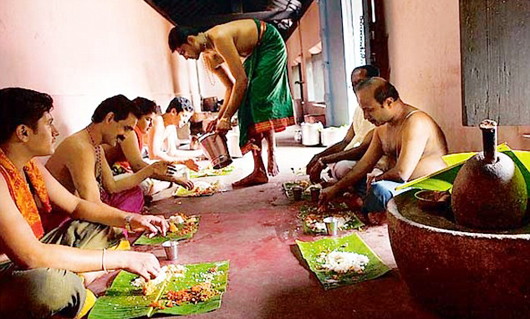
In Udupi, meals are served on banana leaves in a particular order. Many recipes and foods have also proven health benefits. For example, dishes made from the inner banana stem prevent kidney stones, pepper rasam helps with the lactation of new mothers, jackfruit seeds have high protein content and so on.

The authors also say that the original of the masal dose or the famous masala dosa is attributed to Udupi.

Before it was invented, plain dosa was served with potato playa, without onions, in a separate cup. With changing food tastes, the Udupi chefs began to saute the mashed potatoes with onions and spices.

"As onions were considered taboo food for orthodox Brahmins, it is said that the doses were stuffed with onion-laced playa, instead of served in a separate cup, so that the onion could be 'hidden'," the authors say.

Comments

Usha moorthy
 - 
Wednesday, 8 Jun 2016

I'm extremely pleased that I now have a book to refer to for genuine udupi food!!! Thanks to the authors for painstakingly bringing together these wonderful recipes!!;

Add new comment

  • Coastaldigest.com reserves the right to delete or block any comments.
  • Coastaldigset.com is not responsible for its readers’ comments.
  • Comments that are abusive, incendiary or irrelevant are strictly prohibited.
  • Please use a genuine email ID and provide your name to avoid reject.
News Network
May 5,2020

Mangaluru, May 5: As many as 7,119 labourers, who were stranded in Dakshina Kannada district, were sent to their native places in buses operated by KSRTC’s Mangaluru and Puttur divisions.

After the announcement of lockdown, the stranded labourers were provided shelter in various halls, Town Hall and government hostels in the district.

The stranded labourers from Kuloor, Panjimogaru, Panambur, Baikampady, Yeyyadi, Mulki, Ullal, Bunder, Hoige Bazar and from taluk centres, who wished to take up farming activities in their villages, were sent back in KSRTC and private buses. As many as 266 buses were engaged for ferrying the labourers.

The labourers underwent health check-up prior to their departure to their native villages, Deputy Commissioner Sindhu B Rupesh said.

Comments

Add new comment

  • Coastaldigest.com reserves the right to delete or block any comments.
  • Coastaldigset.com is not responsible for its readers’ comments.
  • Comments that are abusive, incendiary or irrelevant are strictly prohibited.
  • Please use a genuine email ID and provide your name to avoid reject.
News Network
May 4,2020

Davanagere, May 3: Karnataka's Davanagere district on Sunday reported 21 COVID-19 positive cases, said Mahantesh Beelagi, Deputy Commissioner.

The number of COVID-19 patients has suddenly taken a giant leap in the district.

"We had sent 94 samples on May 1, on May 2 we sent 72 samples. Today we sent 164 samples for testing. In the last two days, 21 samples have tested positive for coronavirus, we are tracing to know how did all of them came in contact with COVID-19 infected person," said Mahantesh Beelagi.

"Our surveillance team and police team have started tracing the primary and secondary contacts of all 21 people," he added.
Davanagere is currently in the Green Zone.

Meanwhile, 13 new COVID-19 positive cases were reported in Karnataka till 5 pm on Sunday, taking the total number of cases in the state to 614, according to the State Health Department.

Comments

Add new comment

  • Coastaldigest.com reserves the right to delete or block any comments.
  • Coastaldigset.com is not responsible for its readers’ comments.
  • Comments that are abusive, incendiary or irrelevant are strictly prohibited.
  • Please use a genuine email ID and provide your name to avoid reject.
News Network
July 22,2020

Bengaluru, Jul 22: Congress MLA Priyank Kharge has questioned the Karnataka government on the alleged breakdown of oxygen in the intensive care unit (ICU) at ESIC hospital in Kalaburagi, saying he had got complaints that eight persons who were on ventilators had died.

He asked the government if it is "deliberately" hiding something about the patients that were admitted in ESIC.

"I have got complaints that eight people who were on ventilators are dead in ESIC Kalaburagi because there was oxygen breakdown in ICU. ESIC has not been admitting patients as the issue has not been resolved. Nobody is confirming or denying it. Is the Government deliberately hiding something?" he asked.
Kharge also accused the government of not having adequate facilities to combat COVID-19 in different parts of the state.

"I hope I am wrong, but if it is a fact, this ascertains that the administration has lost control over Corona pandemic in the district. No addition testing centre. No beds are available. PPE Kits and medical waste is thrown in Gulbarga Institute of Medical Sciences (GIMS)," he added.

According to the Union Health Ministry, there are 67420 COVID-19 cases in the state.

Comments

Add new comment

  • Coastaldigest.com reserves the right to delete or block any comments.
  • Coastaldigset.com is not responsible for its readers’ comments.
  • Comments that are abusive, incendiary or irrelevant are strictly prohibited.
  • Please use a genuine email ID and provide your name to avoid reject.