


Yettinahole project a blunder; it can't quench the thirst of parched districts'

[email protected] (CD Network)
September 29, 2016

Bengaluru, Sep 29: A new study conducted by a team of the Indian Institute of Science, Bengaluru concluded that the Rs 13,000-crore Yettinahole diversion project doesn't hold much water to quench the thirst of the parched districts of Kolar, Chikkaballapur, Tumakuru and Bengaluru Rural.
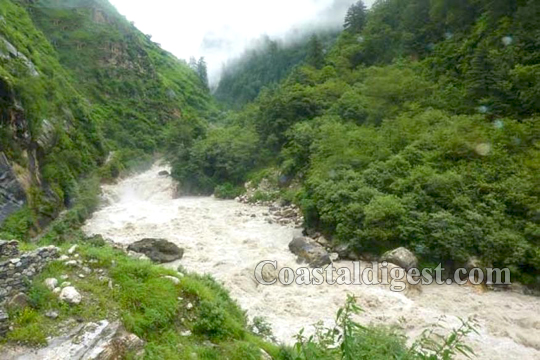
Yettinahole

Headed by TV Ramachandra and comprising of experts like Barat Aithal and S Vinay, the study team after visiting spots and using the latest technology, including remote sensors, found that Yettinahole can generate only 9.5 tmcft of water against 24 tmcft as claimed by the state government which is awaiting environmental clearance to go ahead with project. The team has called the project as an "an ecological blunder".

The study, Environment Flow Assessment in a Lotic Ecosystem of Central Western Ghat, was published in international journal Hydrology Current Research. The Karnataka government, some experts and leaders seeking project implementation had slammed its earlier findings saying it lacked conviction.

The government has already spent Rs 1,690 crore for the project and set up a dedicated authority to oversee its implementation. The project is now temporarily halted following a green bench order besides widespread protests in the coastal belt as the Yettinahole project aims at diverting 24.01 tmcft of water from Nethravathi's tributaries.

The report highlights alterations in the catchment integrity (land cover) or water diversions would result in variation in the natural flow, affecting the biodiversity of the riparian and aquatic habitats, and more importantly, people's livelihood dependent on fishing in the downstream.

The sustainable option to meet water requirements in arid regions, the study points out, would be to rejuvenate existing lakes and ponds, reuse treated waste water, recharge groundwater resources, plant native species of plants in the catchment areas and implement soil and water conservation through microwatershed approaches.

Sources in the water resources department, however, said they will not give much credence to the report but wait for the one by an expert committee set up by the government. On June 9, 2016, the government formed a panel under the chairmanship of Central Water Commission former chairman A K Bajaj. "The committee met just once but nothing much has happened after that. I partly endorse the views of the fresh report prepared by IISc scientists that Yettinahole cannot generate 24 tmcft of water and it greatly affects the ecology,'' said environmentalist Yellappa Reddy.

Comments

Mahesh
 - 
Thursday, 29 Sep 2016

from the beginning only we all know about this fraud supported by congress govt to loot all public money, all corrupt politicians will die one day a dog death. so many people are working hard to get their livelihood in this.. these rich people collecting money in the name of tax and misusing for their posh life.

Add new comment

  • Coastaldigest.com reserves the right to delete or block any comments.
  • Coastaldigset.com is not responsible for its readers’ comments.
  • Comments that are abusive, incendiary or irrelevant are strictly prohibited.
  • Please use a genuine email ID and provide your name to avoid reject.
News Network
January 24,2020

Bengaluru, Jan 24: On the last day of his four-day trip to Davos, Switzerland, to attend the World Economic Forum, chief minister BS Yediyurappa urged the global business community to invest in cities other than Bengaluru in the state.

On Thursday, while extending an invitation to entrepreneurs to participate in the Global Investors Meet in November in Bengaluru, Yediyurappa highlighted the “conducive investment climate” in the state vis-a-vis others by pointing to its 7% growth rate which is much higher than the national average of below 5%.

He also pointed to the state’s rich history and the fact that it is home to a number of desi MNCs such as Infosys, Biocon Wipro and Dynamatics. “At the same time, the state has one of the lowest unemployment rates compared to the national average,” Yediyurappa said.

In his address to heads of businesses, industries minister Jagadish Shettar also urged investors to consider Tier 2 and 3 cities for investment. “Land banks have been created in Tier 2 and 3 cities and regional connectivity has improved. Let us strive to place Karnataka on a highgrowth path,” Shettar said.

Lending a “helping hand”, Union minister Piyush Goyal, in his address, appealed to the community to invest in Karnataka, which “has a robust and congenial industrial atmosphere”, but also urged them to spread “tentacles” to all parts of the country.

Comments

Add new comment

  • Coastaldigest.com reserves the right to delete or block any comments.
  • Coastaldigset.com is not responsible for its readers’ comments.
  • Comments that are abusive, incendiary or irrelevant are strictly prohibited.
  • Please use a genuine email ID and provide your name to avoid reject.
coastaldigest.com news network
June 14,2020

Mangaluru, Jun 14: In a fresh case of vigilante attack, a cattle trader was tied to a buffalo-laden vehicle and thrashed by the miscreants belonging to Bajrang Dal in the city today. 

The victim has been identified as Mohammad Haneef Guddemane (34), a resident of Jokatte village on the outskirts of the city. 

The attack took place in the early morning near Infosys office at Urva, when Haneef was transporting his four buffalos to Kudroli slaughter house. 

The miscreants continued to thrash him until the local police reached spot. Based on the complaint of ‘illegal cattle transportation’ by the Bajrang Dal, the police took the victim to custody and also seized the buffalos. 

The police also took the victim to hospital and subjected him to covid test before producing him before a local judge.

While the Bajrang Dal members lodged complaint of illegal transpiration against the victim, the victim showed all the records of the cattle and lodged a counter complaint against the attackers.

It is learnt that Haneef had purchased 10 cattle from Haveri district and sold six among them. He was transporting remaining four buffalos to Kudroli slaughter house.

Comments

Add new comment

  • Coastaldigest.com reserves the right to delete or block any comments.
  • Coastaldigset.com is not responsible for its readers’ comments.
  • Comments that are abusive, incendiary or irrelevant are strictly prohibited.
  • Please use a genuine email ID and provide your name to avoid reject.
News Network
January 25,2020

New Delhi, Jan 25: The latest edition of the Oxford Advanced Learner's Dictionary features 26 new Indian English words, including Aadhaar, chawl, dabba, hartal and shaadi.

The 10th edition of the dictionary, which was launched on Friday, has 384 Indian English words and incorporates over 1,000 new words such as chatbot, fake news and microplastic.

The dictionary focuses on language change and its evolution through the years, and has ensured that the language and examples used in the new edition are relevant and up to date with the times, Oxford University Press (OUP) said.

The new edition comes with interactive online support through the Oxford Learner's Dictionaries website and an app. The website includes advanced features such as audio-video tutorials, video walkthroughs, self-study activities and enhanced iWriter and iSpeaker tools.

"This edition has 26 new Indian English words of which 22 figure in the printed dictionary. The other four are in the digital version," said Fathima Dada, Managing Director (Education Division) at OUP.

Some of other new Indian words in the dictionary are auntie (while aunty already figures in the English dictionary, auntie is an Indianism), bus stand, deemed university, FIR, non-veg, redressal, tempo, tube light, veg and videograph.

The four new Indian English words in the online version of the dictionary are current (for electricity), looter, looting and upazila (one of the areas that a district is divided into for administration purposes).

According to OUP, the new edition provides better, more accurate and understandable definitions with examples, usage notes and additional resources to help the learner use the right word in the right context.

"Prevalence and common usage are the main criteria for enlisting new words. We scan the globe for words which are often used by people while speaking English. Then these words go through a rigorous testing process," Dada said.

"As OUP is the custodian of English language globally, these words have to go through its processes," she told PTI.

The Oxford Advanced Learner's Dictionary, she said, has been reinventing itself for nearly eight decades, anticipating the growing learning requirements of learners.

"The 10th edition also is equipped with a strong digital support system, including an app," she said.

It is equipped with several digital tools. With iSpeaker, learners can get help preparing for speaking exams and presentations. With iWriter, learners can plan, write and review their written work. Text Checker allows the teacher to check any text against the Oxford 3000, 5000, and OPAL (Oxford Phrasal Academic Lexicon) written word list.

Resources accessible through online premium access include lesson plans, worksheets, video walkthroughs, and classroom and self-study activities. With the OALD app one can find 86,000 words, 95,000 phrases, 112,000 meanings and 237,000 examples.

The dictionary, which spans 77 years, was originally published in Japan in 1942 and was first brought out by OUP in 1948. The learner's dictionary is based on the original values of its creator, Albert Sydney Hornby, whose aim was to help language learners worldwide understand the meaning of English words.

Comments

Add new comment

  • Coastaldigest.com reserves the right to delete or block any comments.
  • Coastaldigset.com is not responsible for its readers’ comments.
  • Comments that are abusive, incendiary or irrelevant are strictly prohibited.
  • Please use a genuine email ID and provide your name to avoid reject.