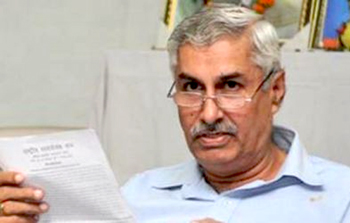
Senior RSS leader shot at in Punjab, critical

August 7, 2016

Jalandhar, Aug 6: Senior RSS leader Brig (retd) Jagdish Gagneja was tonight shot at by some bike-borne persons at Jyoti Chowk area here, police said.

rssJalandhar Commissioner of Police Arpit Shukla said Gagneja, Sah-sarsanghchalak of RSS's Punjab unit, was shot at around 9 PM near Makhdumpura colony here.

He was rushed to a private hospital where his condition is stated to be critical.

Local BJP MLA Manoranjan Kalia said that three bullets hit Gagneja.

Police have started probe in the matter.

Punjab Pradesh Congress Committee President Amarinder Singh condemned the attack on the RSS leader.

"Such nefarious designs deserve to be nipped in the bud lest these push Punjab into anarchy," he said in a statement.

People may not agree or approve of RSS ideology, but in a democracy everyone has a right to pursue his political and ideological beliefs, Amarinder said.

"Such intimidation is unacceptable," he said.

Comments

Shaad
 - 
Sunday, 7 Aug 2016

One member of Gow Rakshak Team (GST) down.

Add new comment

  • Coastaldigest.com reserves the right to delete or block any comments.
  • Coastaldigset.com is not responsible for its readers’ comments.
  • Comments that are abusive, incendiary or irrelevant are strictly prohibited.
  • Please use a genuine email ID and provide your name to avoid reject.
Agencies
June 9,2020

Srinagar, Jun 9: Suspended Jammu and Kashmir DSP Davinder Singh, who was nabbed while ferrying two Hizbul Mujahideen terrorists on the Srinagar-Jammu Highway, moved a Delhi court on Tuesday seeking interim bail.

Besides Singh, two other accused -- Syed Naveed Mushtaq and Imran Shafi Mir -- have also sought bail. The Special Cell of the Delhi Police is probing their role in the alleged planning of a terror attack.

The trio has sought bail asserting that there is no evidence to show that there was any conspiracy to commit an act that would threaten the sovereignty of the country. The court has listed the matter for hearing on Wednesday.

"The accused are wrongly and falsely implicated in the case. There is also no material to substantiate that the accused had the intention or conspired to carry out a terror strike," the plea stated.

Singh is currently under judicial custody at the Hira Nagar Jail in J&K till June 16. Besides Singh, three other accused -- Javed Iqbal, Syed Naveed Mushtaq and Imran Shafi Mir -- are also under custody.

Delhi Police's Special Cell had brought him from Hira Nagar Jail to the national capital in March for interrogation in another case.

The police had earlier told the court that Mushtaq, who was the commander of Hizbul Mujahiddeen in Shopian district, along with other militants were planning to execute a terror attack in Delhi and other parts of the country and targeted killings of protected persons.

In connection with this, the Delhi Police had filed an FIR which stated that the youth of Jammu and Kashmir and Punjab are being trained for carrying out terrorist activities. Singh was taken into custody under this FIR and was also interrogated regarding the Khalistan angle.

Comments

Add new comment

  • Coastaldigest.com reserves the right to delete or block any comments.
  • Coastaldigset.com is not responsible for its readers’ comments.
  • Comments that are abusive, incendiary or irrelevant are strictly prohibited.
  • Please use a genuine email ID and provide your name to avoid reject.
Agencies
February 4,2020

New Delhi, Feb 4: Saying the matter had been adjourned many times and it will have to hear it someday, the Supreme Court on Tuesday fixed April 14 for hearing a plea by Zakia Jafri, wife of slain MP Ehsan Jafri, challenging the SIT's clean chit to then Gujarat chief minister Narendra Modi in the 2002 riots.

A bench comprising Justices A M Khanwilkar and Dinesh Maheshwari posted the matter for hearing in April after Zakia's counsel sought an adjournment and urged the court to post it after the Holi vacation.

When advocate Aparna Bhat, appearing for Zakia, told the court that the issue in the matter is contentious, the bench said, "It has been adjourned so many times, whatever it is, we will have to hear it someday. Take one date and make sure you all are available." Zakia had filed a petition in the apex court in 2018 challenging the Gujarat High Court's October 5, 2017 order rejecting her plea against the decision of the Special Investigation Team.

Ehsan Jafri was among the 68 people killed at Gulberg Society on February 28, 2002, a day after the S-6 Coach of the Sabarmati Express was burnt at Godhra killing 59 people and triggering riots in Gujarat.

On February 8, 2012, the SIT filed a closure report giving a clean chit to Modi and 63 others, including senior government officials, saying there was "no prosecutable evidence" against them.

Comments

Althaf
 - 
Tuesday, 4 Feb 2020

No use.. will Supreme court gives justice??? 

Add new comment

  • Coastaldigest.com reserves the right to delete or block any comments.
  • Coastaldigset.com is not responsible for its readers’ comments.
  • Comments that are abusive, incendiary or irrelevant are strictly prohibited.
  • Please use a genuine email ID and provide your name to avoid reject.
Agencies
June 6,2020

United Nations, Jun 6: The coronavirus disease has not "exploded" in India, but the risk of that happening remains as the country moves towards unlocking its nationwide lockdown that was imposed in March to contain the Covid-19, according to a top WHO expert.

WHO Health Emergencies Programme Executive Director Michael Ryan on Friday said the doubling time of the coronavirus cases in India is about three weeks at this stage.

“So the direction of travel of the epidemic is not exponential but it is still growing,” he said, adding that the impact of the pandemic is different in different parts of India and varies between urban and rural settings.

“In South Asia, not just in India but in Bangladesh and...in Pakistan, other countries in South Asia, with large dense populations, the disease has not exploded. But there is always the risk of that happening,” Ryan said in Geneva.

He stressed that as the disease generates and creates a foothold in communities, it can accelerate at any time as has been seen in a number of settings.

Ryan noted that measures taken in India such as the nationwide lockdown have had an impact in slowing transmission but the risk of an increase in cases looms as the country opens up.

“The measures taken in India certainly had an impact in dampening transmission and as India, as in other large countries, open up and as people begin to move again, there's always a risk of the disease bouncing back up,” he said.

He added that there are specific issues in India regarding the large amount of migration, the dense populations in the urban environment and the fact that many workers have no choice but to go to work every day.

India went past Italy to become the sixth worst-hit nation by the COVID-19 pandemic.

India saw a record single-day jump of 9,887 coronavirus cases and 294 deaths on Saturday, pushing the nationwide infection tally to 2,36,657 and the death toll to 6,642, according to the health ministry.

The lockdown in India, was first clamped on March 25 and spanned for 21 days, while the second phase of the curbs began on April 15 and stretched for 19 days till May 3. The third phase of the lockdown was in effect for 14 days and ended on May 17. The fourth phase ended on May 31.

The country had registered 512 coronavirus infection cases till March 24.

The nation-wide lockdown in containment zones will continue till June 30 in India but extensive relaxations in a phased manner from June 8 are listed in the Union home ministry's fresh guidelines on tackling the Covid-19 pandemic issued last week.

WHO Chief Scientist Soumya Swaminathan said the over 200,000 current coronavirus cases in India, a country of over 1.3 billion people, "look big but for a country of this size, it's still modest.”

She stressed that it is important for India to keep track of the growth rate, the doubling time of the virus and to make sure that that number doesn't get worse.

She said that India is a “heterogeneous and huge country” with very densely populated cities and much lower density in some rural areas and varying health systems in different states and these offer challenges to the control of Covid-19.

Swaminathan added that as the lockdown and restrictions are lifted, it must be ensured that all precautions are taken by people.

“We've been making this point repeatedly that really if you want behaviour change at a large level, people need to understand the rationale for asking them to do certain things (such as) wearing masks,” she said.

In many urban areas in India, it's impossible to maintain physical distancing, she said adding that it then becomes very important for people to wear appropriate face coverings when they are out, in office settings, in public transport and educational institutions.

“As some states are thinking about opening, every institution, organisation, industry and sector needs to think about what are the measures that need to be put in place before you can allow a functioning and it may never be back to normal.”

She said that in many professions working from home can be encouraged but in several jobs, people have to go to work and in such cases measures must be put in place that allow people to protect themselves and others.

“I think communication and behaviour change is a very large part of this whole exercise,” she added.


Comments

Add new comment

  • Coastaldigest.com reserves the right to delete or block any comments.
  • Coastaldigset.com is not responsible for its readers’ comments.
  • Comments that are abusive, incendiary or irrelevant are strictly prohibited.
  • Please use a genuine email ID and provide your name to avoid reject.